The $2 Trillion Man
|
◆ In this issue ◆ |
Top story
The $2 Trillion Man
“Not Your Trust, Not Your Use, but Your Voice”
Attack Surface
Patch Everything, All at Once
Unlocked
Ask for the Undo First
Below the fold
When your closet becomes a data center
The NAS with Pizzazz
The Last Laugh
Seeing Avian Intelligence Everywhere
For anyone who has been following AI, it’s clear that the tremors of weeks past turned into a shockwave last week as the market was digesting Jensen Huang’s resignation from Nvidia, which many consider to be the backbone of the AI and data center build-out and, in many cases, also the source of financing. Despite record earnings at Nvidia and record spending from the AI companies for the foreseeable future, this one man sat at the top of it all, and when he fell, the story began to crumble. What that crumble looked like was the erasing of ~$6 trillion from the S&P and $9 trillion globally.
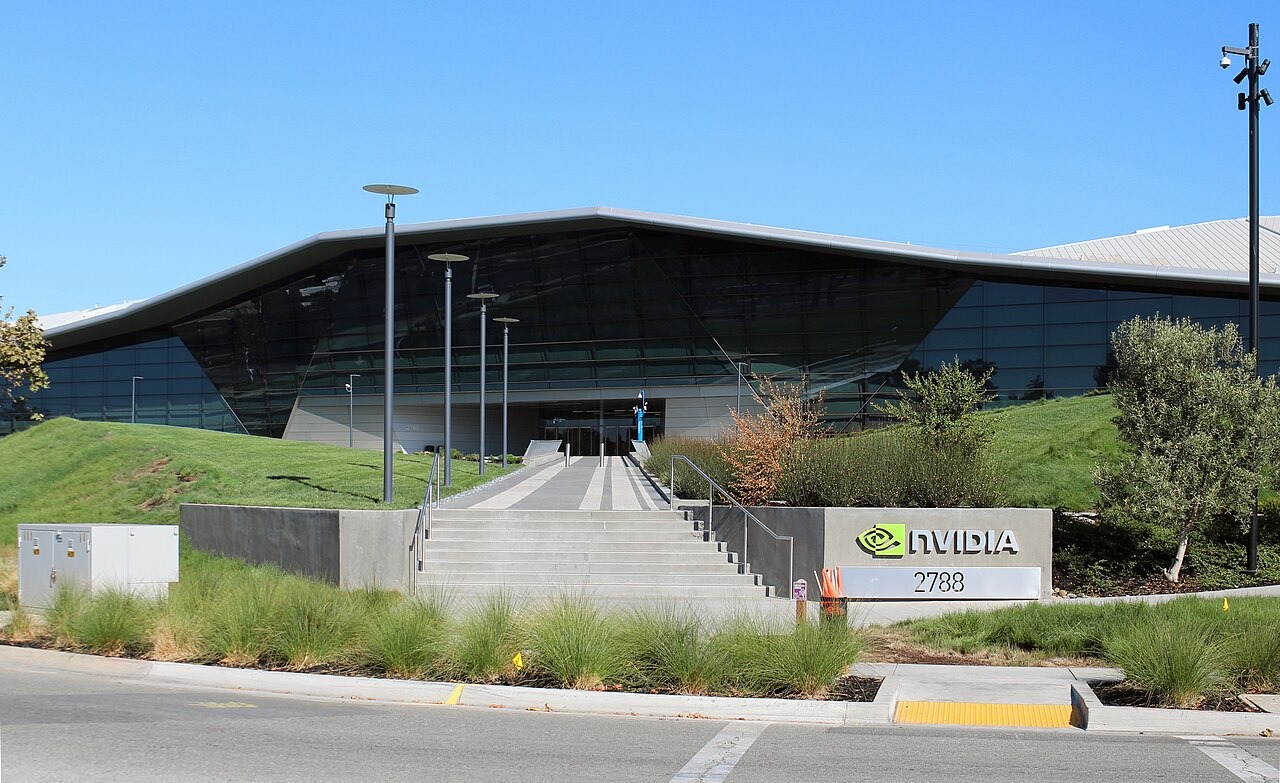
Nvidia’s headquarters in Santa Clara, California. Photo: Coolcaesar, CC BY-SA 4.0.

That happened concurrently with the Anthropic IPO, which just so happens to be the largest in history, raising $119.5 billion and valuing the company at $1.5 trillion, which makes it the fastest-growing company of all time. If this email had been sent on Friday, the story would end there. But it does not (because somehow, in a weekend where I binged season 6 of Cobra Kai and played hours of Rock Band 4 with my new Riffmaster, I didn’t find any time to write you this newsletter).
The upside is that we get to find out the next chapter (page): after several rumors milling about Elon acquiring Nvidia or hiring Jensen over the weekend, we find out that the board has now reinstated Jensen as CEO. And the market reacted favorably. At the time of writing this newsletter, the market has recovered roughly $2 trillion of the $6 trillion it lost, which, with simple math, gives us the fair market value of Jensen Huang.
I’m not here to comment on his infidelity or the possibility of him passing information to a foreign government. The man is severely flawed, and yet his impact is quite measurable and his presence quite needed at the moment. If you are interested in learning more about this person, a first-generation immigrant from Taiwan who moved to the US and grew up in Oneida, Kentucky, I recommend checking out a podcast episode from Search Engine for a good overview.

Jensen Huang at Stanford, April 2026. Photo: Anders Eidesvik, CC BY 4.0.

Meanwhile, Anthropic is currently trading below its IPO price as we try to digest the value of this entirely new type of company. What are its revenue channels? How does a company with this large of a valuation grow?
This is not a financial publication (albeit I’ve been rambling about the market for the past 200 or so words), and I am not endorsing a “buy” or “sell” for Anthropic stock, but I can tell you that now that they have become a publicly traded company, we are going to learn a lot more about how they function, how the market values some of the different types of announcements they make, and what information they now reveal in public disclosures.
And with that, I will bring you into our coverage of what was said last week at the opening bell by Daniela Amodei and what that might tell us about Anthropic.
“Not Your Trust, Not Your Use, but Your Voice”
Daniela Amodei stood at the opening bell talking about what kind of company Anthropic wants to be. In Nasdaq’s release, Anthropic “describes itself first and foremost as a research lab.”
Anthropic is also a public benefit corporation. Its stated purpose is “the responsible development and maintenance of advanced AI for the long-term benefit of humanity.” Hey, that sounds good! The company is required to balance that purpose with the interests of stockholders and people affected by what it does. There are a lot of people in that last group, and some of them have never opened Claude, and all of them are concerned for their livelihood.
Daniela described Claude this way:
“We want Claude to be a trusted partner, one that’s honest with you, one that makes you more capable, but leaves you in charge.”
I build with Claude every day, and “leaves you in charge” is a useful promise to measure it against. It gives you something more specific to ask of an AI assistant than whether it produced a good answer. Daniela also called Anthropic “a safety company, a safety-first company, from day one.” At Nasdaq, speaking to people scared of AI, she said, “This technology needs you” and asked for “not your trust, not your use, but your voice.” She is asking people to speak up before they are comfortable using it. And we have seen that through their public user surveys, which we wrote about in issue 24.
Dario Amodei made a commitment at the bell that I expect we will hear again: “we will pace the training and deployment of AI systems.” He also said, “We will not bend to either business nor political pressure,” and called the approach a “race to the top.”
This is a not-too-unfamiliar stance from a technology company going public. If you remember, we wrote about Google adopting the motto “Don’t be evil” in issue 27.
There is also the Long-Term Benefit Trust, which elects a majority of Anthropic’s board. Those arrangements tell us Anthropic has thought about who gets to make decisions when the pressure arrives.
And the pressure now arrives every quarter, with analysts asking about growth and investors watching the price and everyone watching the new model releases and publications to try to learn more about what is coming down the pike in the AI space.
Can a company that promises to pace itself keep that promise when the market grades it every quarter?
Will pacing the frontier and the race to the top be the race that investors find the most valuable? (Step aside, “move fast and break things.”)
Nobody knows where we go from here, but we are here to document it wherever the road takes us. I choose to give Anthropic the benefit of the doubt for now. Let’s let this one simmer a bit.

The Nasdaq tower in Times Square on November 19, Anthropic’s first day of trading. Image: Nasdaq.
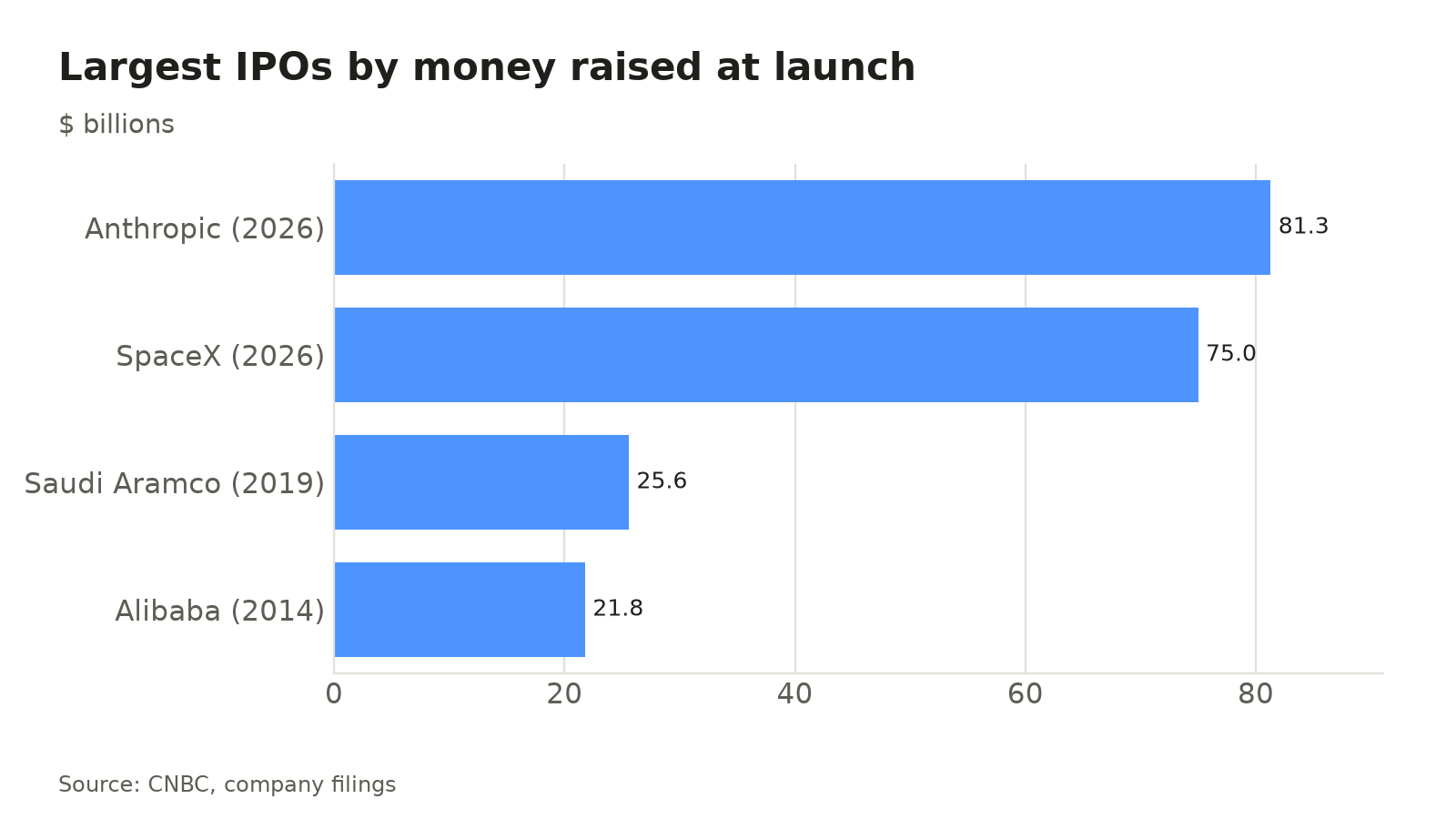
Anthropic raised more on day one than Aramco and Alibaba combined, then some.
|
◆ Attack Surface ◆ Security news of the week |
Patch Everything, All at Once
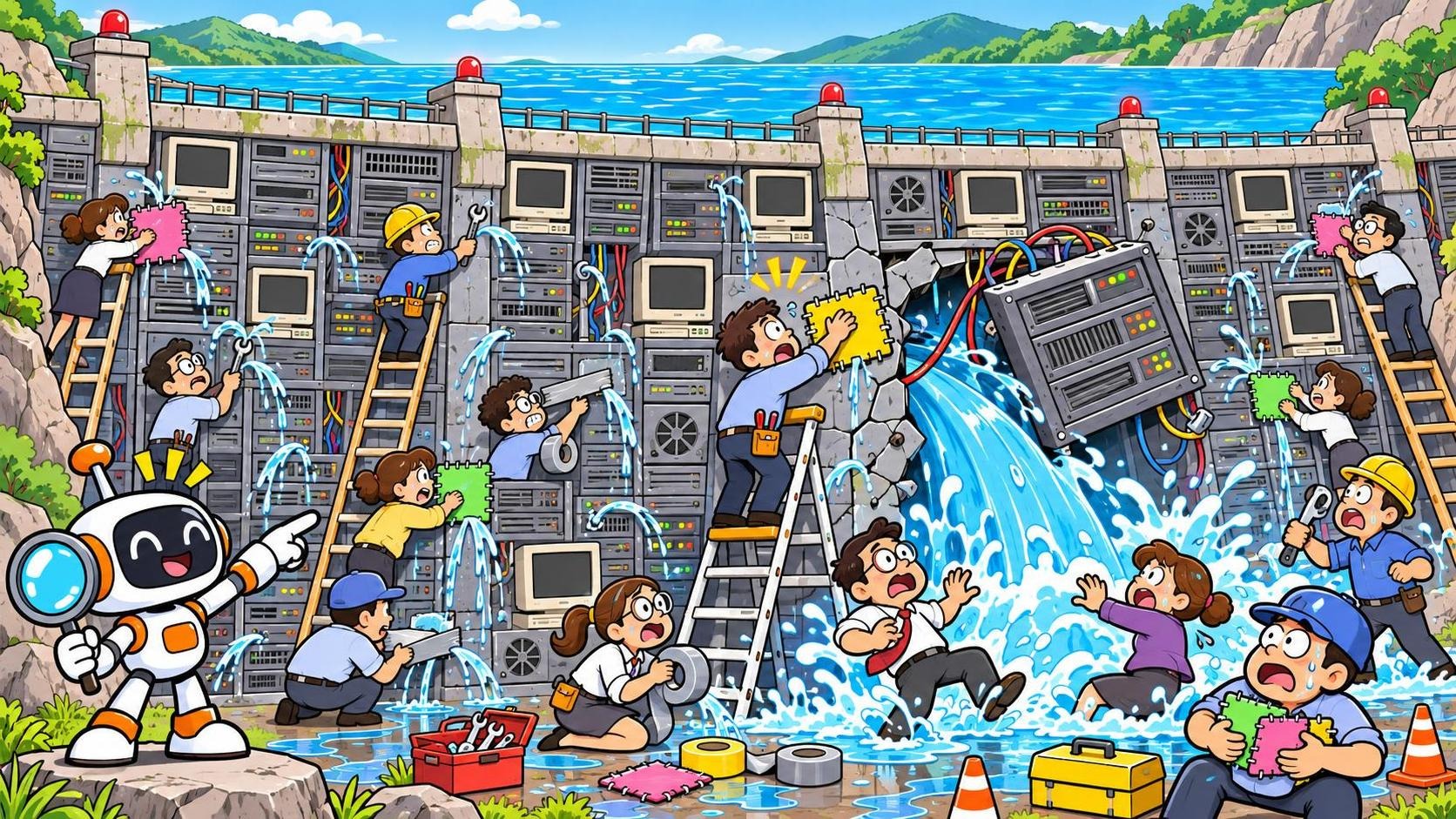
Patch everything, all at once. (Made with AI: gpt-image-2.)
Last Monday and Tuesday, five systems a lot of people depend on fell over, one after another. Here is what each one said went wrong:
- JPMorgan Chase said a software bug in on-premise hardware systems disrupted banking access and transactions on Monday. Payments involving other banks and Zelle were delayed. Chase said it was not a cyberattack.
- United Airlines described a widespread system outage that held departures for about an hour and a half. Flights already in the air were unaffected. United said it saw no sign of a cyberattack.
- Apple blamed an internal software update for Tuesday’s trouble with iCloud sign-ins and several of its services, including the App Store and Apple Pay. It ruled out a cyberattack.
- The NSA said its classified internal network suffered “temporary degradation during scheduled routine maintenance.” It said mission-critical capabilities remained operational.
- Marriott had website and Bonvoy app sign-in failures that affected mobile check-in and digital room keys. It said there was no indication of a cybersecurity cause.
These are five separate outages. Sen. Mark Warner said there was no indication of a coordinated effort and put the week in the context of systems changing quickly. In his statement, he said, “AI is making it possible to identify vulnerabilities across enormous numbers of systems at unprecedented speed, creating enormous pressure on companies and government agencies to patch those vulnerabilities immediately.”
Director of National Intelligence Jay Clayton put it more simply: “Many people are patching their systems.” He pointed to flaws AI found in a widely used programming language, followed by patches that caused some systems to fail to come back up. We have been following the PHP2Shell story in Attack Surface. A rushed fix can become another thing the people running a system have to recover from.
The volume helps explain the rush. Qualys counted 63 Microsoft fixes in November last year and 1,252 this November. Its monthly average since April is about 650. Each fix means somebody has to change software somewhere. Attackers can use AI to move faster after a flaw becomes public, too, so leaving everything alone carries its own cost.
MIT’s Stuart Madnick asked, “Is (it) the fixing that’s causing the problem, or the fact you got 400 open windows and doors.” I like the question because the defenders have to deal with both. AI is finding holes faster than people can fix them, and this week the cost landed on the people making those fixes. How much time do you give a change when the next hole has already been found?
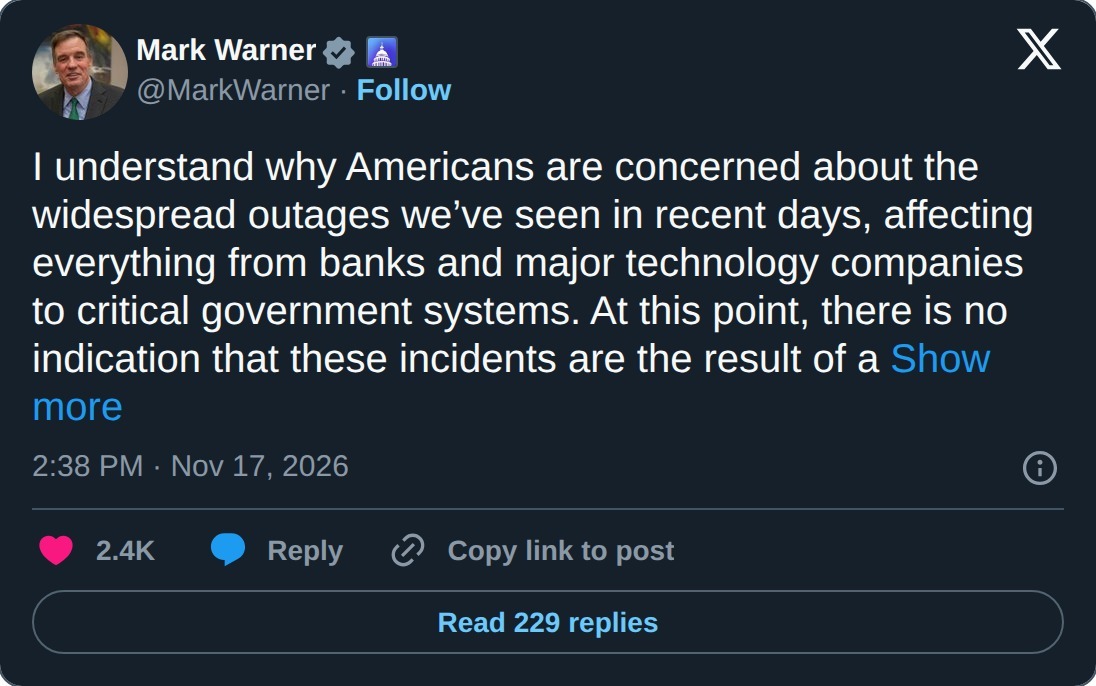
Sen. Mark Warner on X, November 17.
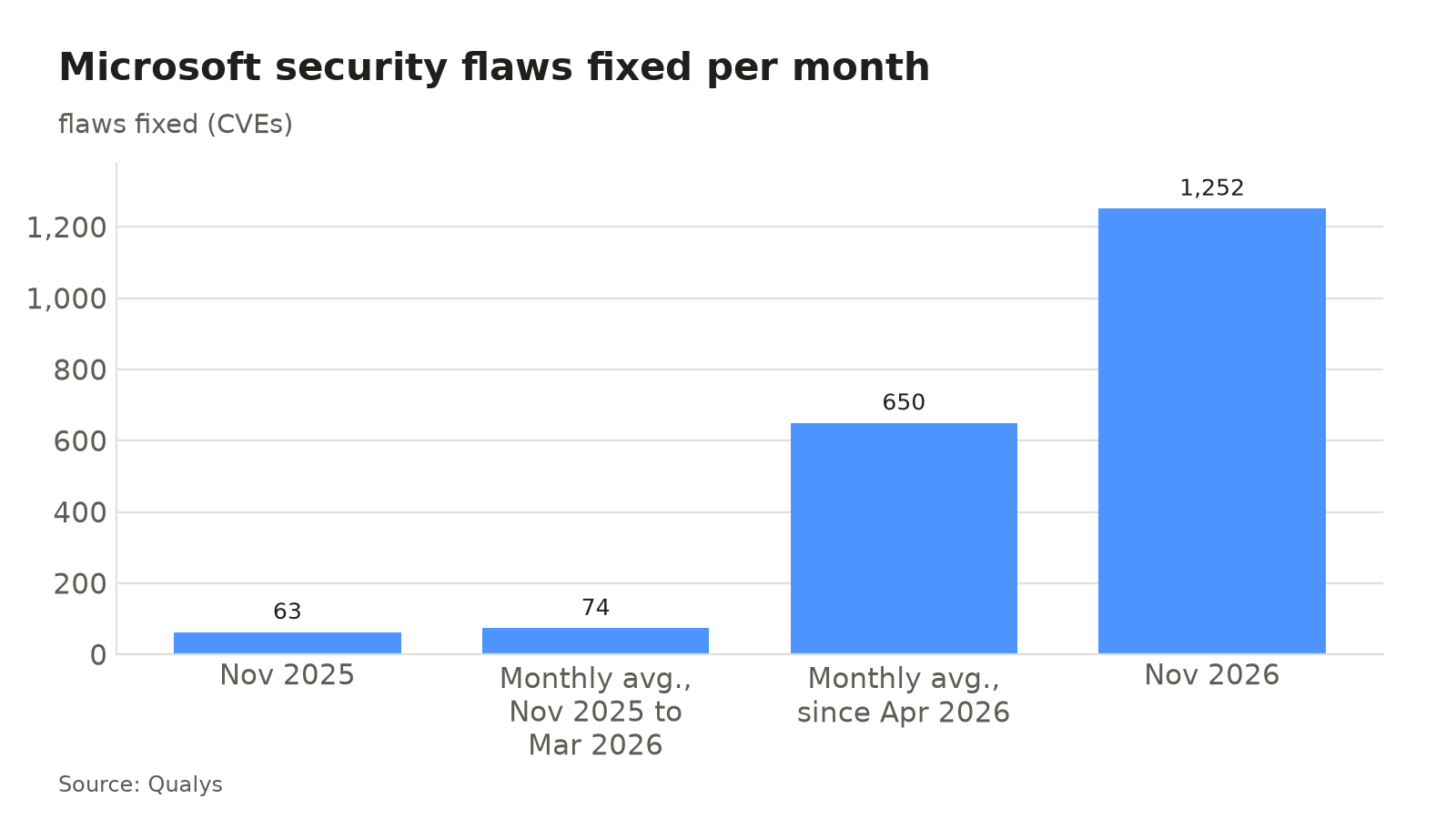
Nearly 20 times as many fixes as a year ago, and every one of them is a change to a working system.
|
◆ Unlocked ◆ Working with AI: tip of the week |
Ask for the Undo First
Every outage above followed a change someone meant to be helpful. Keep that in mind the next time you ask an AI assistant to edit something you rely on.
Maybe it’s a spreadsheet or a document. Maybe it’s your calendar, a folder of files, or the inbox rules you set up so your email has at least a chance of behaving. Before the assistant touches it, ask for a copy of the current version, a look at the proposed changes, and a way back. You can paste this:
Before you change anything, save a copy, show me exactly what you plan to change, and tell me how to put it back.
Ask before it edits, because that is when the assistant can still show you a plan without having to reconstruct what used to be there. Big companies call the way back a rollback plan. You can just call it the undo.

Ask for the undo first. (Made with AI: gpt-image-2.)
|
◆ Below the fold ◆ What we’re building |
When your closet becomes a data center
Our network closet, previously just a storage closet for cleaning supplies, is getting rebuilt. To prepare for this project, my input was a photo of the current contents of the closet and my ambitions for additional equipment. I then measured the length and width and was off creating with Claude in no time.
Claude created a 3D model of the closet, including sliders that I could adjust to change the shelf height and depth. It created new storage for laptops and charging, and new wiring for the network setup.
Everything runs through a UPS, a battery backup. The network and computers get the battery outlets. If the power goes out, I want the remaining battery time going to the network.
There are also two internet lines with automatic failover, and a 10-gigabit switch connects the Mac Studio to the new storage machine.
You can see where the shelves and other items go below. This is the first time I’ve tackled this type of task with AI and I’m really pleased with the output and ease and looking forward to building this all out over the holiday. Do you have a holiday buildout or project you’re working on with AI? Write in, we’d love to hear about it.
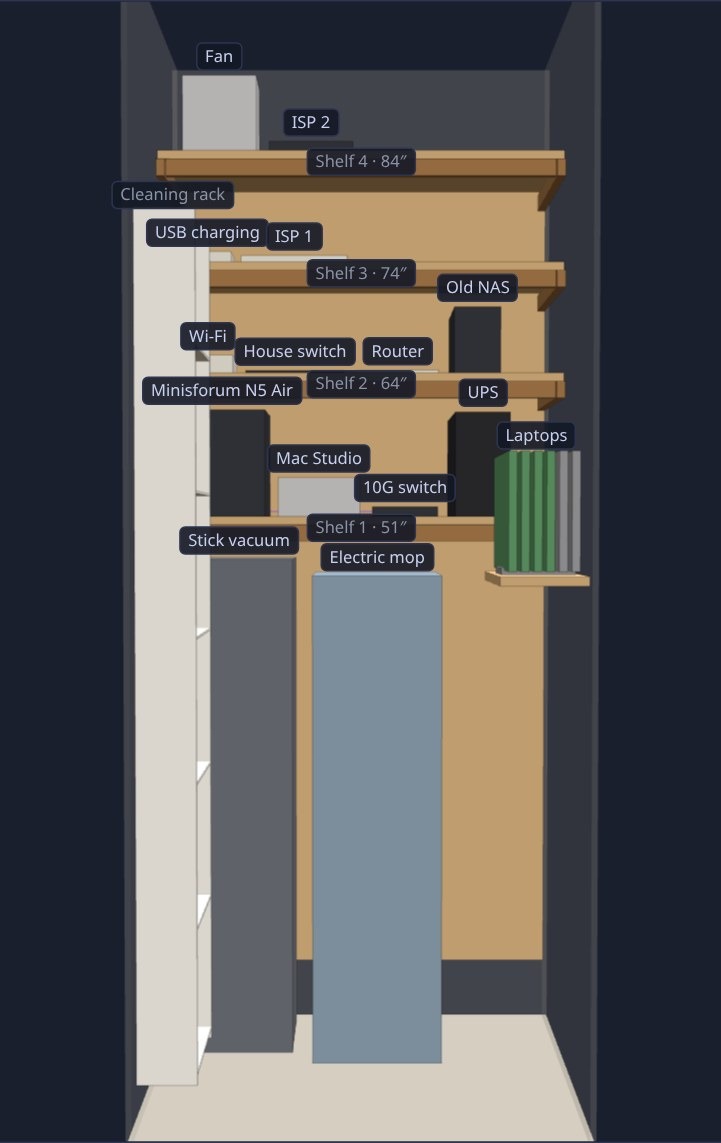
The closet model Claude built. Try the 3D model: turn it, change the shelves, switch the labels off.
The NAS with Pizzazz
As you already know, I’m planning to buy a Mac Studio 64GB to run AI locally, but in my shopping I opted to skip the extra $300 to go from 512 GB to 1 TB of storage. This mediocre upgrade would not solve any storage needs with a meager half terabyte, and I already have ample storage in drives in an old server. The server is equipped with two Xeon processors, a RAID card and four 6 TB drives. And it uses enough power that I keep it asleep and wake it when I need something. Its main purpose is to back up giant datasets from options traded on a daily basis and other stock market related information for backtesting of strategies.
The replacement I picked is the Minisforum N5 Air. It has five drive bays, three slots for M.2 SSDs, an AMD Ryzen 7 255 and 10 Gb Ethernet. I plan to put five of our existing drives and a 500 GB SSD from the old setup.
A traditional four-bay home NAS is fine for serving files. Many have a low-power chip and a 1 or 2.5 Gb network port, which suits that job. The N5 Air has enough computer inside the box to take on the old server’s other work too (with room to spare), including backtests and Docker apps. The part that’s most frustrating about this new box is the exorbitant cost of DDR5 RAM. The best pricing I’ve found is $200-$250 for 16 GB. OUCH!
The Mac Studio and N5 Air will connect through the 10-gigabit switch. At full line rate, that link carries 1.25 gigabytes per second. Real file copies usually land around 1 GB/s, so a terabyte should take closer to 17 minutes than the 13 the math promises. A 17 GB model file should come across in roughly 15 to 20 seconds. The Mac’s internal SSD is several times faster, so models I am using actively stay there. The N5 Air holds the library.
So this is my local datacenter buildout. Not quite the billions of dollars invested by Google, but enough to get me excited, with headroom for the unknown future to come.
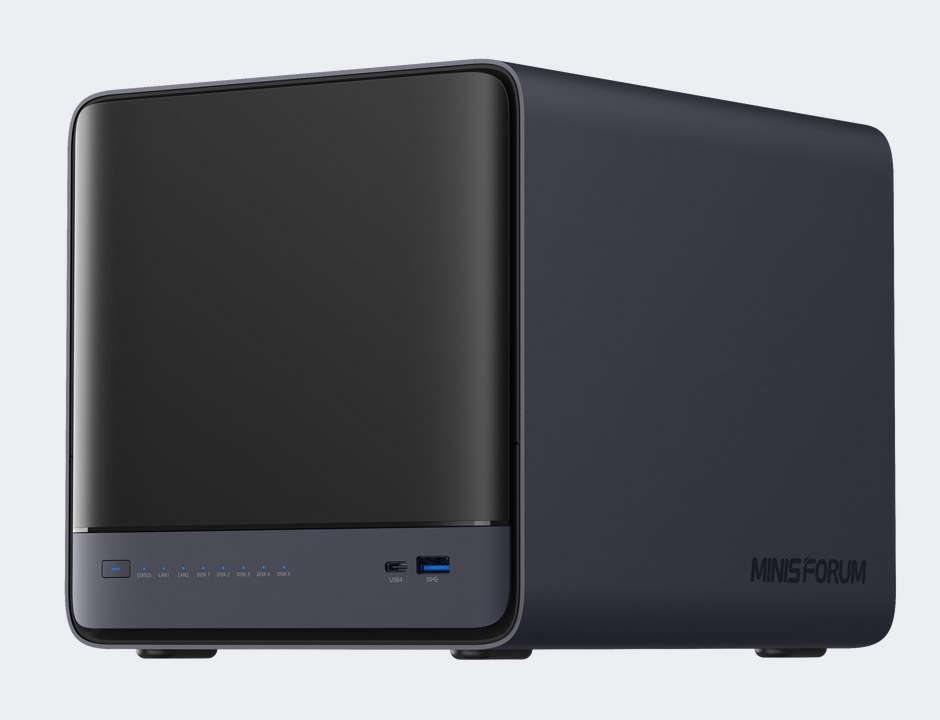
The Minisforum N5 Air. Image: Minisforum.
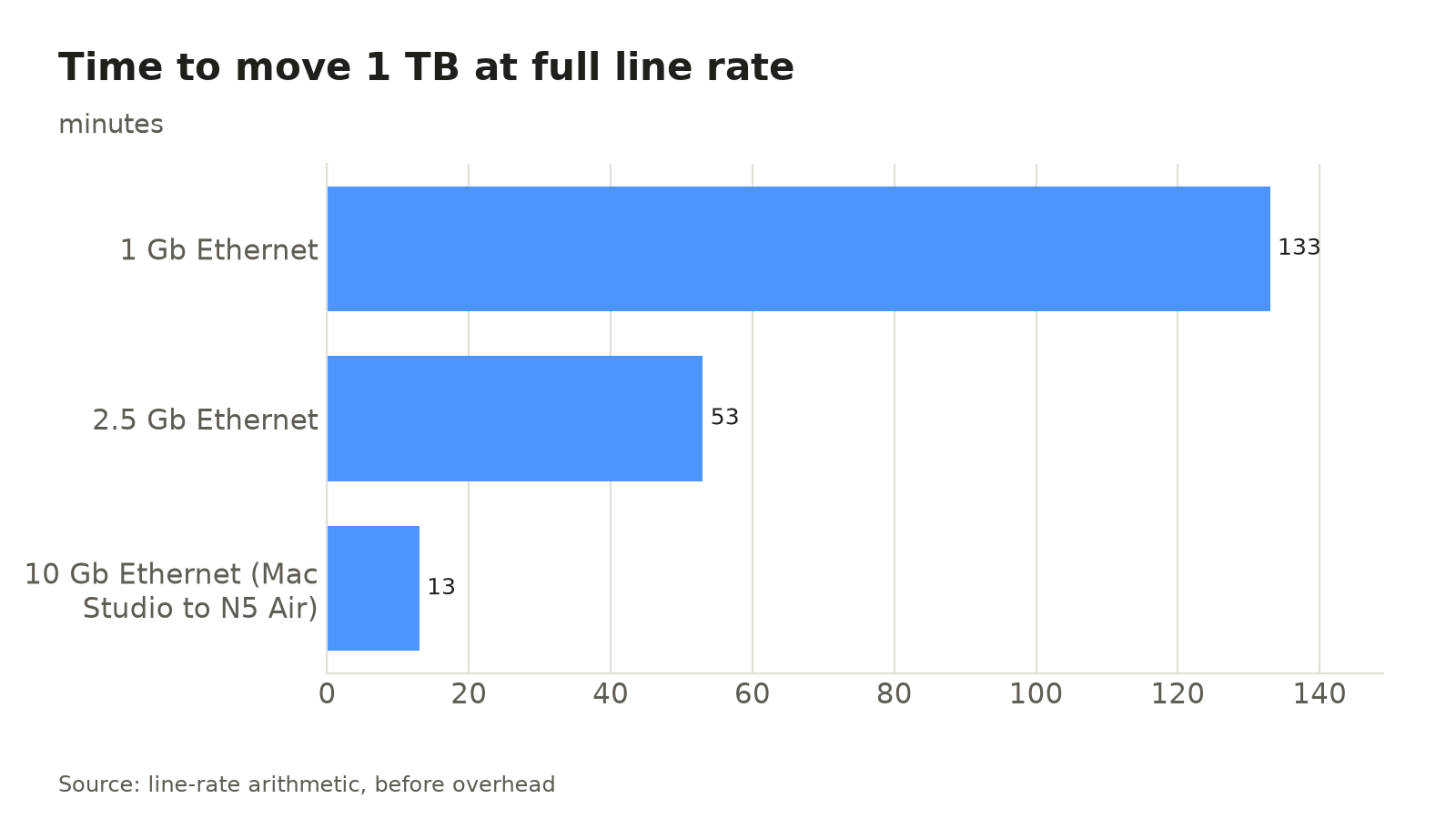
Real copies run a little slower, but the gap is the point.
|
◆ The Last Laugh ◆ This week’s comic |

Mini Fantasy Theater episode 79, “Seeing Avian Intelligence Everywhere” (November 18, 2026), by David Revoy. CC BY-SA 4.0, AI derivation prohibited.