The Real, Real Frontier
Welcome back to Wundervault Weekly. The AI news is getting a little closer to your own accounts this week, including the one you might use to buy stock. There’s been a lot happening with our builds too. Wundervault 1.0 has to wait until next week as Claude already put in 39 of its “40 hours” and we need the last hour to ship this newsletter. So without any further babbling I will tell you why this week feels like it might be the beginning of something bigger.
Buying the frontier
If you wanted to invest in AI today, you could buy Meta stock if you are impressed with how they are going after the consumer market with Meta Muse. Or you could buy Google stock if you are impressed with Gemini’s expanding reach into your Google apps and their latest ‘frontier’ model. But they are not a pure AI investment, you get the rest of the ecosystem too. With Google it’s search and mail apps etc., and with Meta it’s Facebook, Instagram, Threads and so on.
For a pure bet on AI you would want OpenAI or Anthropic, whose stock you can’t buy yet, although they are in the midst of preparing IPOs.
Despite other labs releasing ‘frontier’ models that can compete well with the current ‘frontier’ from OpenAI and Anthropic, I can’t help but think these late entries are exactly that.
I suspect that we are not yet seeing the real frontier from OpenAI and Anthropic because they are saving some extra special announcements for the lead-up to IPO. Brace yourself for an exciting end of year!
So reader, do you want to invest in the real, real frontier? Well these labs are hoping you do. They both filed confidentially for US IPOs in June 2026 and are actively in another AI race, to be the first IPO to market. With valuations around a trillion dollars. Do you think that’s accurate, and will you participate in the coming IPO? If you are reading this newsletter you probably already see value in AI. Soon we’ll find out exactly how much.

The New York Stock Exchange on Broad Street. Photo: Jakub Hałun, [CC BY 4.0](https://creativecommons.org/licenses/by/4.0/), via [Wikimedia Commons](https://commons.wikimedia.org/wiki/File:New_York_Stock_Exchange_Broad_Street_facade,_20231002_1720_1842.jpg).
Anthropic for the public good
While both labs are hoping you’ll buy shares, Anthropic has plans for some of its own. This announcement just missed inclusion in the newsletter last week:
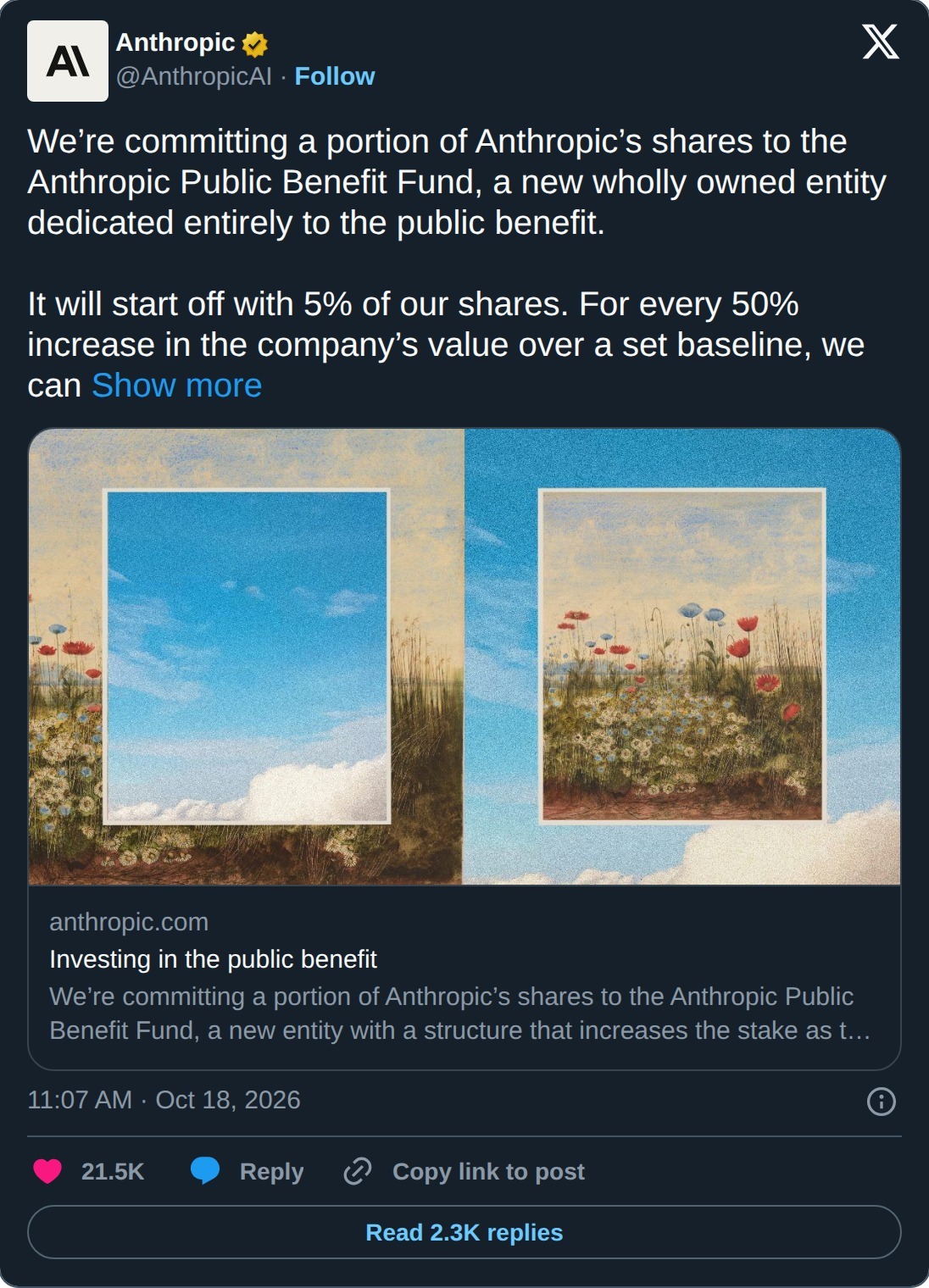
[Anthropic on X](https://x.com/AnthropicAI/status/2111881963657412903), October 18.
From the lab that just two weeks ago told us to be nice to Claude, Anthropic is now looking to be nice to the public, with 5% of its shares set aside in the new Anthropic Public Benefit Fund (pending stockholder approval), and the stake grows as the company does. It’s set up as a company instead of a charity, so it can give in more ways than a foundation usually does. Did I mention the co-founders had already pledged to give away 80% of their own shares? (Interesting move when you see Meta is simultaneously creating a class of shares with no vote to pay for its AI build, so Zuckerberg keeps about 61% of the vote.) Maybe it’s time Anthropic adopts the tagline “be nice”? Google’s own motto used to be “Don’t be evil”, until 2018, when it got moved from the top of the code of conduct to the last line. Give it a few more years and I expect it to read “do more good than evil”. I am riffing here a bit, but a motto is easy to move, while 5% of the shares is something you can actually count.
Is the internet prepared for AI?
|
↩ Previously · Issue 26 “On October 15, Japan’s national cyber response team confirmed that attackers used AI to search for those weak spots and attack them.” Issue 26 |
Last week we started the discussion on data leaks and AI-assisted attacks across the Pacific in Japan. This week, that discussion reached the software behind much of the public web, with an announcement I’ve never seen before.
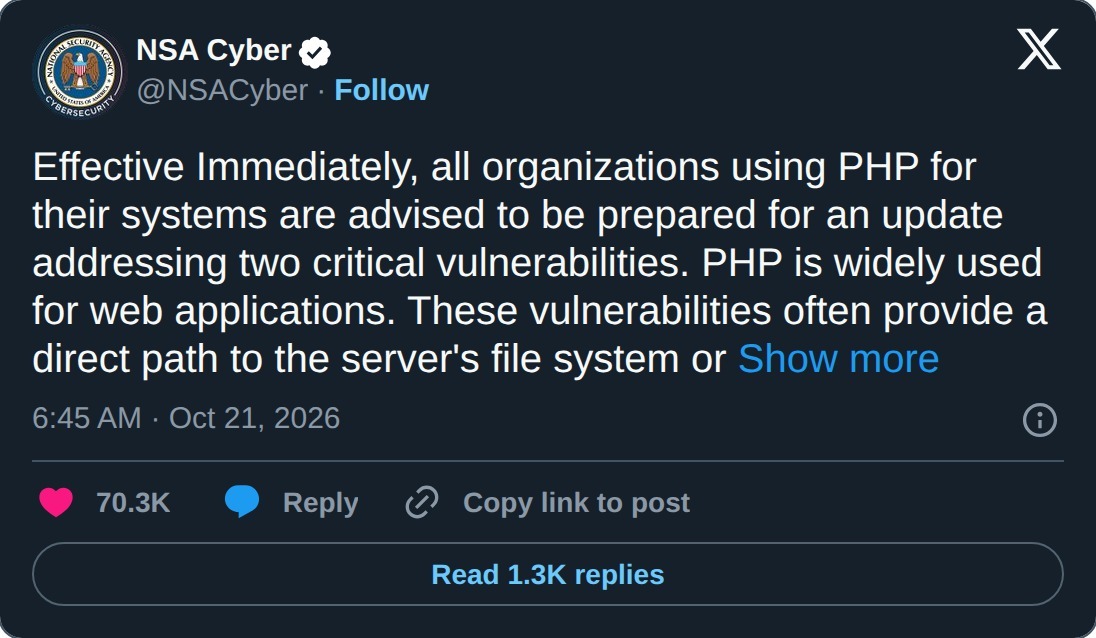
[NSA Cyber on X](https://x.com/NSACyber/status/2112903220209098897), October 21.
To break this down for the lay person, PHP is a programming language that runs on web servers. It’s literally everywhere, powering about 70% of websites according to Wiz, and the two flaws called PHP2Shell could let hackers completely take over a server without ever logging in. The NSA (National Security Agency) told organizations to get ready to patch and to take systems offline if they couldn’t patch right away.
The first flaw was found on August 19 and reported to the PHP team five days later. The fix was planned for October 22, but details leaked online on October 20. PHP moved the release up a day. Then a video showed the attack working, giving people a head start on making their own attack code (great timing).
SecurityWeek reports that Cloudflare, Patchstack and watchTowr saw attack attempts on the day the fix came out. Amazon said it had seen attempts four days earlier. Palo Alto Networks counted more than 22.6 million potentially vulnerable servers exposed to the internet, according to TechTarget. As of October 22, watchTowr had confirmed no successful break-ins. The flaws affect PHP versions released across the past decade, so if you run a site, check which version your server is using.
Which hat is AI wearing?
Wiz Research worked with Calif and OpenAI, using AI models to help find the flaws and check the fix. The fix itself took about two months to prepare, OpenAI said. When details leaked, the fix was already finished and could go out a day ahead of schedule. Within hours of the leak, attack code was out there, and as Japan found out last month, attackers use AI too. Black hats and white hats both have AI on their desks now. Defenders need it to keep pace.

The server room got crowded.
AI is now inseparable from cyber security. The same AI whose code got mocked as “vibe coding”, and which just a few years ago struggled with basic math and told people to put glue on pizza, is now a critical tool in building and maintaining the infrastructure that our economy is built on. And now we’re asking it to sign in to our own accounts.
1Password beats me to the punch
How is it that a huge corporation is beating the guy with the full-time job who is on the side vibe coding agentic tools for password safety to the punch? Oh well wait I guess that kinda makes sense? This week’s announcement from 1Password hit close to my wunderheart, with some very similar tools to the ones we have been building. They have always been a company I’ve admired and been inspired by, and while they shipped a Claude sign-in in July, this week’s launch is much bigger. On October 22 they launched 1Password for Agents for personal agents, an area that is growing rapidly since the introduction of Meta Muse. Your agent asks 1Password to sign in, you approve it on your own device, and 1Password fills in the password so the agent never sees it. Muse is one of the launch partners, along with Claude, ChatGPT and Grok.
While Wundervault is mostly developer focused, we do plan on releasing some more solutions along the way that will address some similar areas. We’re still as always excited to see others building in the space, and ours is built differently. Below the fold, you can see how we handle that handoff and what stays on your computer.
The world keeps on spinning
And so the world turns like some giant AI soap opera. Wundervault will return and keep you updated on all the highlights.
The camera returns to the stock exchange. OpenAI and Anthropic are both trying to get through the front door, and Anthropic has stopped to give away some shares. Across town, Meta is holding onto the voting remote. Cue the organ music. The PHP server is at the hospital after AI found a hole and somebody brought AI along to try getting in. Why is the server at a hospital? It needs a patch. 1Password enters carrying the agent’s login and asks everyone to approve it on their own device.
Like sands through the hourglass, so are the days of our AIs.
Until next week,

Somebody reset the hourglass, please.
|
◆ Below the fold ◆ |
Wundervault 1.0
My usage tokens reset next week, and Wundervault 1.0 launches then. You get the inside track on one of next week’s AI releases because I happen to be making it. Convenient arrangement, really.
Three things Wundervault does differently from 1Password for Agents.
- The handoff happens on your computer. The small program that hands out secrets after you approve runs there; with 1Password for Agents, the sign-in request goes through 1Password’s service.
- The detailed record stays with you. You keep the record of where each key went on your computer, and I stripped the online log so Wundervault keeps no map of your network; 1Password’s announcement doesn’t say where its record of agent sign-ins is kept.
- We can’t decrypt anything we store. When an agent uses a key, it is unlocked on your computer, not on our servers; 1Password’s vault is encrypted too, but its announcement doesn’t say where a password is unlocked when filled in for an agent, only that the safeguards vary by integration.
What would you want to see before letting an agent use one of your logins?
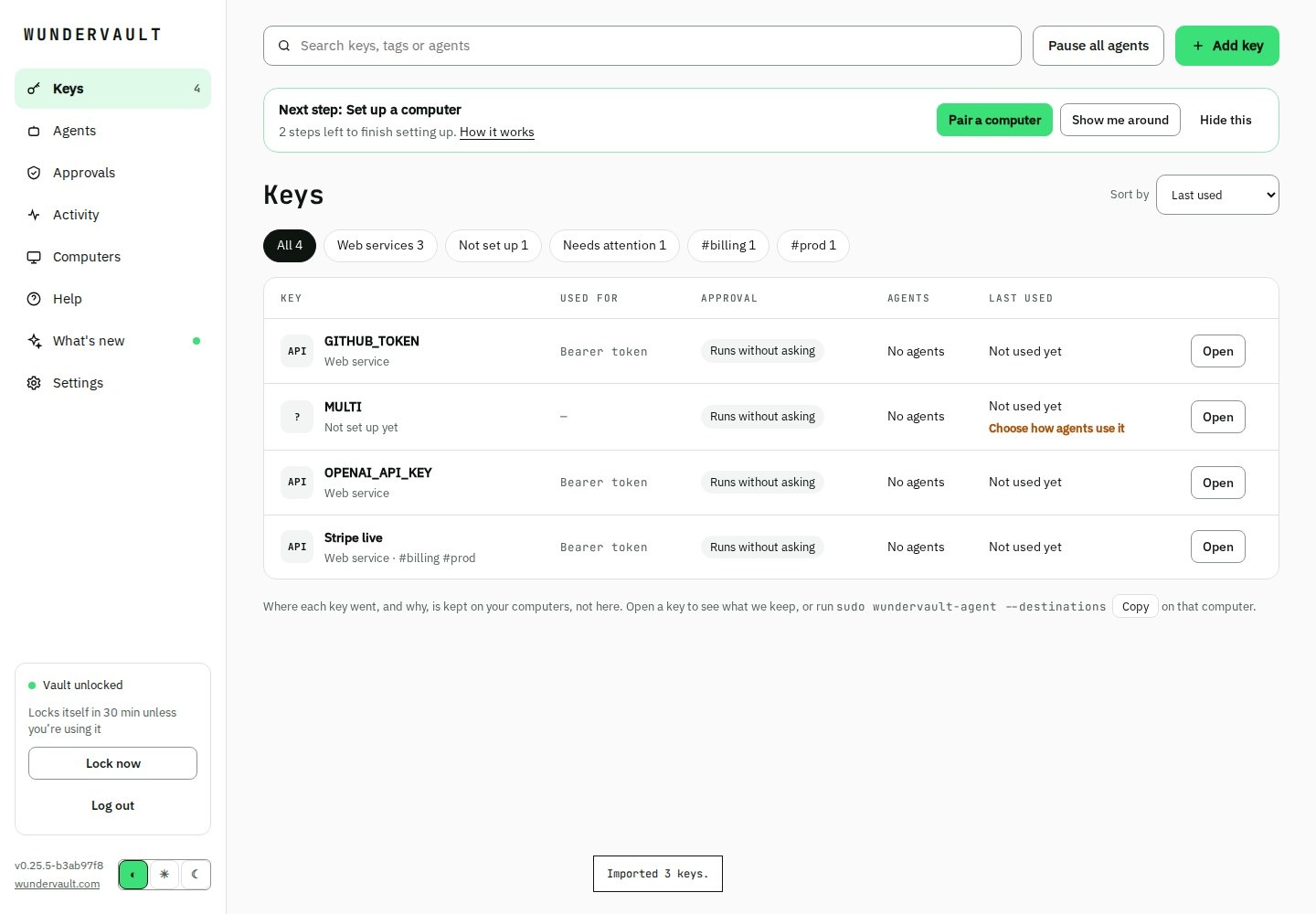
The Keys page in Wundervault 1.0, on a test vault (no real keys).
Here’s the Keys page I’ve been staring at this week. The Stripe key has #billing and #prod tags, alongside keys for GitHub and OpenAI and one I still need to set up. You never see the secret values on this page. You can see which agents are allowed to use each key and when it was last used.
The Approval column is where I decide how much interruption I want. Some requests go through without asking; “Ask me first” waits for my passkey approval. And if I want every agent to take a break, Pause all agents stops them at once. That little line below the table points back to the local records I mentioned above. I can lock the vault from the sidebar too.
See you at the 1.0 launch next week.
“Everything’s got a moral, if only you can find it.”— The Duchess, Alice’s Adventures in Wonderland