Is This the Most Useful AI to Date?
This week has found me on the road a lot more than usual and being on the road means driving. But this is 2026 and if you drive a Tesla you know that the state of self-driving is actually quite impressive. For $99 a month your Tesla will drive you safely from your driveway to the grocery store and park your car. All with an AI model running on your vehicle, in redundancy, not in a cloud or datacenter somewhere.
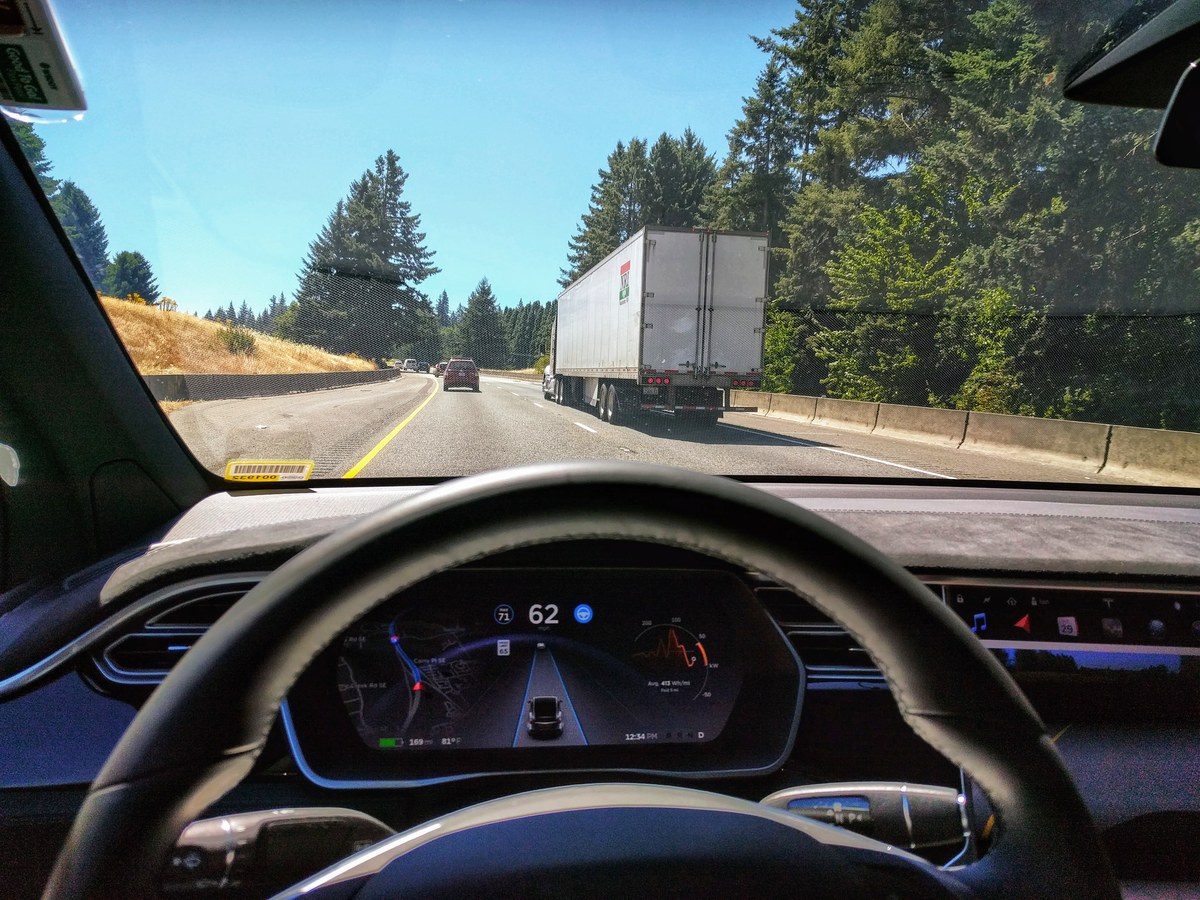
Photo by Ian Maddox, CC BY-SA 4.0.

In past issues we explored the large frontier models of the time (which many are probably already outdated) and the medium sized models and even the smol models. Today we will talk about the self-driving model in the Tesla vehicle, what do we know about it? And what does the future hold.
Two Steps Forward
Thank you readers for sticking with us. I am continuing to experiment with bringing you a reliable weekly newsletter with several sections, a bit of consistency and my own voice, with AI assisted writing. Every week presents a new challenge and balance of using these tools.
Last week I did a revision of my voice file and dove deeper into removing the AI-isms that make the newsletter sound more like talking to Claude than sitting down with your nerdy friend who enjoys talking AI ad nauseam and is sometimes clever and funny and hopefully a little bit entertaining.
But last week the process that I was trying to streamline took a turn for the worst when I ran out of OpenAI credits, Claude ignored the extra voice file and the end result was me writing up 25 different changes to the output file. The newsletter took twice as long as usual to write and I wasn’t fully satisfied with the outcome but shipped it anyway because I couldn’t stand to look at it anymore. And so it goes, I take two steps forward and one step back.
|
↩ Previously · Issue 21 That is the one with the 25 changes in it. We Have That Time Now, about Moonshot relaying customer questions to Claude and showing people the answers with Kimi’s name on them. |
The changes will be outlined below the fold. What we had before, where it went and a greater plan that I have.
What Is Jev?
First a quick aside on the most interesting thing I saw in AI this week, and you will see that it might also tie into our discussion along Tesla FSD. So on X we got an exciting model announcement but not from OpenAI or Anthropic or any of the usual suspects (maybe we did get a big announcement, but that’s not what we are going to talk about here). The model that I found most interesting was from a lab called TypeSafe and the model is called Jev.
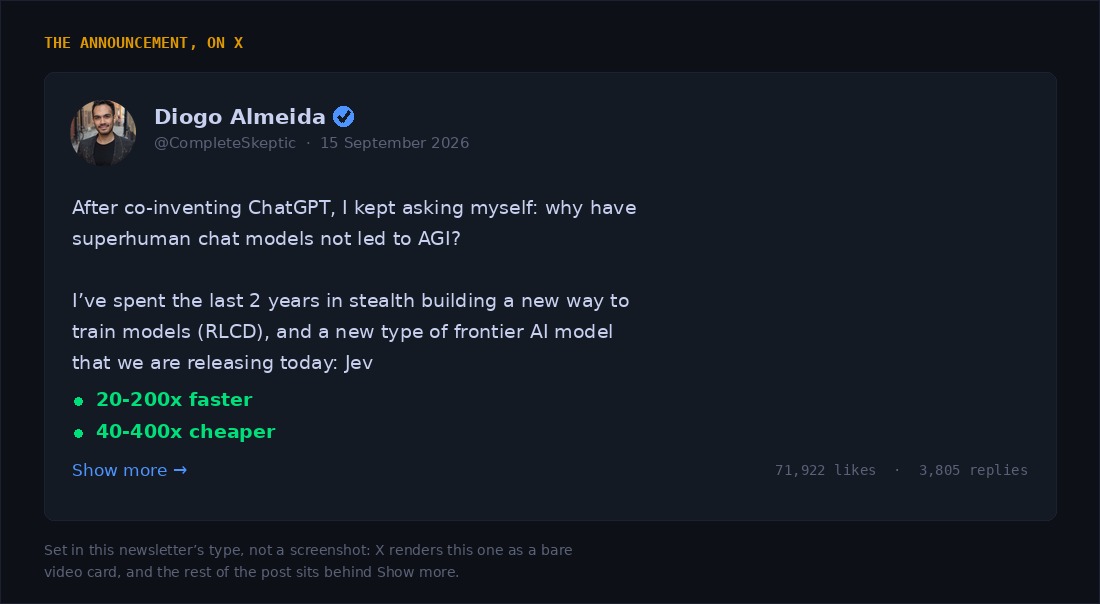
The post, and the thread under it is worth the scroll.
This new model is a bit different in functionality. It is a very fast model that takes a situation in and hands back a decision, with a number attached saying how sure it is. You define the possible answers ahead of time and Jev returns all of its answers in parallel. TypeSafe calls it a System One Model.
|
◆ Concept · System One Model A model that returns a decision instead of a sentence. The list of allowed answers is written down before the model runs, so it picks from that list and attaches a probability to each one. It cannot wander off and invent a twelfth option, because there are only eleven. |
TypeSafe put the whole thing up on the 15th. They say Jev answers in 70ms to 500ms, compared with 3 to 329 seconds for the frontier models they tested, and claim it is 40x to 200x faster on those jobs. The price is $0.042 per million input tokens, with the output free. Since you have already told it what kind of answer can come back, the shape of the answer cannot wander off and become a small essay about goblins.
Their more useful rule for automation is this: if a model can do a job 95% of the time and doesn’t tell you when it has landed in the other 5%, you still can’t hand over the job. Jev attaches a calibrated probability to the decision. Knowing how sure it is becomes part of the output.
They posted videos too. Here they are, so you do not have to go looking.
Jev against GPT-5.6 Terra. One of them is typing and one of them is not.
In Doom, a bot plays at 10 queries a second for about $7 an hour. Apparently the engineer thought 10 queries a second was a lot and the rest of the team thought it was low.
Every green bar on the right is a separate question, answered in that frame.
Wikiracing starts on one Wikipedia page and tries to reach another using only the links it finds. A page can offer hundreds or thousands of choices. Jev handles up to 255 options together, and above that it scores them before making a second pass to choose.
Baseball to Sun. Stay for the scoreboard, where one of the others takes a link that was never on the page.
The name comes from William Stanley Jevons, who observed that making steam engines more efficient increased the demand for coal. System One comes from Daniel Kahneman’s Thinking, Fast and Slow, meaning the quick intuitive kind of thinking.
Unfortunately, Jev is not fully available to tinker with just yet, but you can sign up for early access here, like I did. I’m looking forward to the opportunity to play around with a different type of model and find some fun uses for it.
How Little Is Doing How Much?
Musk said on X back in April that the model running FSD v14.3 is what he calls the small model, roughly 1 billion parameters. Tesla has never published an official parameter count, so that is Musk’s number. Still, that is smaller than models people download onto a laptop for fun.
“Our rate of advancement with the small model has been so fast that the large model has not yet caught up. V15 will be the large model.”
That larger v15 model is described as about 10 billion parameters. Which sounds large until you remember that the current one is already driving the car to the store and parking it. The shopping cart left rolling through the parking lot has no interest in parameter counts.
Now for the money. In Tesla’s quarterly filing for the period ending June 30, deferred revenue for connectivity, FSD (Supervised), free Supercharging and over-the-air updates stood at $4.05 billion, up from $3.87 billion at the end of 2025. Tesla expects to recognize $962 million of that balance over the next twelve months. It recognized $468 million from the same bucket during the first half of 2026, against $428 million in the first half of 2025.
That bucket combines several products. Tesla does not break out the FSD piece or publish a subscriber count, so there is no honest way to turn it into “$4 billion of FSD revenue”. The outside subscriber estimates I found disagreed with each other by a factor of three anyway.
The current release is FSD v14.3.10 and it added Automatic Collision Evasion. As you approach a destination, Arrival Options asks where you want the car to put itself:
- Parking Lot
- Street
- Driveway
- Pull Over
Then it goes looking. So a model small enough to run inside the computer in the dashboard is sitting underneath part of a rather large software line on the balance sheet of a car company. I find that pretty amazing. So what else are we making enormous because enormous happens to look impressive?
Can an Open Model Actually Drive a Car?
Yes. openpilot from comma.ai drives real cars today as advanced driver assistance across more than 300 supported vehicles. Version 0.11.2 shipped in August with a driving model listed in the release notes at 880 million parameters.
The model runs on an external AMD GPU while image warping and driver monitoring stay on the Qualcomm chip. comma.ai describes it as 30x larger by parameter count and 100x larger by FLOPs than its on-device model at launch. The launch post rounds the model to 1 billion parameters and the release notes say 880 million. A small disagreement by AI model standards, where apparently 120 million parameters can fall behind the couch.
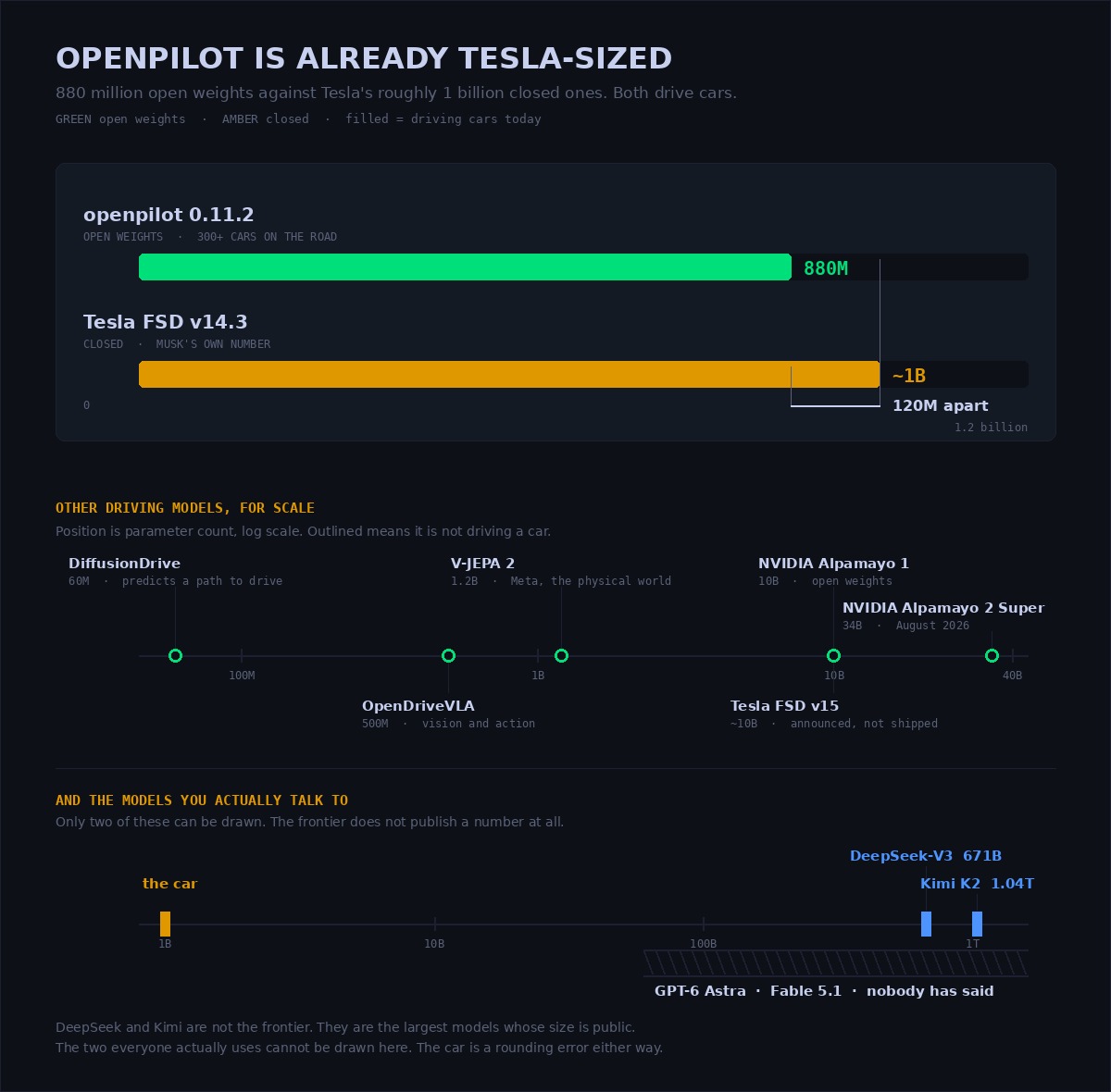
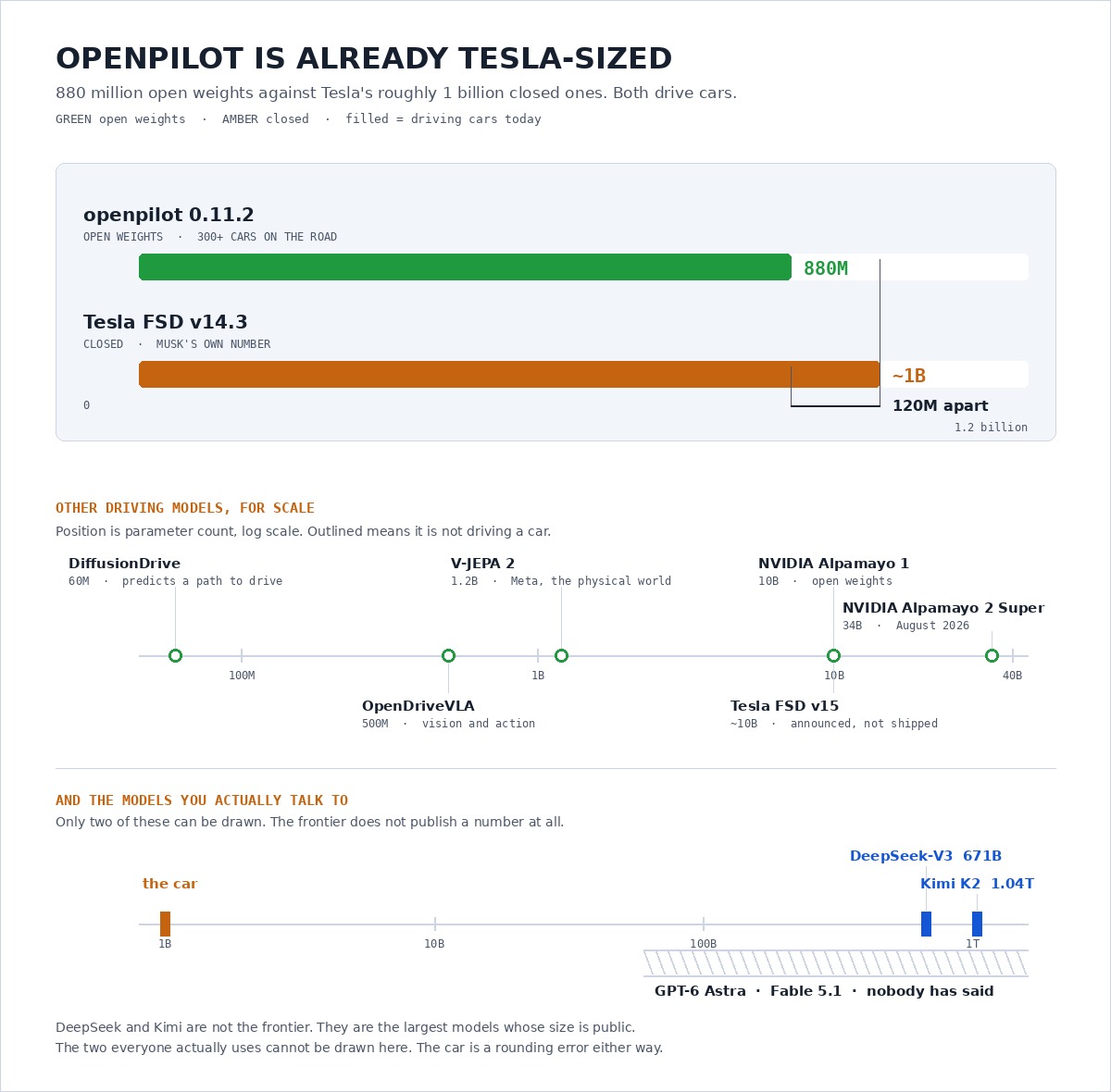
Everything that drives, and then the two biggest models anyone is willing to measure.
880 million against Tesla’s roughly 1 billion. That comparison is a little startling. Tesla’s advantage seems to come from the fleet and the video coming off it. Tesla also builds the computer in the car, so it knows the memory budget before training starts. openpilot being this close in model size tells us very little about how close the entire system is.
There is a funny little size ladder underneath all this. DiffusionDrive predicts driving trajectories with 60 million parameters and runs at 45 frames a second. OpenDriveVLA has 500 million. V-JEPA 2 has 1.2 billion and is Meta’s general model of the physical world rather than a driver. And NVIDIA’s Alpamayo goes the other way entirely: 10 billion in January, and Alpamayo 2 Super at 34 billion in August.
Which is where the car stops being able to play. The computer Tesla ships holds about 16GB of memory per chip, and the public descriptions cannot even agree on whether there are one or two of them. Either way, that is the box.
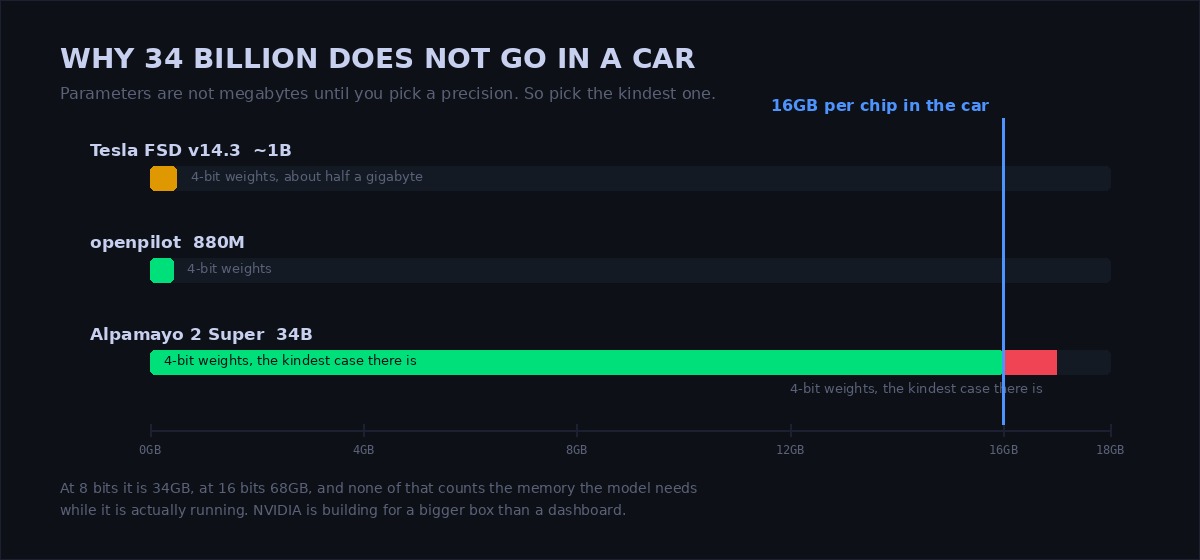
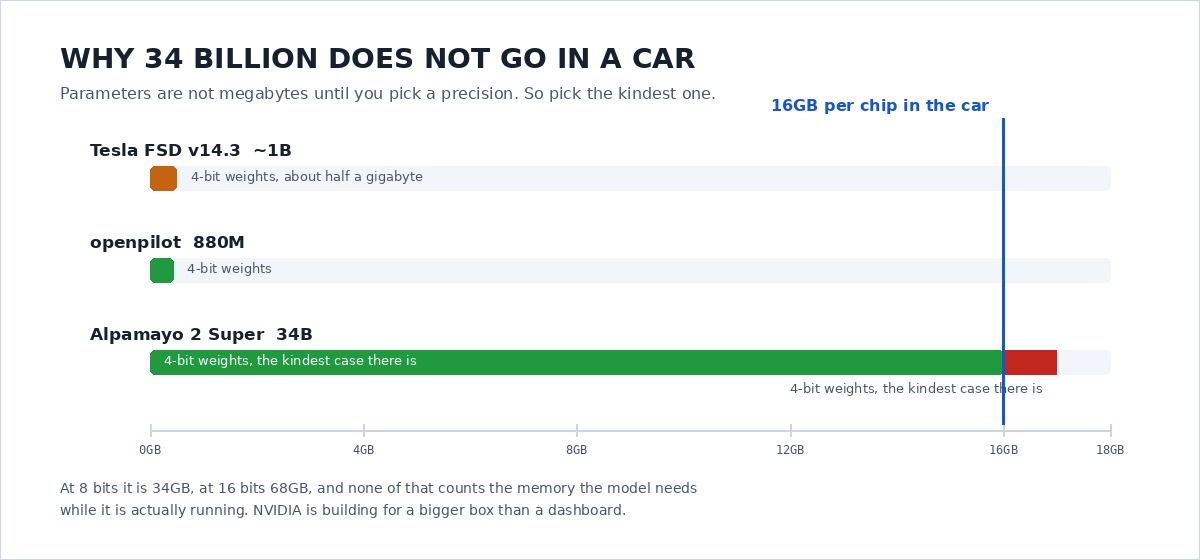
Squeezed as hard as anyone knows how to squeeze, Alpamayo still does not fit in the dashboard.
Would a Thing Like Jev Help Build One of These?
Jev cannot see video. It offers no help training the network that watches the road, and a steering or braking loop moves far faster than a 70ms to 500ms call. So Jev could not drive the car today. Nothing about it makes building the perception model easier.
There is one layer where I can see it being useful. TypeSafe’s pitch keeps coming back to knowing when a model does not know. A calibrated number attached to each decision sounds rather useful when the decision is carrying a family down a highway.
This is me guessing now. Video and perception could build a picture of the world. A fast calibrated decision model could choose the high-level move, like whether to wait at an unprotected left or change lanes. Then a planner turns the decision into a path and the controls carry it out. Language might be a rather strange middleman for some of this.
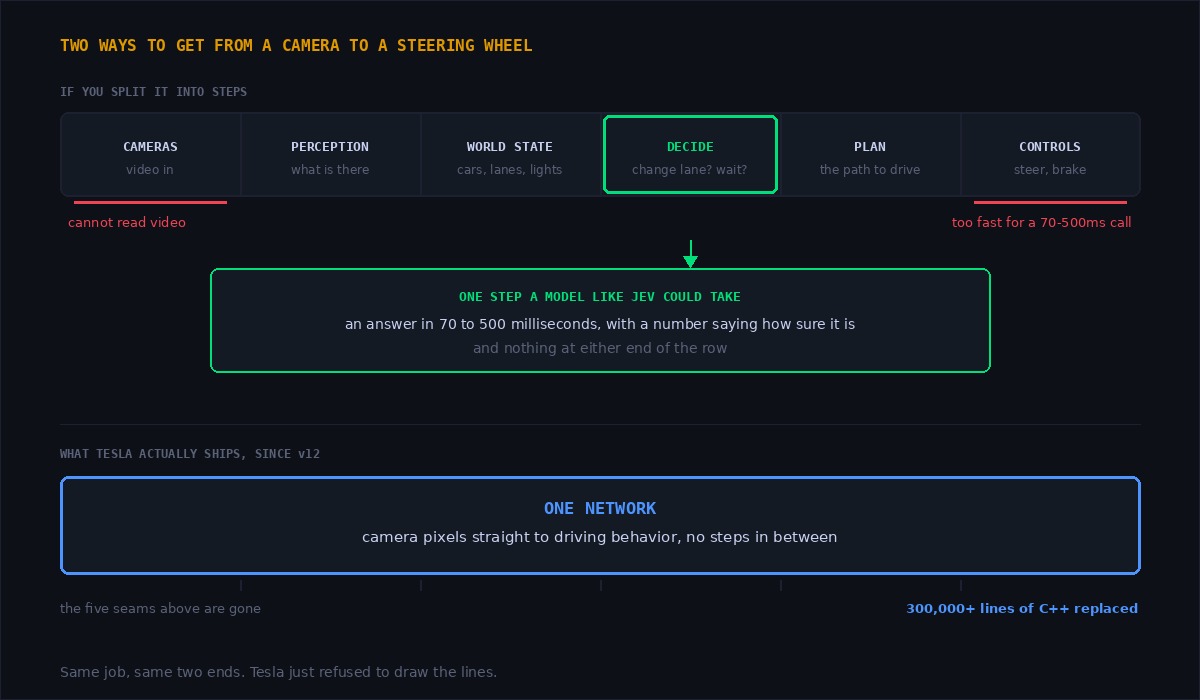
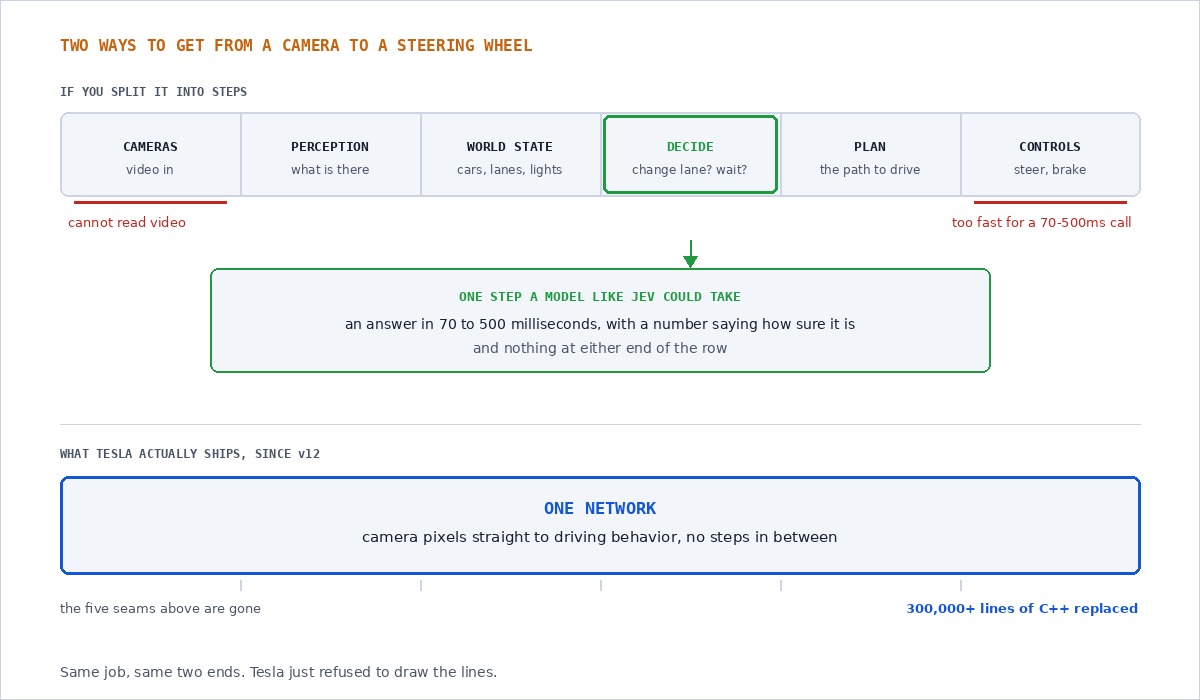
The top row is where a decision model fits. Tesla deleted the top row.
Maybe the broader opportunity is small and fast foundation models built around perception and action. Models for cars and robots, maybe drones or a factory floor. We have spent a lot of time making models that can talk about the physical world. Giving them a useful role inside it looks more interesting to me.
Tesla has a large head start because it has the fleet. Every car can produce more examples, and Tesla knows the exact computer those examples eventually have to run on. The open models do not have that stream of real-world driving data. And yet openpilot at 880 million parameters is sitting very close to Musk’s roughly 1 billion parameter claim, running in cars people can drive right now.
Would you trust an open driving model in your car? I think I would try it, although perhaps I should answer after Jev gives me a calibrated probability.
Below the fold, the newsletter machinery gets a new writing model and some more rules, along with my larger plan to give the whole setup away.
Until next week,
|
◆ Below the fold ◆ |
The newsletter machine, and the plan to give it away.
The Machine Behind This Newsletter
Apologies that this week’s below the fold is more of an idea than a fully baked product.
The source for this newsletter begins as an HTML fragment. A script splits it into a website issue and an email. The site version gets a light-mode override block bolted onto it. The email version gets every image wrapped in a link back to the issue page, because email clients strip video embeds and leave you with a sad empty rectangle.
The subscriber list and sending flow through Listmonk, which is open source and self-hosted. Mail goes through the Resend free tier. The whole thing runs on a small box. It has been optimized for cost first, then ease of use, which sometimes means the easy part arrives later.
The Voice File Got a Rider
There is a VOICE.md file derived from the earliest issues I wrote by hand. It has the broad rules about how these issues sound. Use second person. Leave the parentheticals alone. Admit when the process went sideways. Avoid the very polished AI writing that somehow says a lot while leaving you with nothing to remember.
What that file missed was all the stuff that is difficult to turn into a broad rule. Starting a paragraph with And or But. Leaving a fragment unfinished. Correcting myself in the middle of a sentence and letting both versions stay there.
So there is now a rider file that lists those moves and keeps a separate list of words that have never appeared in my hand-written issues. It also bans what I have started calling stage directions, those little lines that step outside the writing to announce that something interesting is coming.
I cut five of those lines out of last week’s draft by hand. Claude seems to believe every paragraph needs a tiny person standing beside it with a sign.
Where the Writing Went
The writing now goes to an outside model with the voice file, the rider and the hand-written specimen issues attached. Claude still does the markup. It also checks facts and runs the linter.
Last week I ran out of credits at the outside model, so the writing fell back to Claude with the rules file and none of the specimens. That is the whole story of the 25 changes. Claude had the recipe and had never tasted the dish. It produced something that passed every check and still sounded like Claude wrote it.
Examples matter more than I gave them credit for. A voice summary can describe the obvious habits. It has a harder time capturing the unfinished thought, the interruption or the sentence that remains a little crooked because that is how I said it.
The Bigger Plan
I want to formalize this setup and open source it. The self-hosted backend, the scripts that turn the source into a site and an email, and the voice system with its linter. Then someone else could run a weekly newsletter on a free mail tier and their own box, using their own writing as the specimens.
It is an idea today. There are loose scripts and pieces that work for me, along with a few things held together by the software equivalent of tape. I would like to turn it into something another person can install without having to ask me why an email thumbnail has wandered into the wrong directory.
Have you built anything similar? Or is there some part of making and sending a newsletter that continues to annoy you? Send me what you are building, or what you would want out of this.
“The great art of riding, as I was saying, is—to keep your balance properly. Like this, you know—” He let go the bridle, and stretched out both his arms to show Alice what he meant, and this time he fell flat on his back, right under the horse’s feet.— The White Knight, Through the Looking-Glass