The 3 Comma Club
An anecdote from my recent vacation. The hotel was beautiful and the room came with a mini fridge. The mini fridge was 3.4 cubic feet. Naturally I wanted to use all that space to pack it full of perishables and drinks, but when you pack it that full it doesn't cool which, to be frank, is really its only job. But the number itself was in fact just another number that was lying to us, because the fridge was very obviously not cool.
I spent this week reading about Muse Glimmer, which Meta released on Monday: 30 billion parameters, free to download, and small enough to run on a Mac or a PC with one graphics card in it. Like every one of these announcements it leads with a number carrying three commas in it, and I have come round to the view that the number is the mini fridge.
Thirty billion of what, exactly
Everybody watches the frontier. Bigger model, more compute, higher score. The fight I find more interesting is one shelf down, among the models small enough that you could own one instead of renting it. And down there the labels have quietly stopped meaning anything at all.
What is a parameter, anyway? Everything below gets counted in them, so here it is. A parameter is one of the dials inside the model, set during training and then frozen. Billions of them, each holding a sliver of what it picked up. More dials means more room to keep things in, and the count gets quoted constantly for the boring reason that it is the one number that is easy to state. It is not a score. Nothing about it promises the model is any good.
Google's Gemma 4 26B-A4B stores 26 billion parameters and uses 4 billion of them to write each word. So it thinks like a small model. Does it fit like one? Google answers that on its own documentation page, and I appreciate them for it:
While it only activates 4 billion parameters per token during generation, all 26 billion parameters must be loaded into memory to maintain fast routing and inference speeds.
You rent the whole warehouse and you use one aisle of it. Fine, as long as nobody sells you the aisle and then hands you the warehouse. And they do, constantly, because the naming has come completely off its hinges. Mistral Small 4 is 119 billion parameters and uses 6.5 billion per token. It computes like something you could run at home. It stores like something you cannot. It is called “Small”.
The one I opened with is the other kind. Muse Glimmer is dense: no routing, no clever subset, every one of its 30 billion parameters working on every word. The number on the box is the number that runs, which used to be the only sort of model there was. But you cannot tell which sort you are holding from the name or from the headline figure, and that is the whole trouble. Two of Google's sit side by side below, near enough the same size on the page, and only one of them is what it says.
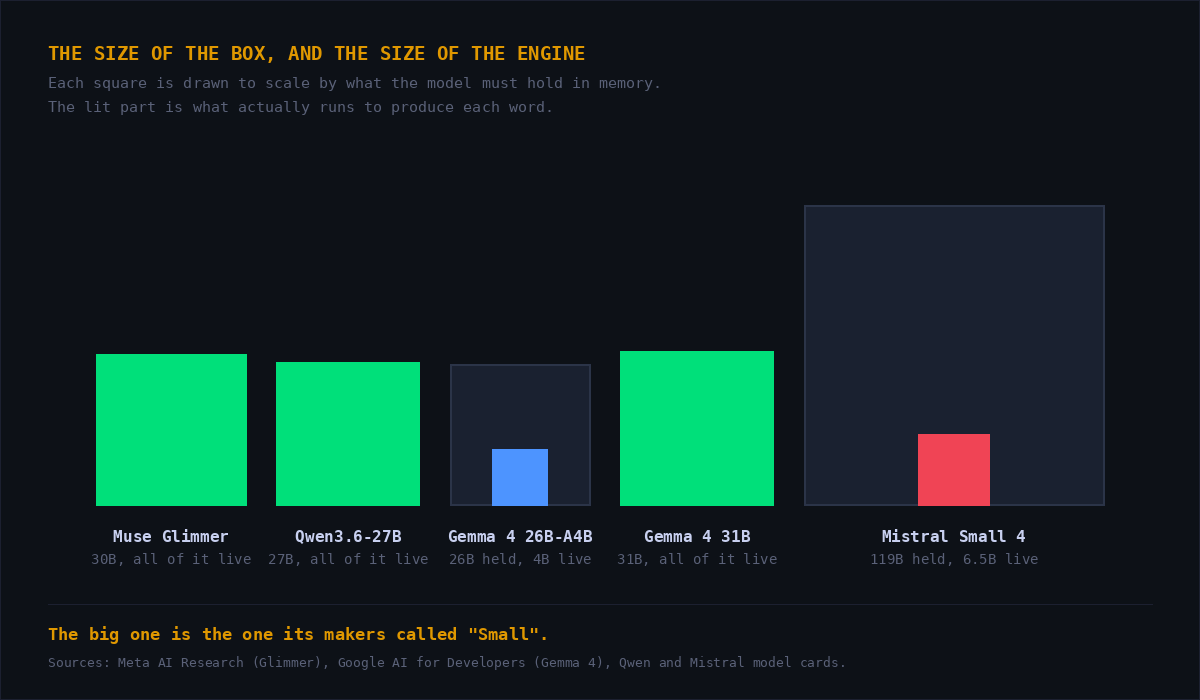
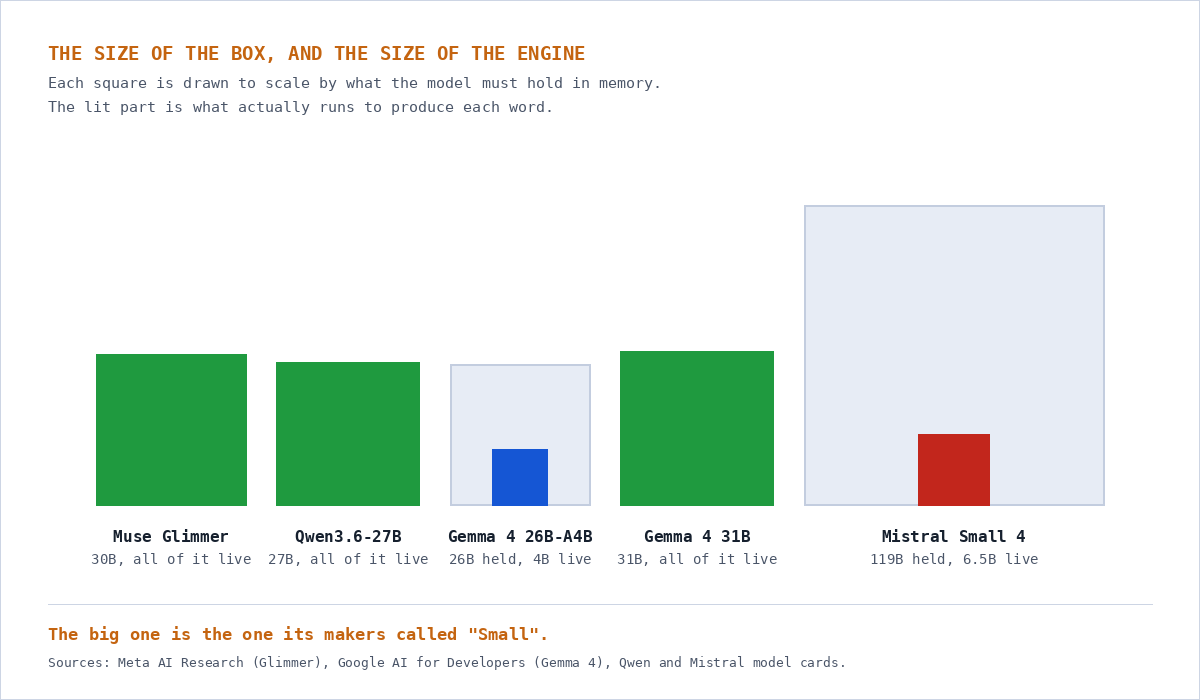
Drawn to scale. Three of them are lit all the way through; two are mostly warehouse.
|
◆ Concept · Total vs active Total parameters decide what you have to store. Active parameters decide how hard it works per word. A number quoted without saying which one it is has told you nothing. |
The job description changed underneath the number
Now look at what a model that size is being asked to do. Qwen3.6-27B is a 27 billion parameter model, Apache licensed, free to download, takes images and video, and holds 262,144 tokens of context. On Artificial Analysis, which grades models independently of the people who make them, it currently sits at #1 out of 134 open-weight models between 4 and 40 billion parameters. It scores 38 on their intelligence index. The median for that whole class is 9.
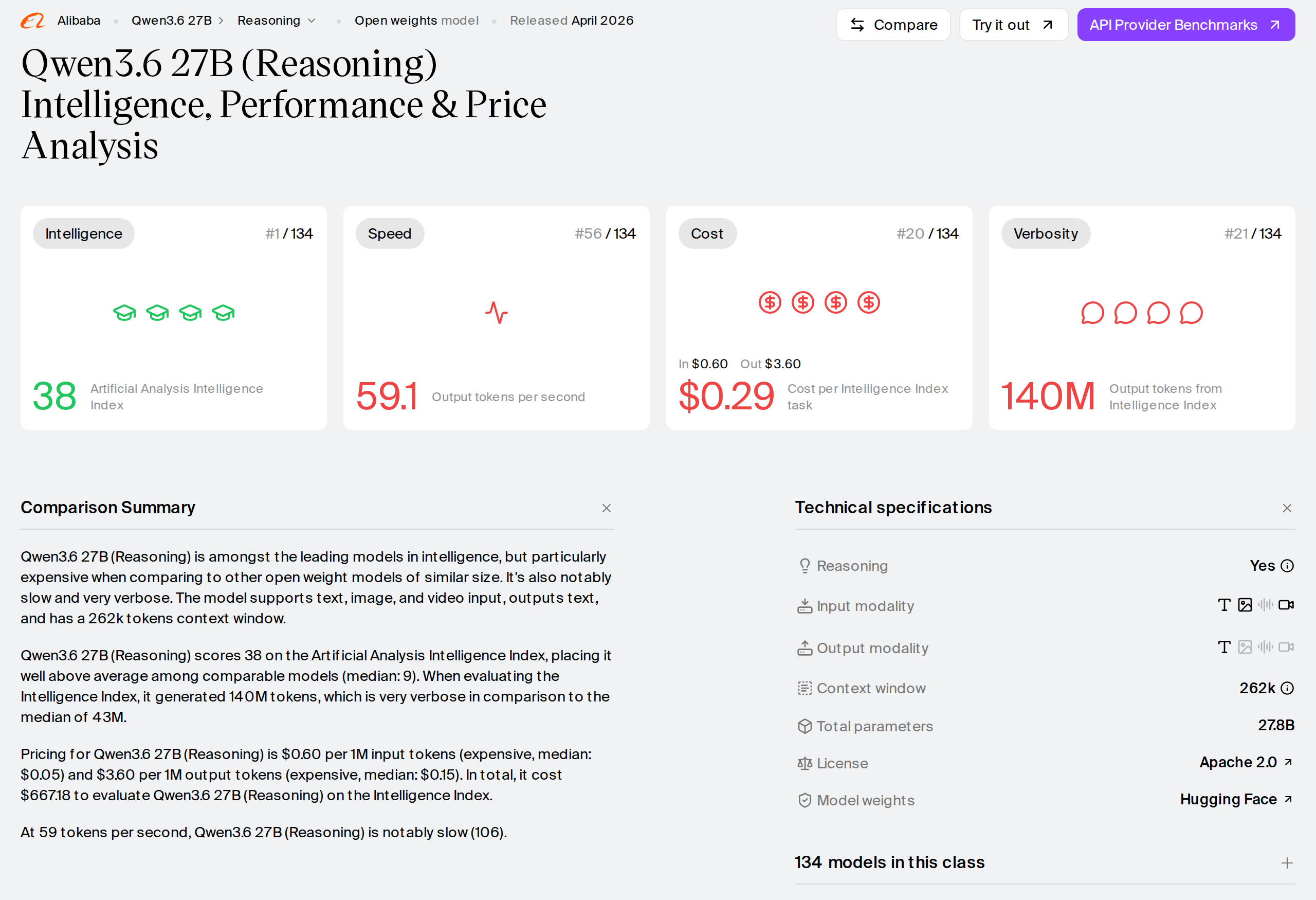
Independent scoring, not the vendor's. Hold on to that fourth panel.
For a sense of how fast that moved: gpt-oss-20b, the model OpenAI put out last August specifically so you could run one at home, scores 15 on the same test. One year, same size bracket, same scoreboard.
But the score is not the interesting part. What they now bother to measure is the interesting part. Qwen's own headline number for the 27B is 77.2 on SWE-bench Verified, which is a pile of real bugs from real open source projects, where the model has to go into a codebase it has never seen, find the fault, edit the files and make the tests pass.
Two years ago a model this size was a good private chatbot that could write you a decent function. Nobody was handing it a repository and a terminal and going to lunch. A 27B model is not being trained to write plausible sentences any more. It is being trained to operate a computer.
|
↩ Previously In issue 16 I watched my feed cram Kimi K3, all 2.78 trillion parameters of it, onto hardware people already owned, and said the shrinking was clever but was not buying back the speed. They were right about what they wanted. This is somebody finally building it that way round. |
Nothing here is free, it is just billed somewhere else
Two things get quietly left out of the celebration, and both are about what you would actually have to pay.
- It is clever partly by talking to itself for a very long time. That fourth panel: getting through the test suite took Qwen3.6-27B 140 million output tokens, against a median of 43 million for comparable models. Some of what looks like intelligence per parameter is really patience per answer, and patience is something you buy in seconds and watts.
- The advertised context is not the context you get. The memory a model needs grows as the conversation does, and that is on top of the model itself.
On that second one, Google publishes an unusually honest table. Squashed down to four bits, Gemma 4 31B needs 17.5 GB just to sit there, which sounds like wonderful news if you own a 24 GB graphics card. Then read the sentence underneath it.
|
◆ The sentence underneath The estimates only account for the memory required to load the static model weights. They don't include the additional VRAM needed for supporting software or the context window. So I can load this model and I can hand this model a novel are two completely different purchases. |
Which is the mini fridge. 3.4 cubic feet was a true number right up until I filled it, and then it was a cupboard. So when Meta says Glimmer runs on one graphics card, the question this whole issue is really asking is how full that card is allowed to get.
The giants are teaching the small ones
So why does this keep happening? Partly better data, partly better architecture, but the part I keep coming back to is that the expensive models have become the teachers. Once you have spent a fortune building something clever, you can point it at a smaller model and have it produce the worked examples, the corrections and the reasoning for the small one to copy.
Google's own Gemma 3 report puts the result in a single line: their new training recipe made the 4 billion parameter model competitive with the previous generation's 27 billion parameter one. Same family, one generation apart, a seventh of the size.
Glimmer is that trick too, and Meta is open about it: it was trained on the output of Muse Spark, the frontier model Meta sells. Which makes the rest of it stranger. Meta launched the Muse family in April with the weights shut, which is what I wrote about in July, and on Monday it opened Glimmer's under an Apache licence and said Spark's own weights are coming. The open model you can have is a copy of the closed one you cannot.
Which means the frontier labs and the run-it-yourself crowd are not two separate stories, however much it suits both of them to be described that way. Every giant is a factory for the next small thing, with maybe a year of lag. If that holds, then the question worth asking each August is not how big did the newest model get. It is what needed a datacenter last year and now sits under a desk. My answer this year: a junior engineer who never sleeps and cannot be trusted alone.
Though I should be straight with you, because I have just spent four sections being enthusiastic. I am not running any of these. Everything I built this week went through Claude and OpenAI, over somebody else's wire, on somebody else's meter, exactly like it did last week. I would like that to change. This is the first year where wanting it has stopped feeling like a hobby.
Below the fold: a report I shipped on what the big institutions actually own, and the loop I now do most of my work inside, which you can copy.
Until next week,
|
◆ Below the fold ◆ |
One page I shipped, and the two-model loop I built it in.
Builds this week
This area is so you can follow along and set up your own Agentic AI.
1. The positioning report. Every large institution in America has to publish a list of the shares it owns, and it gets 45 days after the quarter ends to do it. So the freshest picture available is always a picture of the past. I built that straight into the design: a copper band runs across the masthead from the quarter-end to the filing deadline, and copper is used for nothing else on the page. It is at fader.wundervault.com/positioning, open to anybody, and it refreshes itself twice a day.
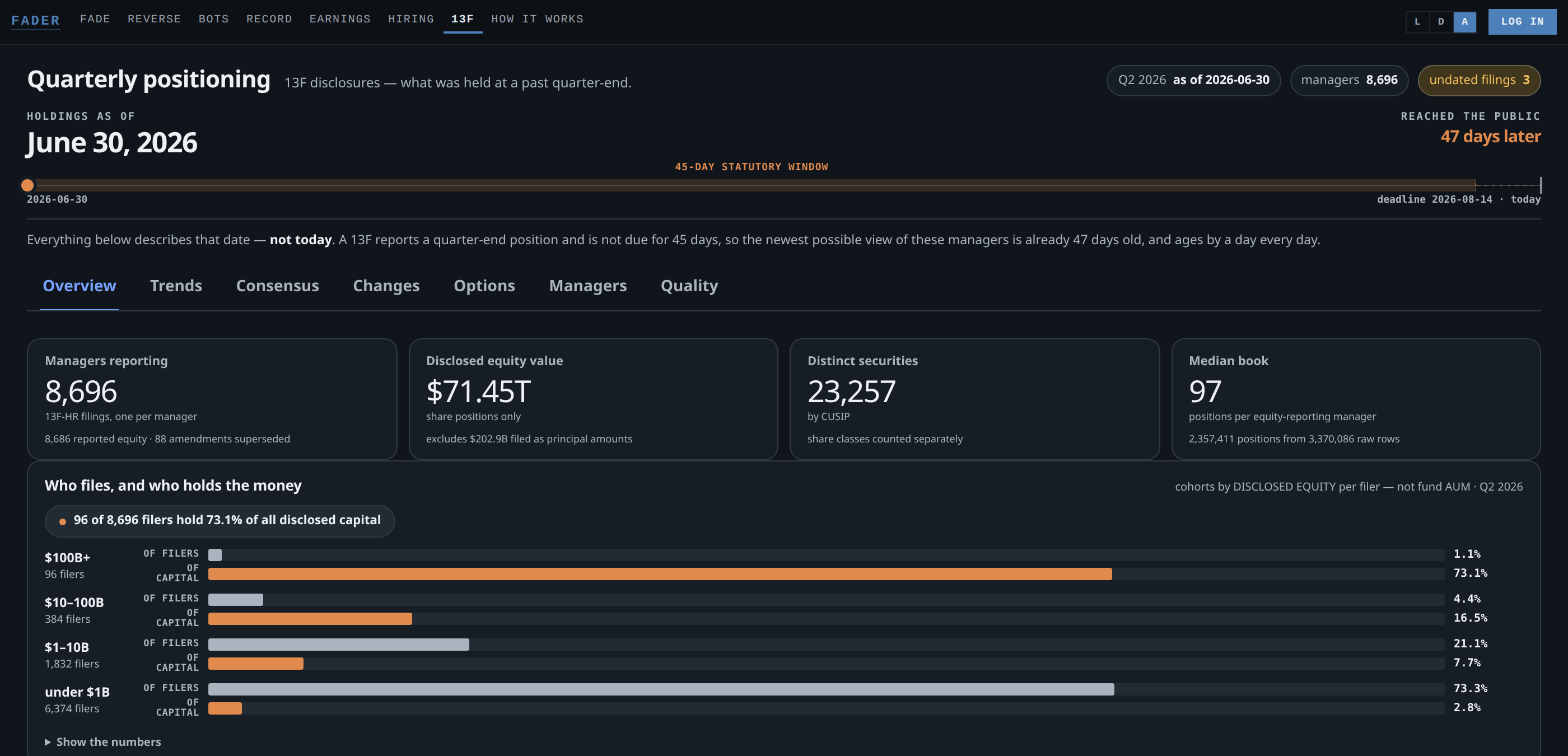
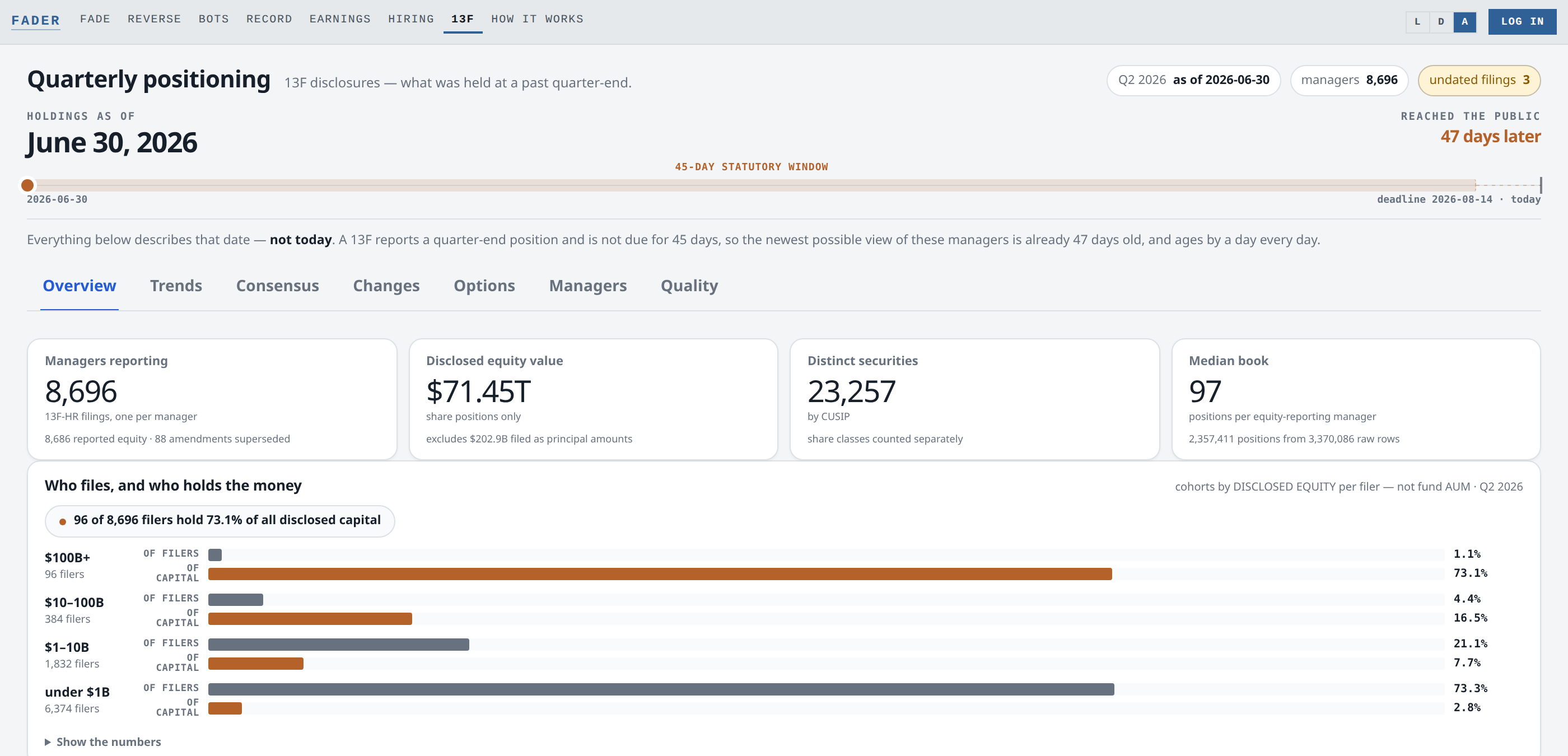
The copper band is the whole point: the gap between what happened and when you were told.
The headline finding is bleak and clean. Of 8,696 filers, 96 of them hold 73.1% of all the disclosed money. The 6,374 smallest filers are nearly three quarters of everybody who files and hold 2.8% between them. And most of the build was not analysis, it was not being fooled: the filing date is not the date the holdings come from, one firm can split itself across hundreds of rows, and the units silently changed convention around 2023. Plus the one that would have ruined everything quietly. You cannot subtract last quarter's dollar value from this one and call the difference buying. Prices move. Count the shares.
2. The loop I now work inside. This is the bit worth stealing. I have a small command called oai. I hand it a job, it hands that job to a model built by a different company entirely, and it hands me back the answer and nothing else. Read this pile of logs and tell me what broke. Which of these forty files mention the thing. Here is my spec and here is what I built, tell me where I have missed.
The point is partly that it costs me nothing on my main account. But the real reason is that the second model has not spent the last four hours quietly falling in love with my design. It turns up cold and slightly rude, which is exactly what you want from a reviewer.
The recursive part is that its output becomes the next input. I build a thing. It reads the thing against the spec and lists what is wrong. I fix what is genuinely wrong, write down what I rejected and why, and hand it all back with the rejections attached. Then round two. Three rounds and stop, because by then it is repeating itself.
The reason I bother is that the first build is always the worst one. It is the buggiest, it is the one that quietly misread the spec, and it is the one I am least able to judge because I have just written it. The two extra rounds are not there to finish the work. They are there to hand me a first look that is actually worth reviewing, so the human pass gets spent on the real questions instead of on the obvious breakage.
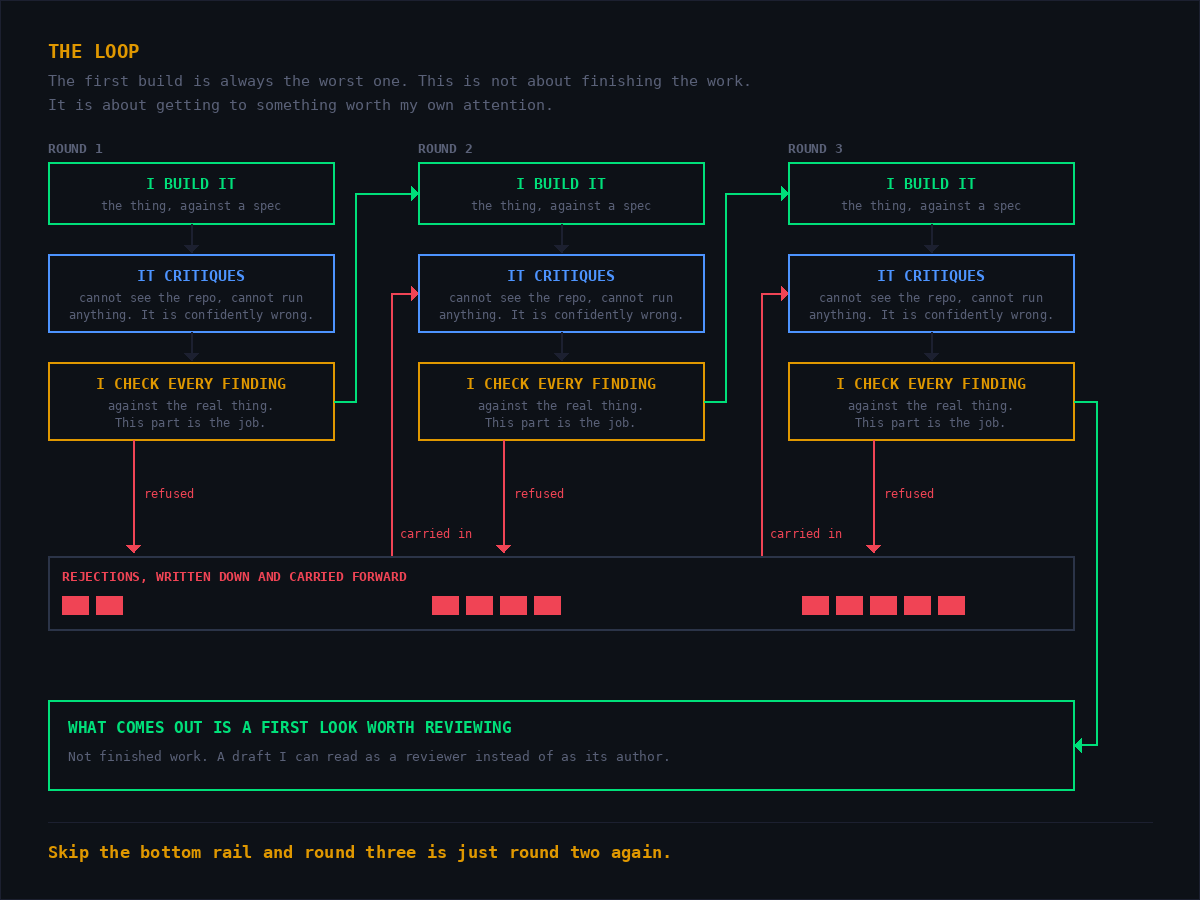
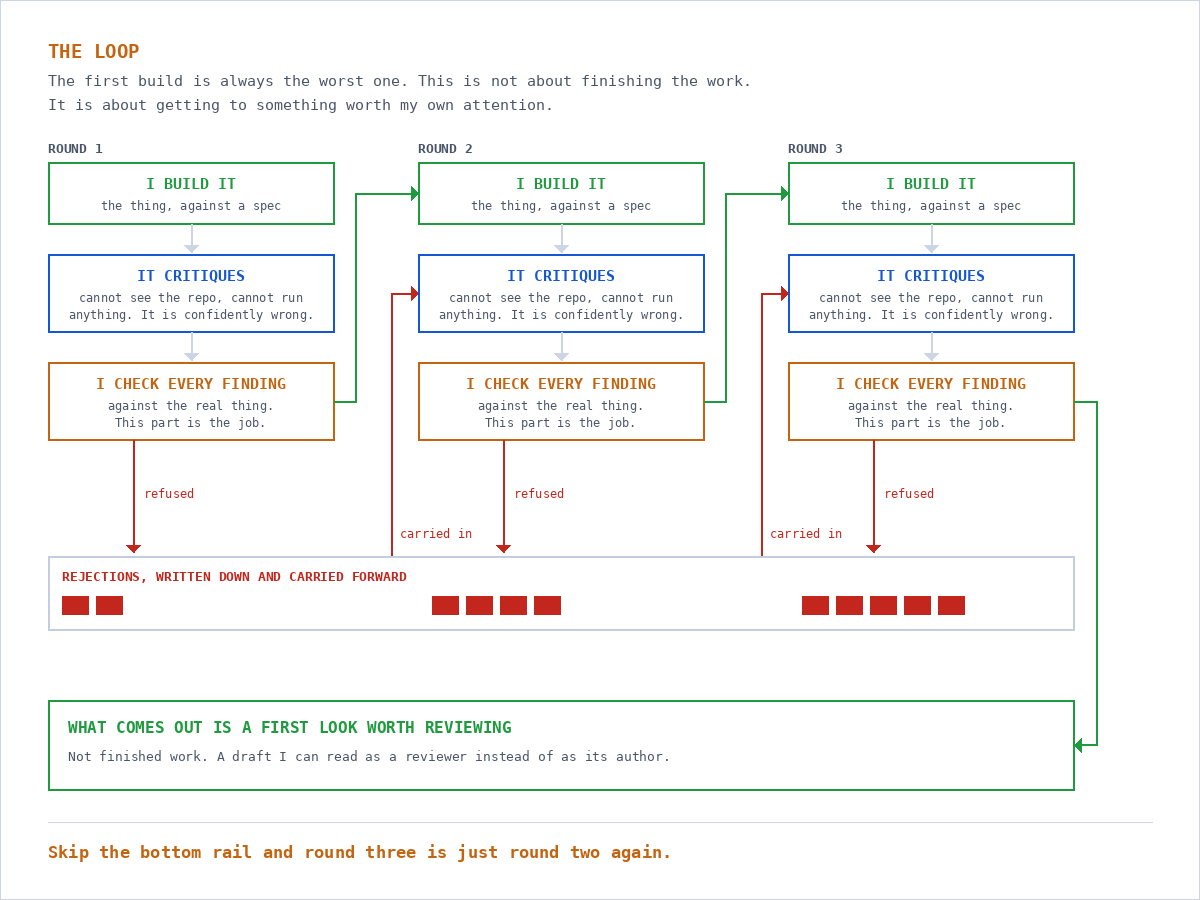
The bottom rail is the bit everybody drops. It is the only thing separating round three from round two.
Two rules make it work, and I learned both by getting them wrong first:
- It cannot see your work and it cannot run anything. It will be fluently, confidently wrong about a file you never showed it. Every finding gets checked against the real thing before you act on it. That check is the job. The critique is just the raw material.
- Write down your rejections and pass them forward. Skip this and round three is just round two again, and you will spend it re-arguing a point you already won.
|
◆ Rule · check the coin too I let the loop invent 131 research ideas for my trading screen and twenty of them passed my tests. Then I tested a rule that picked completely at random. It beat my baseline by 135 basis points. A coin. So I shipped nothing, and the harness got rebuilt instead. |
Which is the same lesson as the top half of this issue, arriving from the other direction. Generating things has become the cheap half. A model small enough to sit under your desk can now produce ideas, critiques and code faster than you can read them. The expensive half, the half nobody is advertising, is the machinery that stops you believing all of it.
So: what is the biggest model you have actually run on your own hardware, and was it useful or just impressive? I genuinely want to know.
“When I use a word, it means just what I choose it to mean—neither more nor less.”— Humpty Dumpty, Through the Looking-Glass