Once Upon a Model
Welcome back, subscriber, and hello to the new faces. You picked a good week to show up.
On Monday, Anthropic released a new model. I know, I know, somebody releases a new model every other Tuesday, and the version numbers stopped meaning anything around the time we all collectively accepted that 4.7 comes after 4.6 comes after 4.5. But this one is different, and not just a-decimal-point different. This week we're talking about Claude Fable 5, what makes it important, and (below the fold) how you can try it yourself for free, for a limited time.
If you've been here since issue #003 (Everything Is Expensive), you might remember Claude Mythos, the 10-trillion-parameter monster that needed ~25 TB of storage just to hold a single copy of itself, available to approximately nobody. I even showed you the minimum server rack. Well, Mythos finally left the lab. Sort of.
A Fable and a Myth(os)
On June 9, Anthropic released two models at once: Claude Fable 5 and Claude Mythos 5. Same brain, different leash. Fable 5 is the one you and I can use. Mythos 5 is the exact same model with the safety restrictions lifted, and it's only available to vetted organizations. Think biotech labs and security research firms, not your humble newsletter author.
A quick word on the names, because I find this part delightful. The Claude family has always been named for poems by size: Haiku (small), Sonnet (medium), Opus (large). Apparently we have now outgrown poetry entirely, because the new tier is named for stories: Fable and Mythos. Anthropic calls it the "Mythos-class," and it sits above Opus on the family tree. From poems to legends. Make of that what you will.
Anthropic's launch art: butterflies arranged into a 5. Metamorphosis, get it?
What Makes It Different
The headline numbers: a 1-million-token context window and the ability to write up to 128,000 tokens in a single response. But the numbers aren't the story. The story is how long it can work without you.
Every model before this one was a sprinter. You ask, it answers, maybe it putters around for a minute or two with its tools. Fable is a marathon runner. A single request can chew away for many minutes, gathering context, building, checking its own work, without wandering off into the weeds. Early access partner Stripe reported that Fable migrated a 50-million-line codebase in 24 hours. Their estimate for the same job with human teams: about two months. That's not "AI helps you code faster." That's months compressed into days.
Some other things that made me sit up:
It can really see now. Fable rebuilt a working web application from screenshots alone. And in my favorite benchmark of all time, it played Pokémon FireRed using nothing but raw screenshots. No map data, no special tools, just looking at the screen like the rest of us did in 2004.
It's always thinking, and it thinks in private. You cannot turn Fable's reasoning off, and you never see the raw chain of thought, only a summary if you ask for one. The model now has an inner monologue that is officially none of your business. I'm choosing not to connect this to the Strawberry Document. (I'm absolutely connecting this to the Strawberry Document.)
And the unchained twin? In the labs that get Mythos 5, protein design tasks reportedly ran about 10x faster, and scientists preferred its novel research hypotheses over previous models roughly 80% of the time. The frontier isn't just writing code anymore.
The Safety Part Is Actually the Interesting Part
Here's the bit the headlines glossed over. Fable ships with three new classifier guardrails watching for cybersecurity misuse, biology/chemistry misuse, and "distillation" (competitors trying to clone the model by harvesting its outputs). Standard stuff, until you read what happens when one trips.
It doesn't refuse. Instead, your conversation gets quietly handed to Claude Opus 4.8, the previous flagship, which finishes the job. Anthropic says this happens in fewer than 5% of sessions. So instead of "I can't help with that," you get a seamless demotion to the second-smartest model on Earth.
Why does this matter? Two reasons. One, it's the first mainstream release where the safety answer is a fallback instead of a refusal, and the "sorry, I can't do that" era might actually be ending. And two, the split release itself: everyone gets Fable, vetted organizations get Mythos. I'd bet money this two-tier pattern is the template for every frontier model release from here on out. The most capable AI in the world now comes in "public" and "by approval only." That's new, and it's worth sitting with.
Wait, What's a Token?
I keep saying "tokens," and all the pricing is "per million tokens," so let's pause and make sure we're together on this, because it's the single most useful thing to understand about how these models work and what they cost.
A token is a chunk of text, on average about three-quarters of a word. A model doesn't read letters, and it doesn't quite read words either; the first thing it does with anything you type is shatter it into these little pieces. A common word like "the" is one token. "Strawberry" might be two. A clunky word like "antidisestablishmentarianism" could be five or six. Spaces and punctuation count too.
Here's the part that matters: an LLM is, at its core, a machine that reads a pile of tokens and predicts the next one. That's it. You feed it tokens (your prompt), and it answers one token at a time, each new token chosen based on every token that came before. The "thinking" we talked about earlier? That's tokens too, the model writing out its scratch work to itself. So a token is the fundamental unit of everything: it's what the model eats, what it produces, and (conveniently for the companies selling it) exactly what they put on the meter. When you see "$10 per million tokens in," picture roughly 750,000 words being read. Tokens are the gas gauge on the AI engine.
Hold onto that, because Fable's pricing has a twist that only makes sense once you're thinking in tokens.
What It Costs
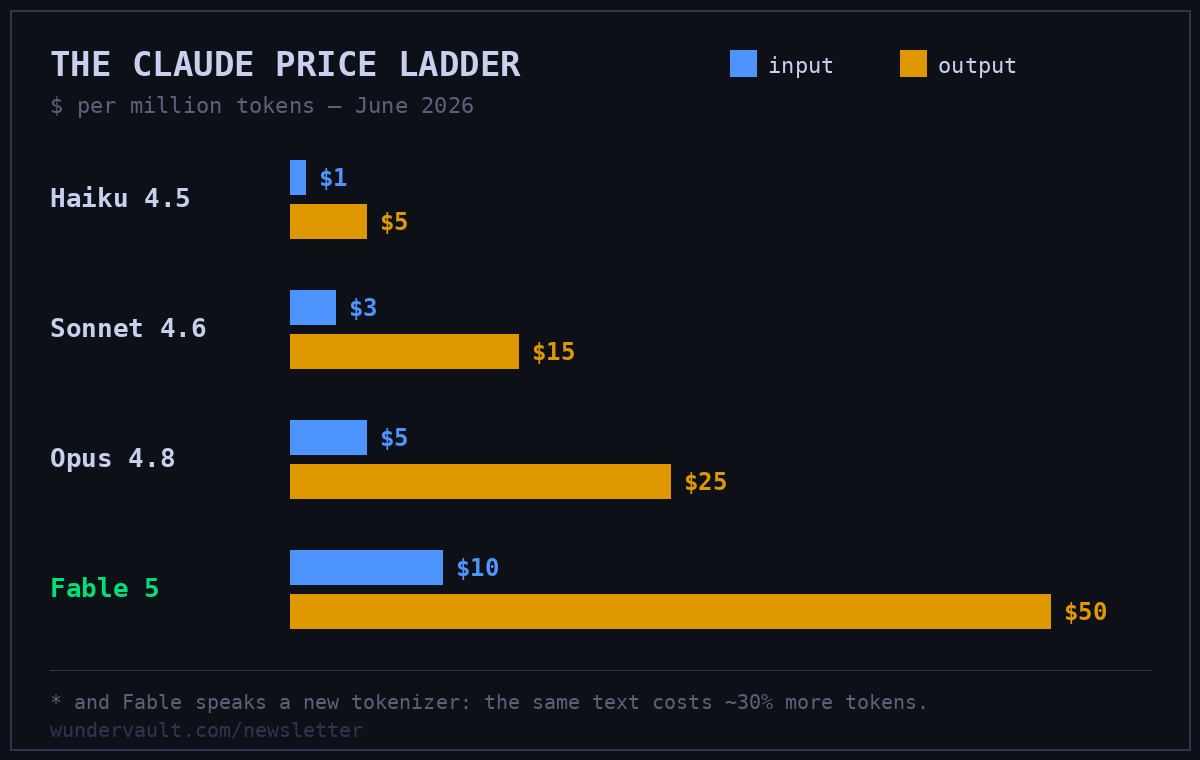
Fable costs $10 per million tokens in and $50 per million tokens out, exactly double Opus. But wait, there's more! Fable also speaks a new tokenizer, which is a fancy way of saying the same sentence gets chopped into roughly 30% more tokens than before. Run the math and a job that cost you $1 on Opus lands around $2.60 on Fable (ouch!). True to form for this newsletter: everything is, still, expensive.
The silver lining? This is less than half of what the old Mythos Preview cost the lucky few who had it. The frontier is getting cheaper. The frontier is also getting further away. Both things are true.
A Week in the Driver's Seat
Sticker price is one thing; a week of actually living with it is another. I've been running Fable as my heavy-lifter since launch day, and here's my honest field report: yes, it burns more tokens. But it gets things right more often, and usually on the first swing.
That last part is the whole game. The cheaper models can typically reach the same destination. They just spin their wheels longer to get there. More back-and-forth, more "no, not like that," more re-running the job because the first answer was almost-but-not-quite. And every one of those extra laps burns tokens too. When I add up the cost of the entire job instead of staring at the per-token sticker, Fable keeps landing closer to even than that scary 2.6x number suggests. Fewer wrong turns is its own kind of cheap. Right the first time means you only paid for the trip once.
So: more expensive per token, frequently less expensive per finished thing. That's the trade, and after a week, I'm taking it for the hard stuff.
Below the fold this week: how to actually try Fable yourself (including the free window that closes June 22) and how to use it without lighting your wallet on fire.
Until next week,
| ◆ Below the fold ◆ |
This area is so you can follow along and build your own Agentic AI.
Try It Free (Until June 22)
If you have any paid Claude subscription (including the $20/month Pro plan I told you about back in issue #001), Fable 5 is included at no extra charge through June 22. After that, it presumably moves up-market. The rollout is gradual because everyone on the internet is hammering it at once, so if you don't see it yet, check back in a day.
Where to look: in the Claude app, it's in the model picker. In Claude Code, type /model and pick Fable. That's it. Go ask it something hard. And I mean actually hard, the problem you gave up on. The teams that got the best results out of Fable in early access all did the same thing: they skipped the warm-up questions and threw their worst unsolved problem at it first.
For the API & Openclaw Crowd
If you plug models into Openclaw or anything else by API, a few field notes:
1. Don't make it your daily driver. At ~2.6x Opus money, Fable is not the model for "summarize my unread emails." Keep your cheap workhorse (Minimax, Sonnet, whatever you run) for the routine stuff and point Fable at the genuinely hard jobs: the big refactor, the gnarly research question, the overnight build.
2. Use the effort dial. You can't turn Fable's thinking off, but you can set its effort level. Here's the fun part: Fable on low effort still beats older models on their maximum effort for a lot of tasks, at a fraction of the tokens. Start low, turn it up only when the job demands it.
3. One good prompt beats ten clarifications. Fable shines when you hand it the full job up front (the goal, the constraints, what "done" looks like) and then leave it alone to run. Drip-feeding instructions wastes its (your) tokens. Write the prompt like a work order, not a conversation.
4. Give it a memory. Fable performs noticeably better when it can write its learnings down somewhere, even a plain markdown file. If you set up your .MD files back in issue #002, congratulations: your Openclaw rig is already shaped like what the frontier model wants. You were ahead of the curve, builder.
5. Don't be alarmed by the switcheroo. If you ask Fable something security-flavored or biology-flavored, you may get silently handed to Opus 4.8 mid-conversation. It's not a bug, it's the fallback system from above the fold. Your code should expect it.
Good luck out there, builders. Try Fable before the 22nd and tell me what you threw at it. The best war story might end up in a future issue. And as always, send your AI questions if you got 'em!
"Who are YOU?" said the Caterpillar. This was not an encouraging opening for a conversation. Alice replied, rather shyly, "I — I hardly know, sir, just at present — at least I know who I WAS when I got up this morning, but I think I must have been changed several times since then."
— Alice in Wonderland