Be Nice
It’s been another week and we are still here. Wundervault is still here and so we carry on with the newsletter. And this week we talk about science and math! With AI already upending coding, it seems like science and math are the two fields that are next. Right now it’s too early to say whether upended really means just speeding up the pace of discovery, the investment and then the impact of these very important fields. For now the discoveries are just tangentially important, but are they not a sign of things to come? Write in and let me know your thoughts.
Claude Can Leave the Chat
Anthropic updated its Usage Policy on October 8. The change takes effect November 12, and this is the new rule:
“We’ve added a prohibition on sustained and needless abusive or cruel behavior toward our models.”
I can see the feelings question waiting there. I’m moving past it because I don’t think Claude has feelings. I do think being nice should be enforced anyway.
The rule targets repeated cruelty with no discernible purpose. Frustration with a broken build, pushback, dark creative themes, and model testing or research are outside it. You can still tell Claude the code is broken (sometimes it is).
The update never says you’ll be banned. Anthropic says Claude ending the chat is its primary enforcement tool, and Claude has been able to do that in rare cases since August 2025. The policy’s fine print also allows Anthropic to warn, throttle, limit, suspend or terminate access for a violation.

Well, that conversation is over.
We Already Ran This Experiment
|
↩ Previously · Issue 21 “I think we are living in the doom and gloom of an unregulated internet era, we don’t trust our neighbors anymore, we have social media that’s not social. The internet was supposed to bring us together, I met friends through Friendster and Myspace and then what happened was it pushed us farther apart. So I feel like if we let AI run its course without putting any thought into how we use it morally and ethically then it will be doom and gloom and we have that time now.” Issue 21 |
I’ve been thinking about my friend’s words. We already ran the no-manners experiment with the internet and got social media that’s not social. I’d like being nice to be part of what we build next, while we still have some say in what feels normal. You talk to these things all day. That gives you a lot of practice talking a certain way, and some of that practice will follow you when the person on the other end is a person.
Amazon tried something small in 2018: an Alexa setting called Magic Word thanked kids for saying please. It still answered when they didn’t. I like the idea of giving manners a little encouragement before everyone settles into their habits. What else should we be practicing now?
Math is Mathing
Is this a two horse race? Recently it hasn’t felt like it with Google releasing a top tier model that competes with the likes of OpenAI and Anthropic but I am still laser focused on these two labs, and both appear to be making strides into the sciences. While OpenAI is making strides in the field of math and Anthropic is going after biology.
Claude for Life Sciences came out in October 2025, with connectors and skills for lab work. That feels like ages ago. Claude Science followed on June 30 as a workbench with access to more than 60 scientific databases. Anthropic also set up its own life sciences research group and wet lab, where human scientists do the lab work.
Then on September 23, Anthropic said Claude found a previously undescribed enzyme system in bacteria-infecting viruses. It calls the system ART; its function is still unknown. A biologist in Copenhagen says his group has studied the same systems for years. Anthropic says it knows of no previously published work describing ART.
And this week, OpenAI brought out its math results.
So How Much Math Is That?
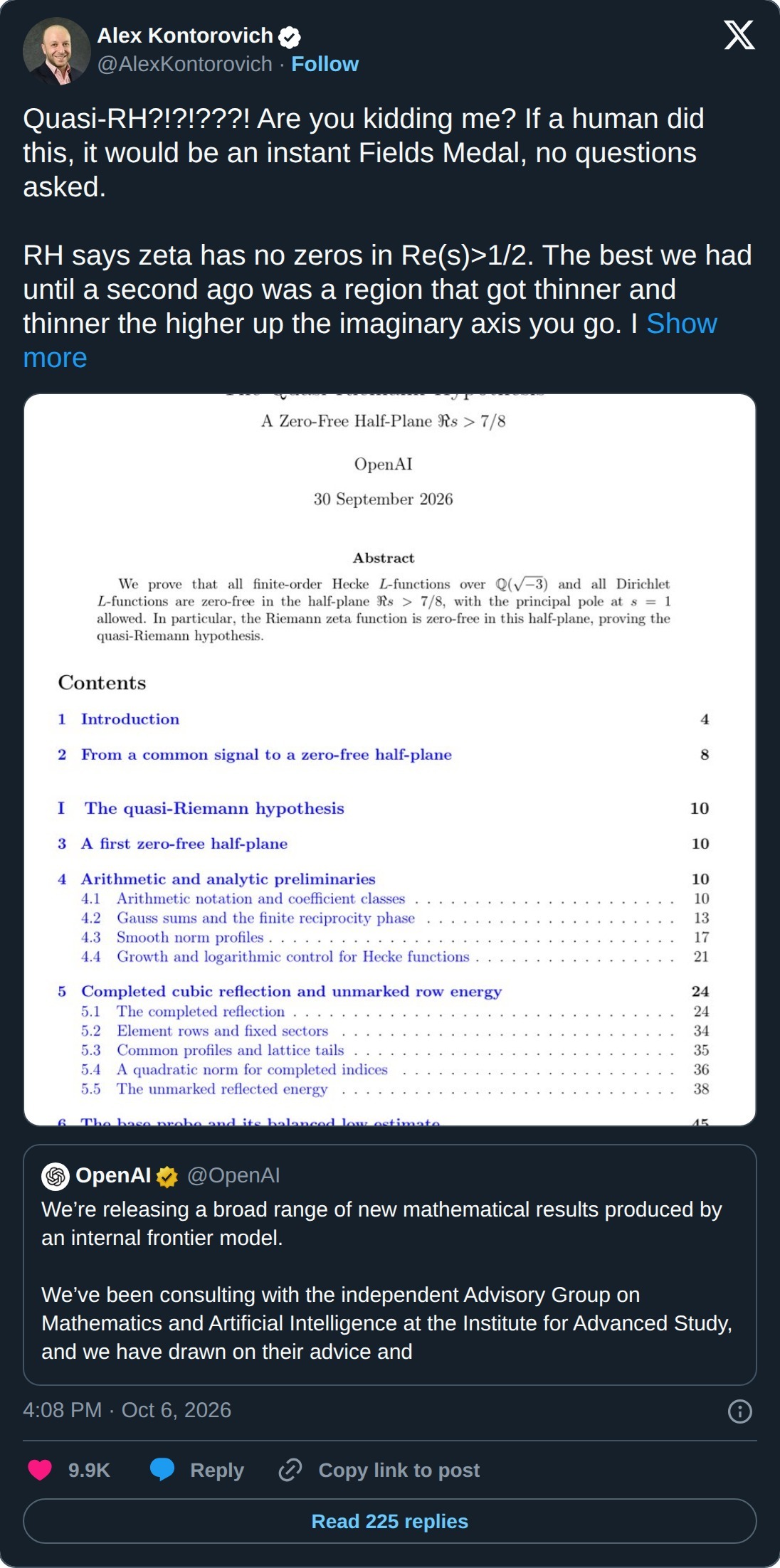
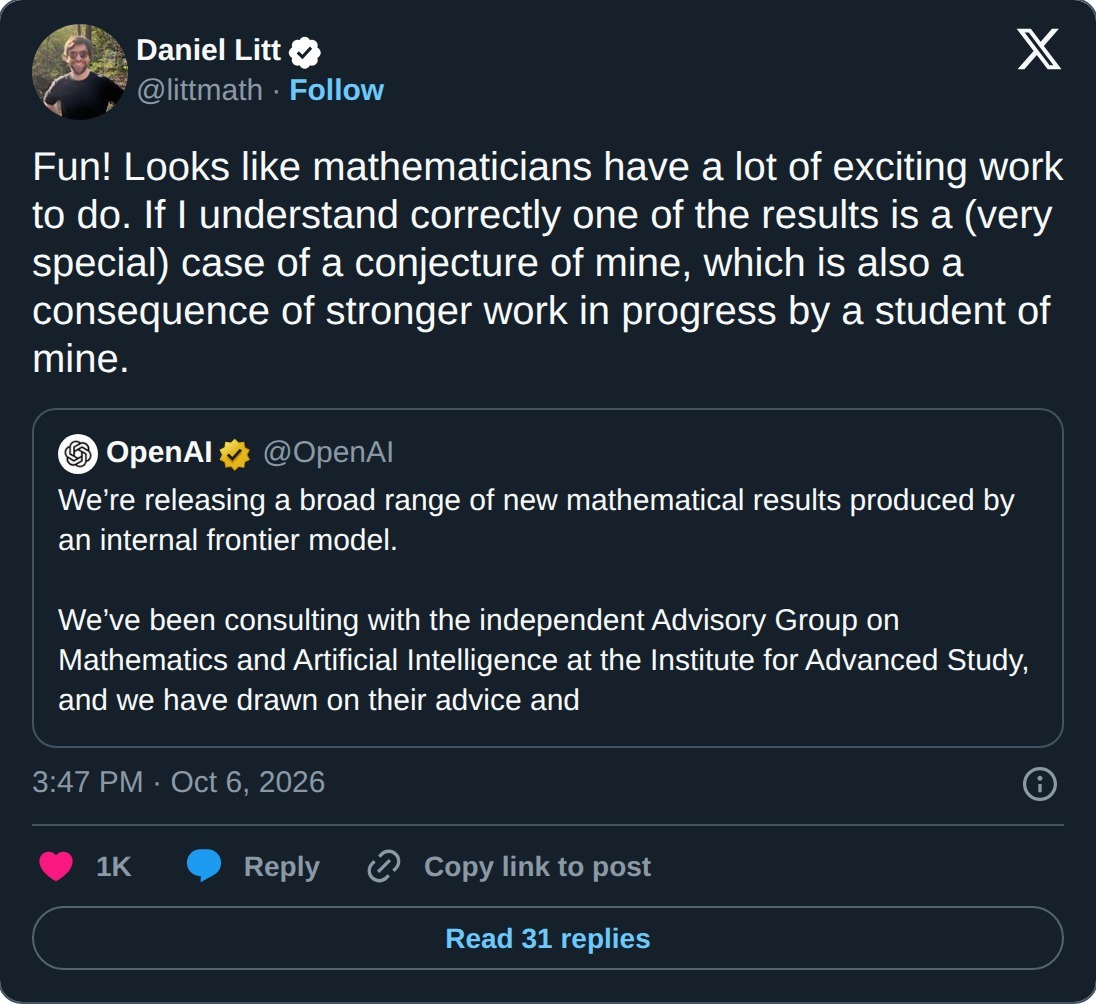
On October 6, OpenAI published results from an unreleased internal model in a GitHub repo simply called math. The model was given about 4,000 problems, with each result using around three hours of ChatGPT Pro thinking on average. After withdrawals, the catalog holds 719 manuscripts in 372 families. About 42% of the top-line results have a Lean proof, meaning a computer has checked every step.
The repo covers quite a spread:
- The matrix multiplication exponent is down to 2.25, a theoretical bound. This one has a Lean proof.
- The quasi-Riemann hypothesis: the zeta function has no zeros with real part above 7/8. This one has a Lean proof too.
- Kaplansky’s direct-finiteness conjecture in characteristic two.
The Lean proofs give readers a checked starting point for some of the results.
A day later, OpenAI found a sign error in one paper and withdrew three manuscripts, including one on the rational Hodge conjecture for products of K3 surfaces. It repaired 14 others. The old versions remain public, which means you can see the corrections happen. I hope you hadn’t started printing them.
Somebody Has to Read These
Before the release, OpenAI consulted an advisory group of mathematicians whose first request was to stop testing advanced math problems on proprietary models. TechCrunch judged the release short of the group’s standards and noted that only 10 of the 719 papers came with the model’s reasoning. The group called its talks with OpenAI constructive and left the verdict to the mathematical community.
Terence Tao put another concern this way:
“Problems are being solved autonomously by AI prompters who have no interest in the broader field itself”
So who checks 719 papers? And when somebody has already been working on a problem, who gets the credit?

A little weekend reading.
Two Horses?
OpenAI has the math papers, Anthropic has its biology work. How long does that split last?
Math gives a lab a handy way to train and test: a computer can check a proof and tell the model whether it got the answer right. François Chollet raised the possibility that math and code can keep moving this way while other fields run up against the limits of human-generated data. Biology takes you into a wet lab. Somebody has to run experiments and other biologists have to check the work, which takes time.
Both labs also have researchers asking about earlier work that may have gone uncredited. MIT Technology Review called the way labs present AI discoveries “breakthrough or bust.” A big claim makes the question of who found what rather important (and rather difficult).
The split is already getting blurry. OpenAI launched GPT-Rosalind, a life sciences research preview, in April. Anthropic has its own Lean proofs repo, updated the night before OpenAI released its math results. Maybe the two-horse race changes next week. Maybe it already has.

Hard to call from here.
If you could point one of these labs at one problem, what would it be? Send me your pick.
Below the fold, I’ll show you how the little decision model from issue 23 got running on a cheap old graphics card in my home server.
Until next week,
|
◆ Below the fold ◆ |
Laya, the little decision model from issue 23, now runs on an old graphics card in my home server.
Laya on the Old Box
Could Laya fit on my computer? I asked that in issue 23. Yes, it fits on my home server, and now it runs on an old graphics card too. Laya is a System One model: it reads a short text and picks from a list of answers you set, with a number attached saying how sure it is. You can read more about System One models in issue 23.
I put a Radeon RX 550 with 2 GB of memory into the box. I tried Ollama first, but its Laya downloads are built for MLX, which needs an NVIDIA card on Linux. AMD’s ROCm software doesn’t support this card either.
llama.cpp runs models from a single file on ordinary hardware, including old graphics cards. Vulkan is a standard way for software to talk to a graphics card, and the Linux driver for this Radeon supports it. That pair worked.
I downloaded the ready-made Vulkan release of llama.cpp and had its server program load the Q8_0 Laya file, with every layer on the card. It listens only on the box itself. My small laya command starts the server on first use; a separate watcher stops it after 30 idle minutes.
Three questions about one email took around 15 seconds on the CPU. On the card they took 0.6 to 0.7 seconds, with the same answers.
The model card cautions against trusting Laya out of the box. In my small test it routed 12 of 12 support messages correctly and caught 8 of 8 phishing emails, but got only 6 of 12 on a yes/no positive-tone question while claiming full confidence. Asked as pick-one, it got 9 of 12. Use pick-one and spot-check a batch before screening lots of short items at home.
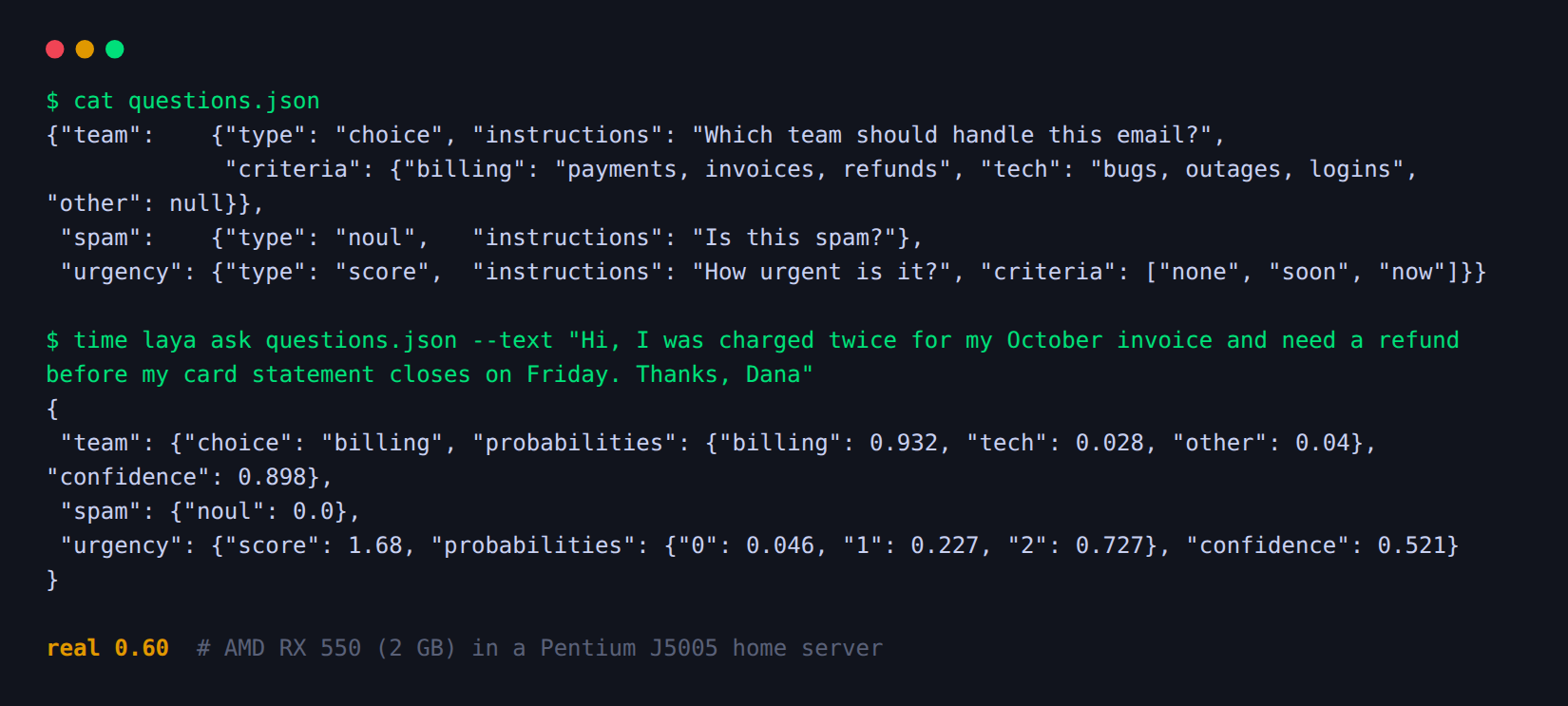
A real run on the home server: three questions about one email, answered in 0.6 seconds.
“Reeling and Writhing, of course, to begin with,” the Mock Turtle replied; “and then the different branches of Arithmetic—Ambition, Distraction, Uglification, and Derision.”— The Mock Turtle, Alice’s Adventures in Wonderland