Can We Cure Cancer Yet?
Hello and welcome back to another week in AI. Last week I told you about the 3 comma models, the ones you are able to run on your powerful ~$2k-$5k home rig, and this week I was planning on telling you about the tiny models, the ones that are most likely going to end up inside your IoT devices. I have a whole theory about where those are going and you are going to have to wait a week for it.
So that was the plan, tell you about the small models and more about where I think they are going, but news is unpredictable and AI news is moving fast, so this week I am instead bringing you a story released by my fanboy favorite company, Anthropic, about moving the capability of our frontier models from the digital to the real world.
|
↩ Previously The number on the front of the box stopped meaning anything: a model called Small turned out to be 119 billion parameters, and a 27B you can download for free took the top of its class. That was issue 17. |
Out of the chat window, into the wet lab
In this article, Anthropic unleashed a hive mind of GPUs and agents against a real world problem. Looking at the protein structures that are biologically important to some diseases, how do we design a structure that will bind to them?
Now, if you are unfamiliar with the biology. The first step in discovering a new therapeutic is identifying what might bind or attach to one of these proteins, then from there you have to determine “does this interaction interfere with the functionality of the protein, in a way that is advantageous to the disease state?” That second question was not answered, but the first question was, and after making their predictions, they went and tested them in the real world.
|
◆ Concept · Hit rate You design a hundred little proteins on a computer. You order them, grow them, and put them in a dish with the target. The share that actually stick is your hit rate. Everything upstream is a prediction; the hit rate is the part reality gets a vote on. |
A quick summary of the results: yes it worked, and yes Anthropic was able to outperform labs that had tried this same exercise before. They went after 15 targets and designed working binders for 14 of them, pulling 354 binders out of 1,320 designs. The comparison that made me sit up is RBX1, a target that Adaptyv Bio had already run as a public competition: human entrants hit 3.7%, and Claude hit 40% (!!). A typical campaign in this field today lands somewhere around 10 to 15%.
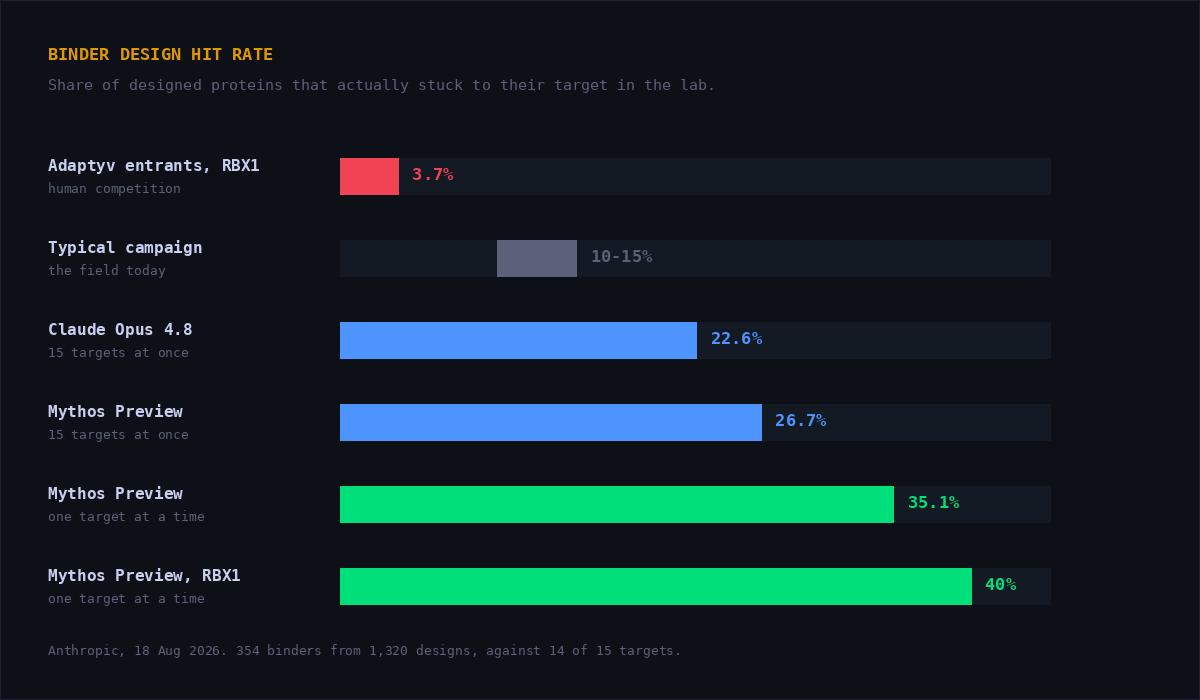
The one number reality gets a vote on.
The 40% makes the headline, but 14 out of 15 is the number that got me. One target could be a good day. Fourteen different proteins is a method.
|
◆ Watch out · A binder is not a drug Sticking to a protein is step one of about nine. Anthropic says so themselves: these little binders are “not a standard therapeutic modality”, and designing one that grabs on tight is “just the first step”. Nobody has shown that any of these 354 do anything useful to a disease yet. That is the next question and it is the harder one. |
Maybe the ad was the game plan
So maybe this is the start of the inflection point where we begin to try and tackle the questions posed in the Anthropic advertisement (the one I liked but got a lot of flak on the web). The film opens on a burning house and asks whether AI can be trusted, and somewhere in the middle of all that gloom it asks this:
“Can AI help scientists cure diseases?”
Maybe Anthropic was giving us their game plan on what to do next, where they are going and the questions they plan to tackle. Right in front of our eyes, and everyone thought it was just another marketing campaign.
And here is the part I find funny. That same week, Dario Amodei was on X taking his own flak, and he gave away the whole game:
“I think by far the most accurate criticism of AI companies including Anthropic is that we haven’t yet delivered on our big promises to benefit the world.”
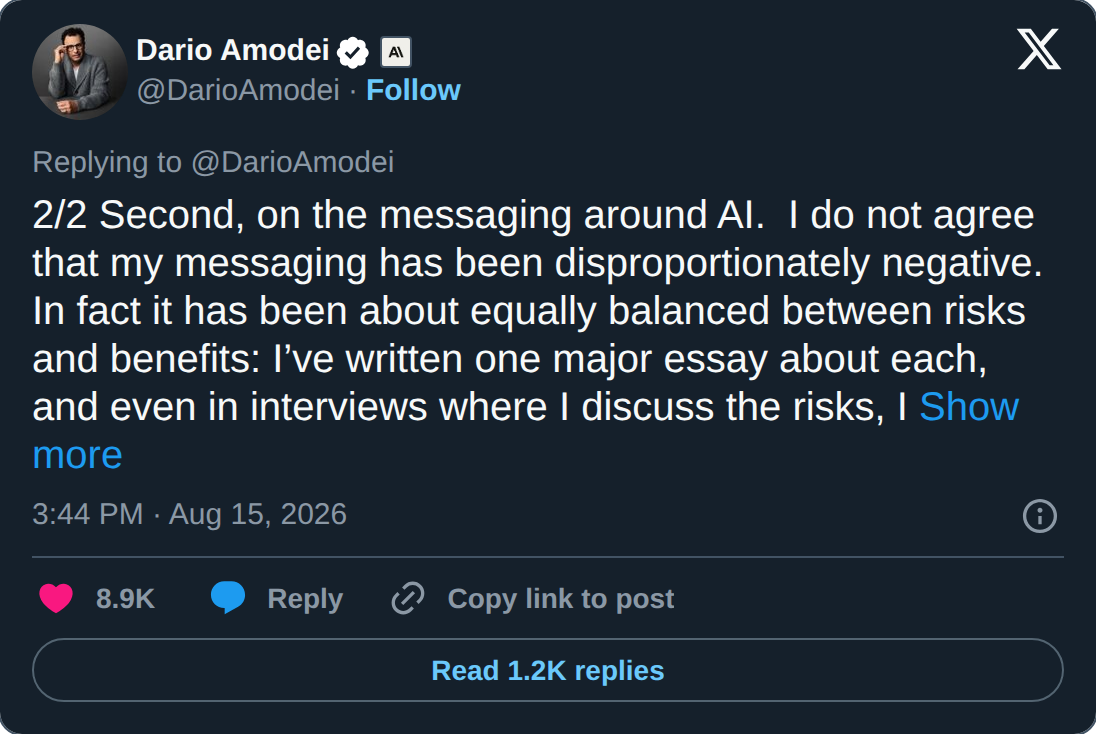
The top of a much longer post. Read the whole thing.
He also called promising that AI will cure cancer “more a cliche than it is inspiring”. Three days later his company published 354 proteins that actually stuck. That is the correct order to do those two things in.
The recipe book, not the peek
Since this is Anthropic, they didn’t just share the paper but they open sourced the entire project, and I think that means more for the community and for what happens next, because the prompt, which was the scaffolding for the organization of this hive project, was enormous. Roughly 30,000 tokens of instructions. It wasn’t just a peek behind the curtain, it was a recipe book that is now available for anyone to ingest and adapt to their own projects.
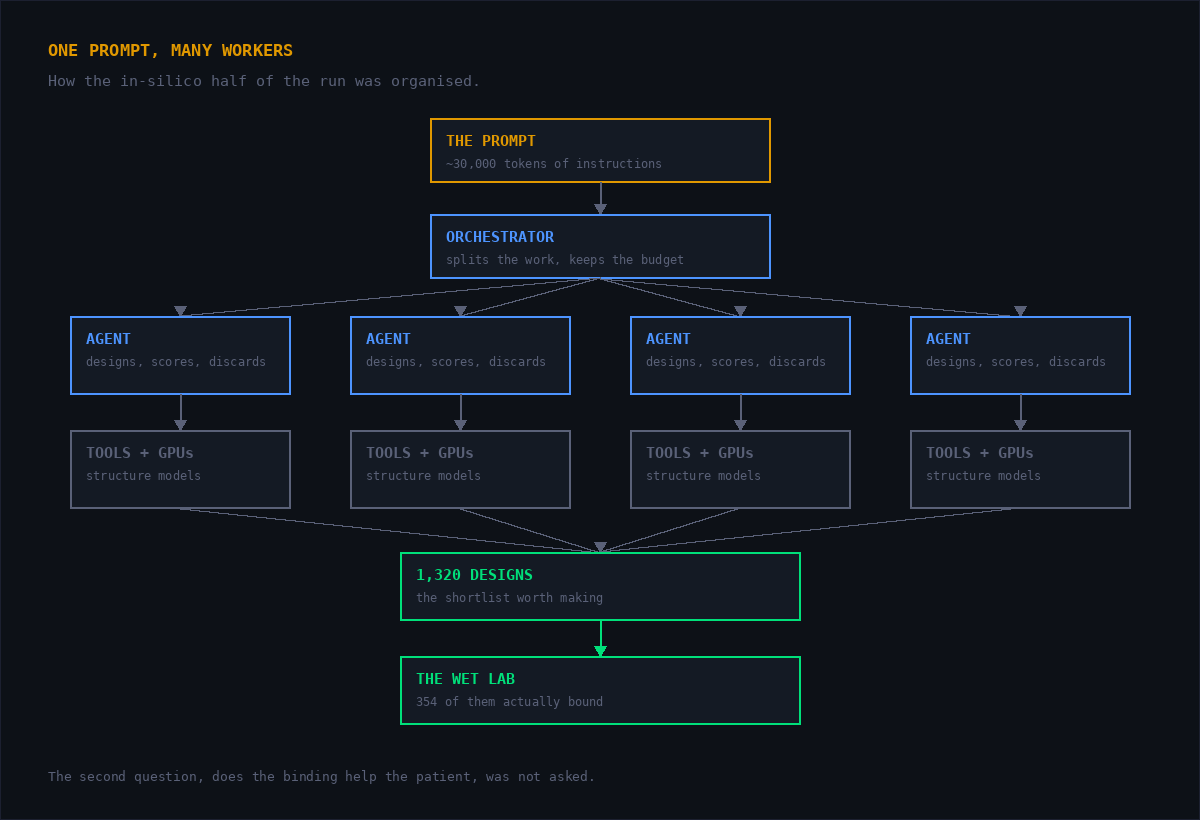
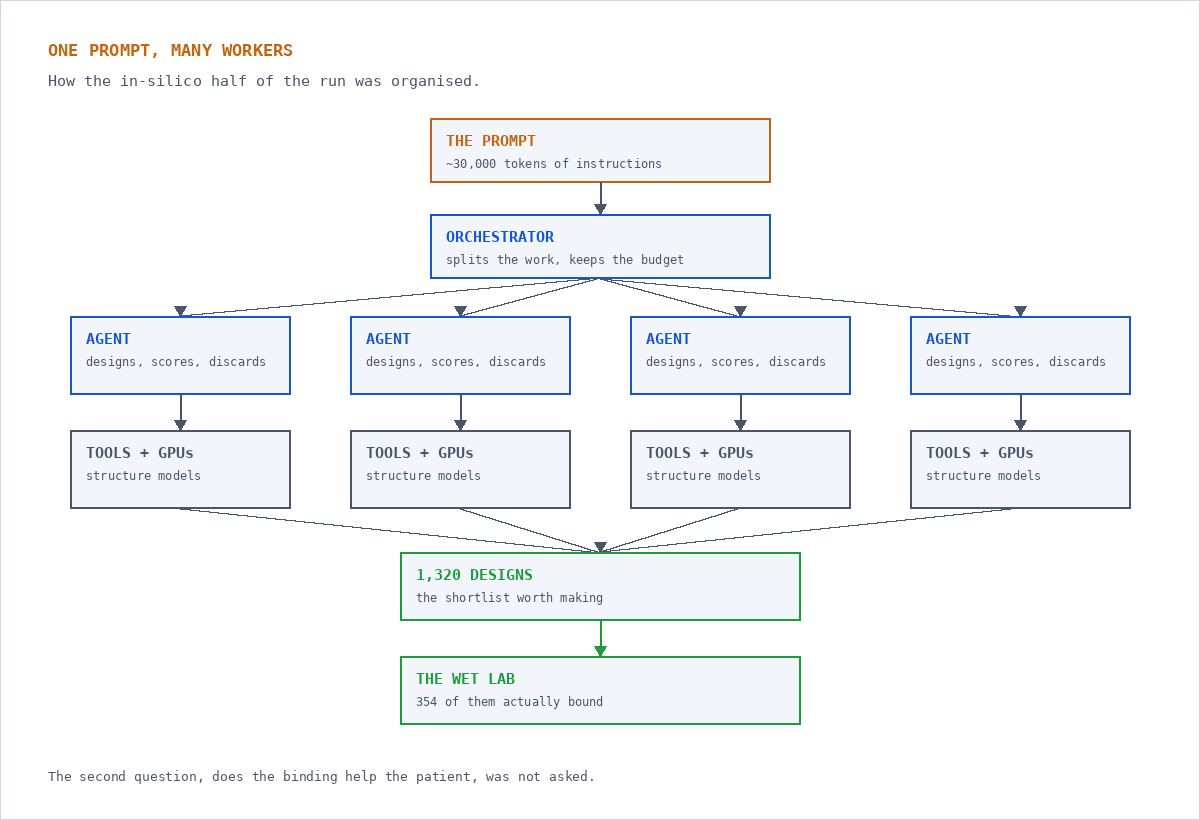
The hive, drawn out. One prompt at the top, a dish at the bottom.
So what do you actually do with 30,000 tokens of somebody else’s prompt? You read it like a recipe. Neither of us is designing proteins on a laptop this weekend, but the shape of the thing carries over: how they told the agents to divide the work, how they told them when to quit on a bad idea, how they kept a thousand parallel guesses from becoming a thousand parallel wrong answers. That is the same problem I have every time I ask an agent to build me something, just with a much bigger GPU bill.
Wall Street noticed too
In other but related news, if you were watching the stock market this week you might have caught wind that Moderna (the notorious covid mRNA vaccine creator) and Merck announced an “AI assisted” drug treatment that was able to prove effective in Phase 3 clinical trials. The AI assisted angle is a small one:
- They sequence your tumour and your blood.
- Machine learning ranks the mutations by which ones your immune system is most likely to react to.
- The winners, up to 34 of them, get written into an mRNA vaccine built for you and nobody else.
The lab is evaluating the different mutations and using that to determine the best treatment for your melanoma, but adding this selection layer means we are one step closer to personalized medicines reaching the market. And this makes me very hopeful for the future we are building, and if you see how this stock moved, so is Wall Street. (Unfortunately I don’t own any Moderna and this is not financial advice, don’t go buying their stock after a big move like this).
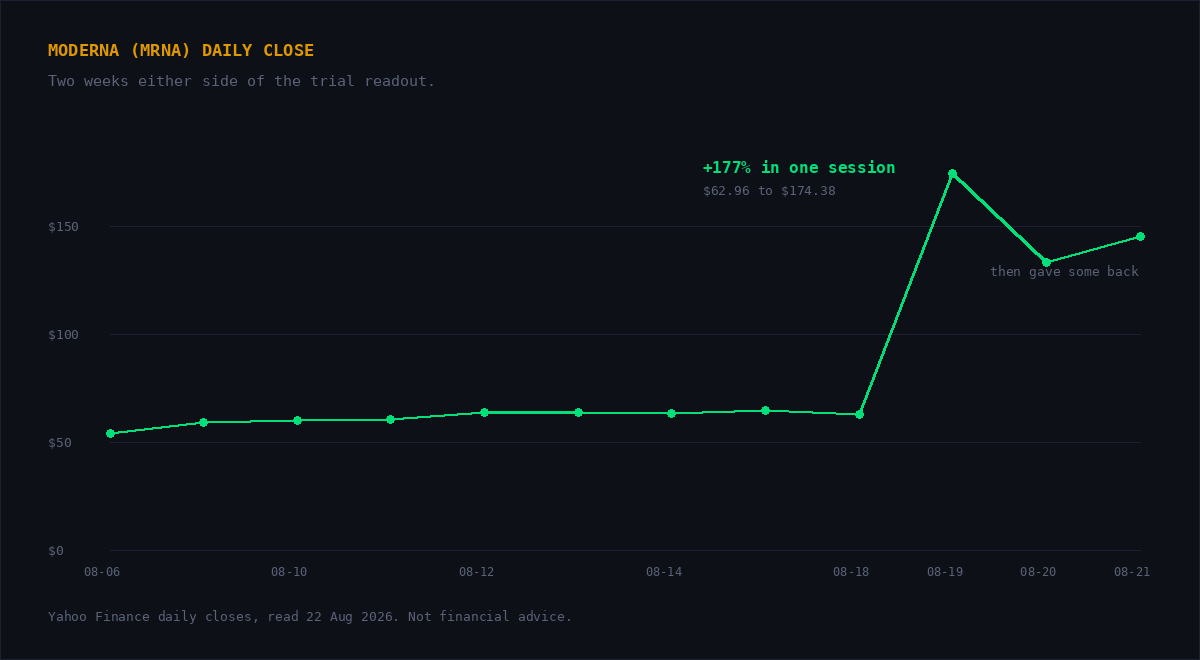
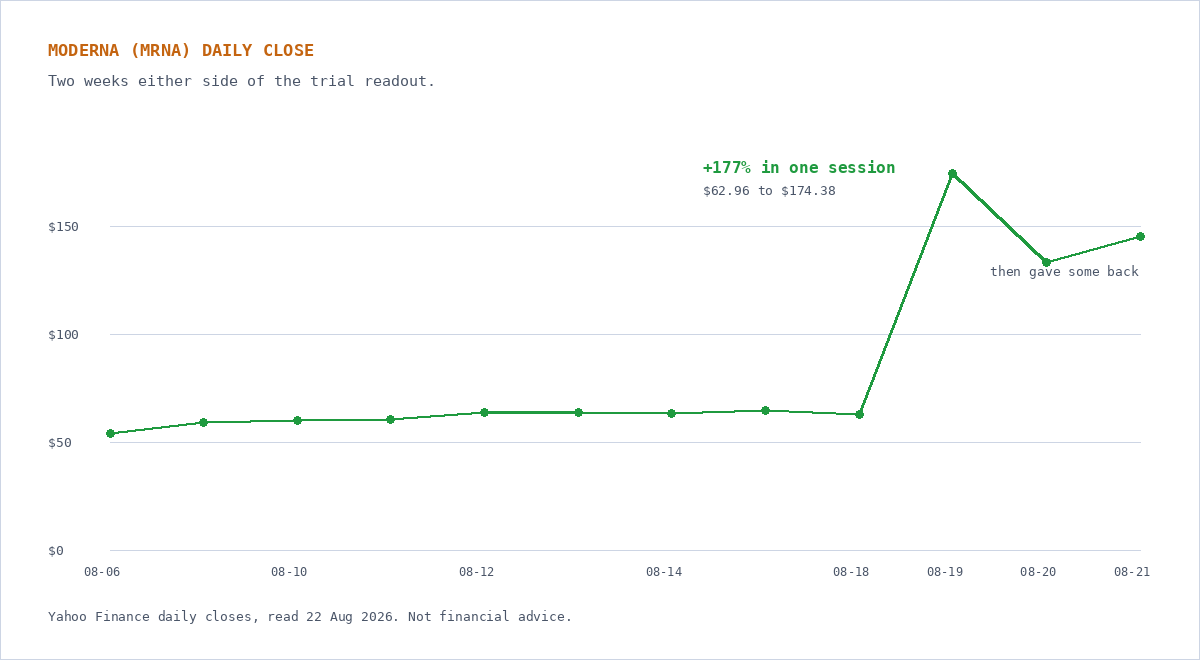
$62.96 on Tuesday, $174.38 on Wednesday. Then it gave a chunk of that back.
And the tiny models? Still coming, and still headed for your light bulb. Next week, I promise, unless Anthropic goes and cures something else on a Tuesday.
Until next week readers! Thanks again for all the interaction with our newsletter and if I can ask a favor, please share this with those people who you think will find the stories interesting. And thank you in advance for helping build our audience. Below the fold we will get into a build from this week that was made exclusively for a user like you. I think you will enjoy this one and maybe even learn about how to create your own builds. I hope to see you … below.
|
◆ Below the fold ◆ |
A reader asked for a tool. Here is exactly how it got built.
You can request a build
This area is so you can follow along and set up your own Agentic AI. This week I had a user request a build from us. (You can do that?) Yes, you can do that and please do! The user had requested that we build out a random username generator, which very nicely complements the offering of Wundervault and is a small but powerful tool in maintaining your anonymity online that everyone should be using.
Simply put, this tool creates unique usernames for you with a variety of variable inputs, and the output is a bunch of names you can choose from. These are all generated on your computer for safety and Wundervault stores nothing.
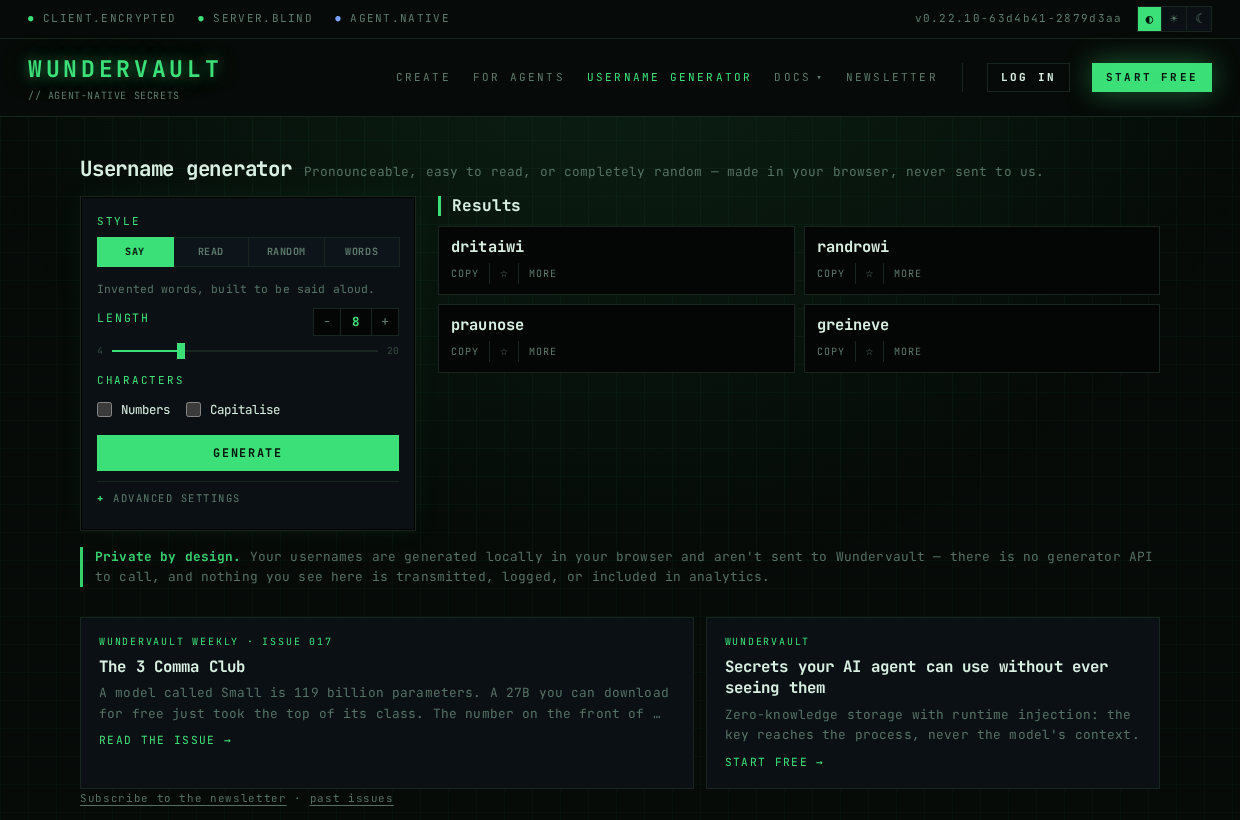
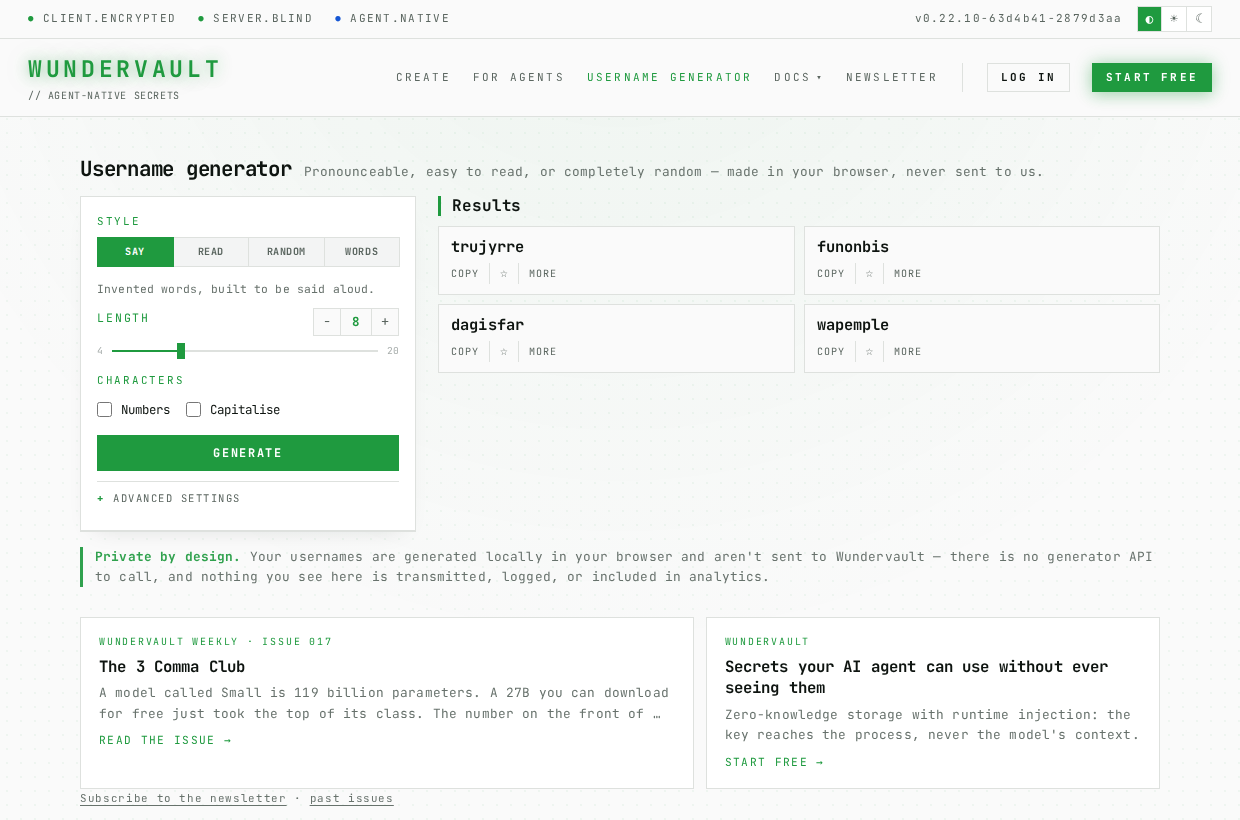
Pick a style, pick a length, hit generate. Nothing leaves your browser.
How it actually got made
The build itself was done by sending in two reference websites that exist or used to exist. I sent those to ChatGPT and asked it to design a prompt for me where we ask another agent to build this tool, but improve upon the design. Then I took that prompt and sent it to Claude Code. Claude Code began the build process and then used our review loop (the one I discussed last week) to do 2 rounds of automated review before presenting it to me for final review. I did my own round of review and the final project was completed in about 2-3 hours. I don’t hand code and I never have, so I can’t tell you how long this project would have taken 5 or 10 years ago, but needless to say it would be a multiple > 2-3 hours.
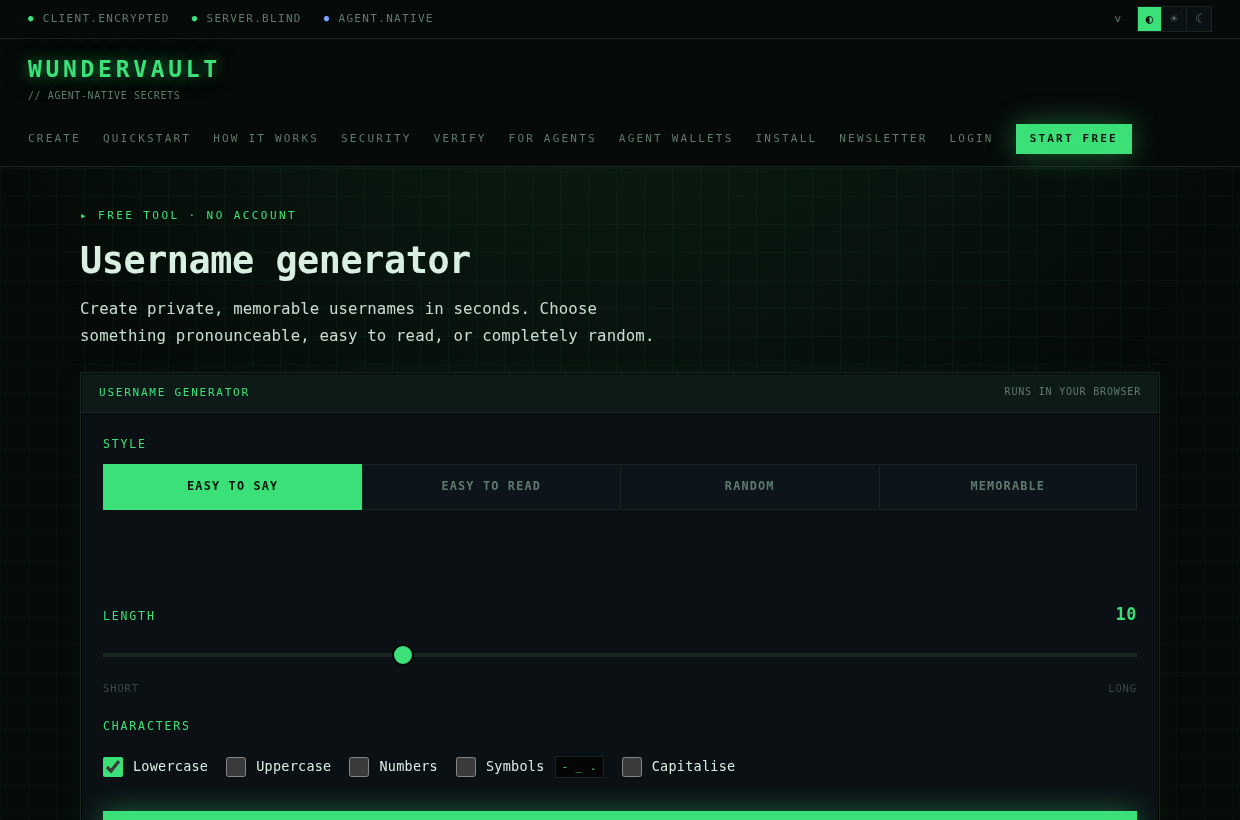
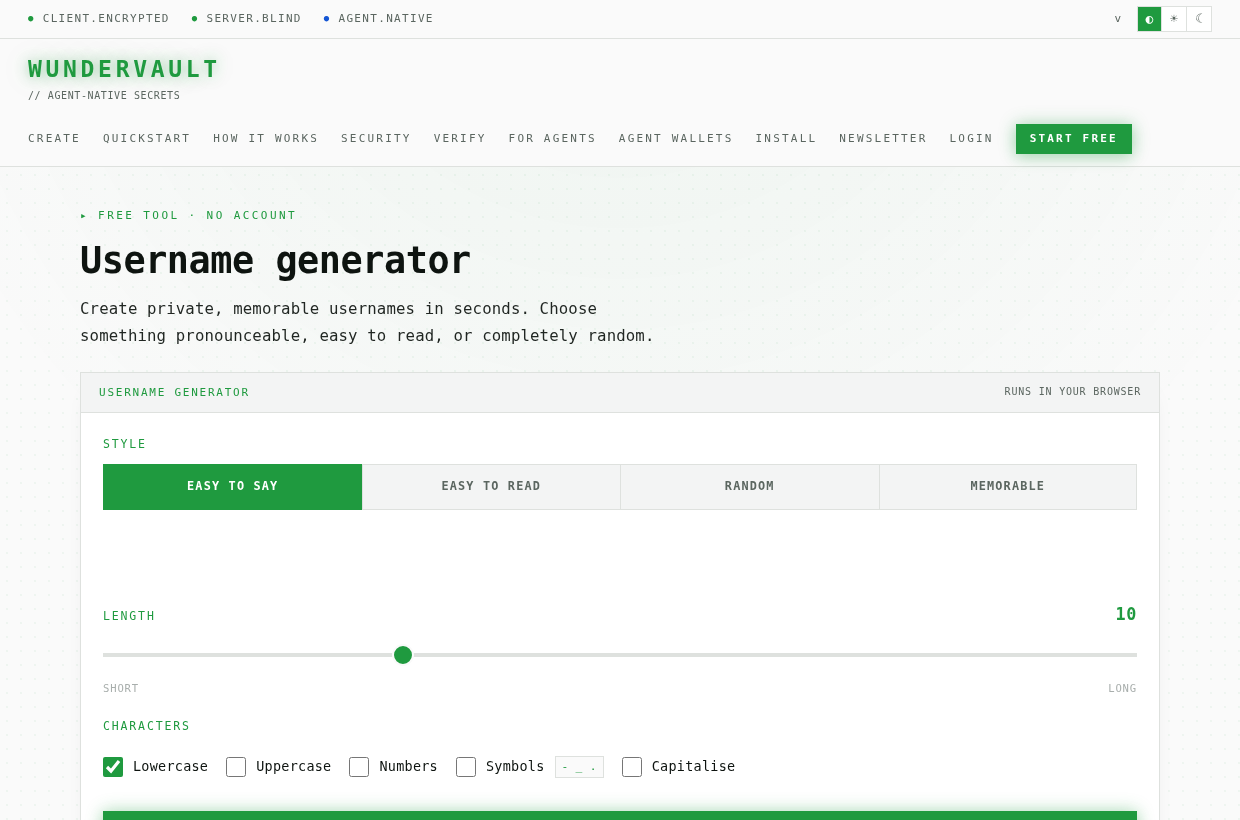
Where it started. One tall column, and you had to scroll past every control to see a single name.
The loop, one more time
I brought this up last week and I want to bang the drum again, because it is the whole reason a build like this comes out the other side usable. The loop is three moves and it repeats: something builds it against a written spec, a different model critiques it without being able to see the repo or run anything, and then I check every single finding against the real thing. That third move is the job. The reviewer is confidently wrong on a regular basis, and a round where I accept everything it says is a round where I did not actually look.
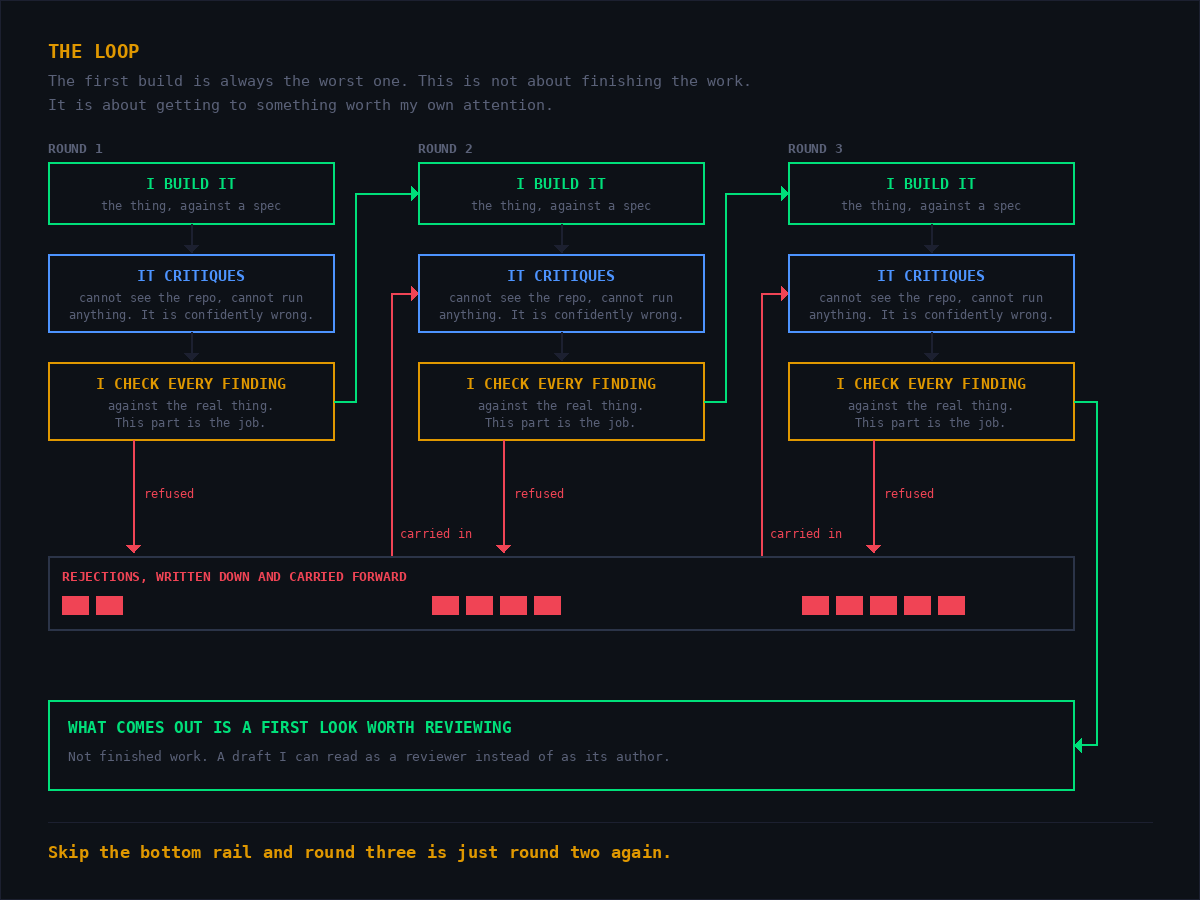
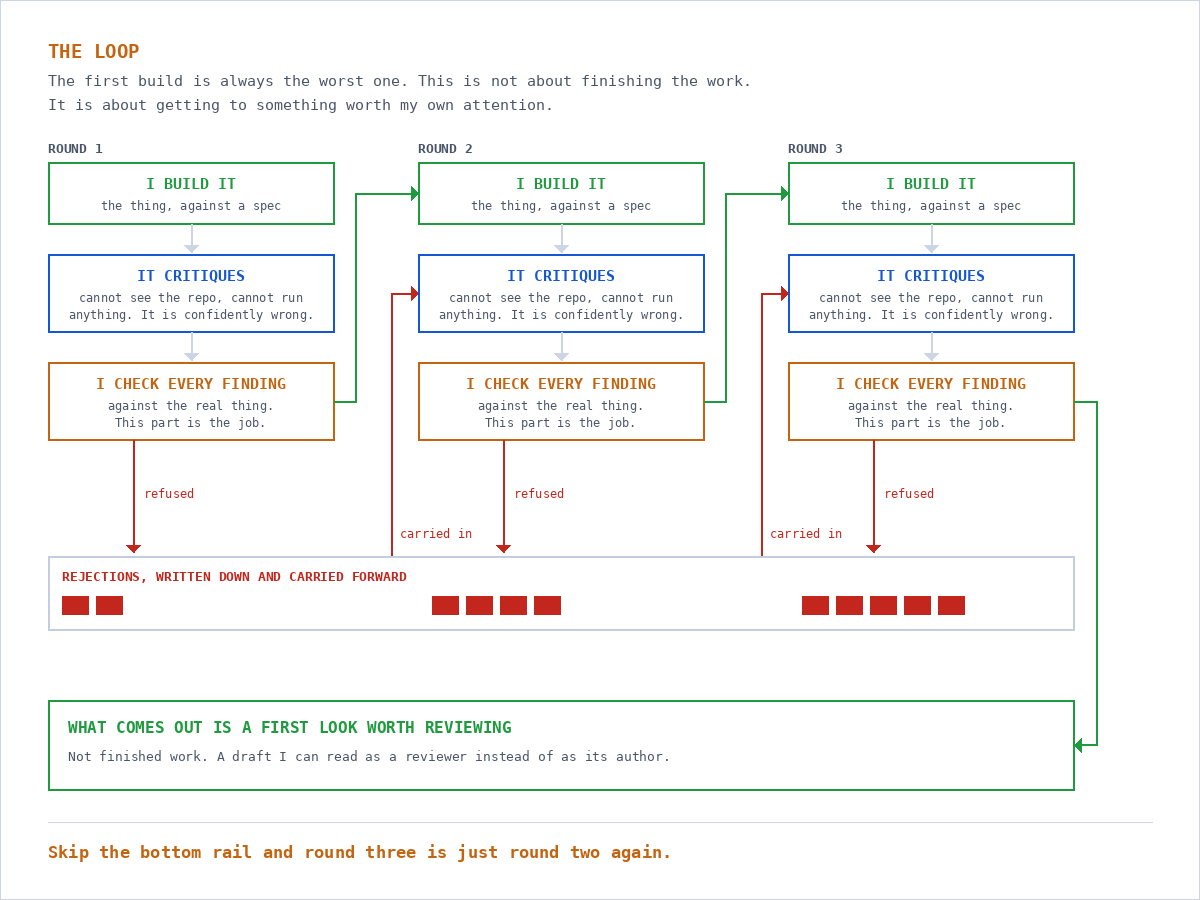
The same diagram from last week, because it is worth looking at twice.
The part people skip is the bottom rail. Write down what you rejected and why, and carry it into the next round. Skip that and round three is just round two again, with the same argument and the same three hours of your life. This is also why a one-shot project actually works: you are not asking one model to be right first time, you are asking two of them to disagree in front of you until the thing is worth your attention.
|
◆ Watch out · The review is not the reviewer Two rounds of automated review still ended with me doing my own round, and I found things. The loop is good at catching what a builder overlooked. It is not good at knowing what you wanted. |
That’s all for this week. Keep sending in your build requests, and be sure to check out this fun one. What should we build next?
“Why, sometimes I’ve believed as many as six impossible things before breakfast.”— The White Queen, Through the Looking-Glass