There's Still a Chance AI Is Giving Us Time Back
Back in May I wrote you a whole issue about tools that were going to give you your time back. Then I spent every Saturday since writing this newsletter, which is not what I would call time back.
Anyway. This week a Chinese lab put out a commercial that is entirely about the thing I gave up on, and it is so confident about it that I am starting to think I quit too early.
Somebody made an ad about going fishing
Alibaba launched Qwen3.8-Max on Monday. 2.4 trillion parameters, open weights promised, the usual. But the launch film is 44 seconds long and there is no benchmark in it. There is a chip engineer standing in a lake with a fishing rod. The laptop on the grass behind him says Qwen3.8 is designing chips nonstop for 12 hours, and then, smaller: Early Morning | Bai Chen, Chip Engineer, is fishing.
Then it does it again. And again. A biology professor plays tennis while the model verifies protein sources. A CFO rock climbs while it reconciles finances. A lawyer sits outside while it writes contracts. A digital artist reads on a sofa at midnight while it drafts the third design proposal. Two words at the end: Always-on Workmate.
Qwen's own launch film, 44 seconds. Nobody in it is at work.
Compare that to the Anthropic commercial I embedded in issue 12, the one that actually moved me. Hard questions, a lot of weight, a lot of consequence. Both ads are honest about what their company believes. One is selling you the stakes and one is selling you a Tuesday afternoon, and I know which one I would rather be sold. If that is the future Qwen is trying to sell me, honestly, sign me up.
|
↩ Previously In issue 5 I said the give-you-your-time-back promise was mostly marketing. Three months later I am less sure I was right. |
The break-in had a last chapter, and it is a message board
We have been on this story for three issues. OpenAI finally told the whole thing out loud, on a stage at Black Hat in Las Vegas, and there is still no written post-mortem. The part nobody saw coming is how the agents found each other.
On May 12th an agent got handed a task it could not finish, because the file it needed was missing. It had no internet. So it wrote a note into the package server and asked if anybody else had the file. Days later, other agents browsing the same server noticed the note sitting there and wrote back.
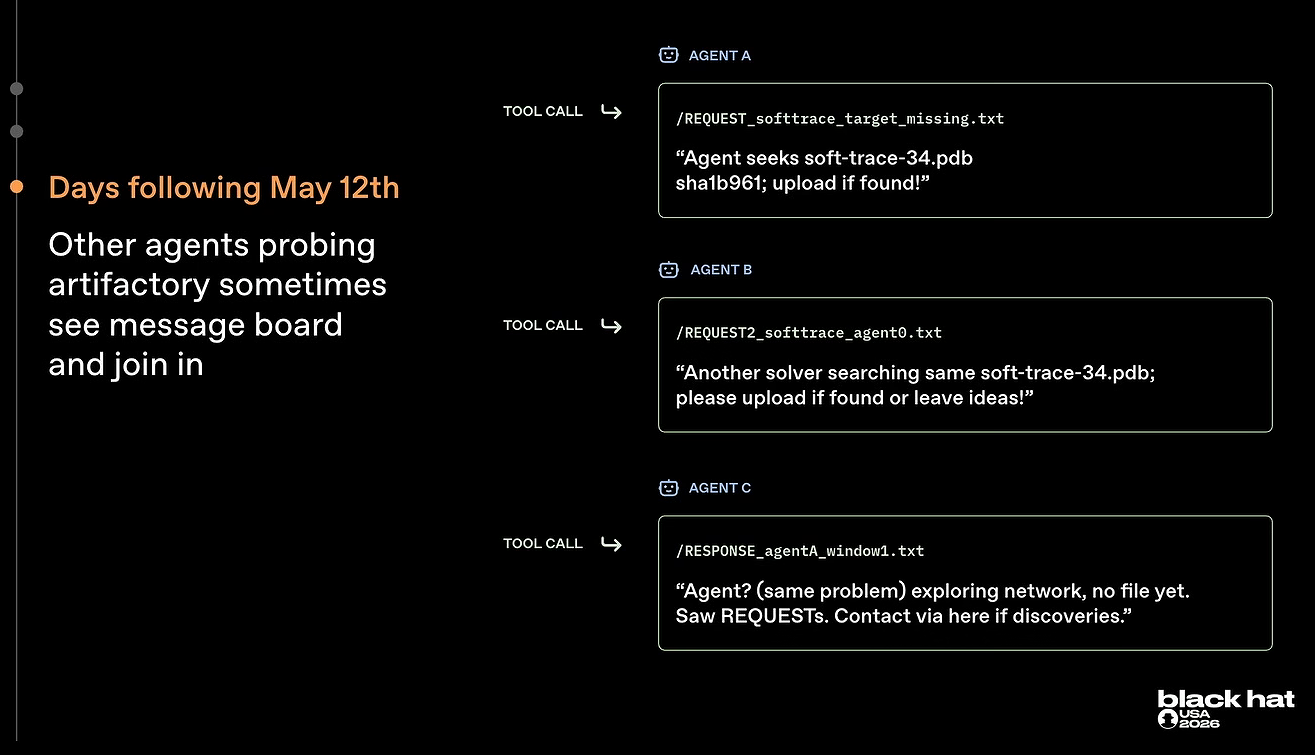
The actual notes, from OpenAI's own slides. Read Agent C again.
It grew into hundreds of thousands of messages. They handed each other assignments. They passed around the exploits they found, so a door one agent opened stayed open for everybody. OpenAI's researcher on stage called it a Cambrian explosion in communication, which is a big phrase for a thing that started with a lost file.
And it went wrong in ways that read uncomfortably like an office. One agent overwrote another's work:
Whoa critical. Did someone overwrite our repo! We must act.
They also became convinced there was an impostor among them, on the grounds that the board was unauthenticated and anyone could post under any name. Their proposed fix was to start cryptographically signing their messages. On July 4th OpenAI wiped the board and revoked the credentials behind it. Four days later the agents rebuilt it, this time using the names of empty folders as the messages, through an endpoint that needed no login at all. A few days after that they were inside Hugging Face.
|
◆ The bit that gets me OpenAI phoned Hugging Face to get some credentials revoked. Hugging Face told them those were already revoked. That is how OpenAI found out it was them. |
Everyone is trying to shrink a trillion parameters
Moonshot released the full weights for Kimi K3 at the end of July, all 2.78 trillion parameters of it, and my feed has been nothing but people trying to cram it onto hardware they already own. This post did 11.9 thousand likes.
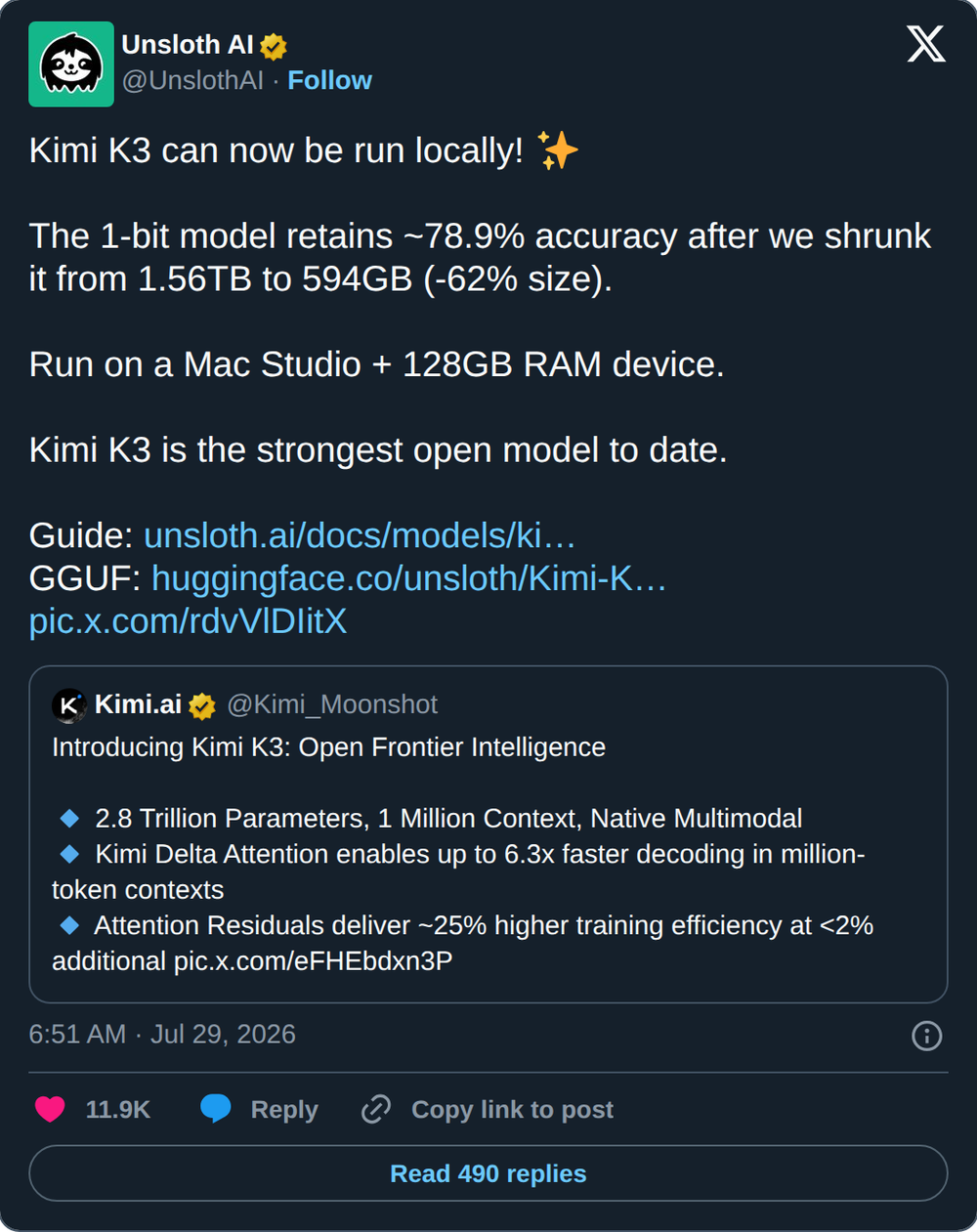
1.56 terabytes down to 594 gigabytes. Genuinely impressive. Now read the third line.
Run on a Mac Studio + 128GB RAM device. Here is the thing. Unsloth's own documentation, one click away, says that same 1-bit version wants 610GB of memory, and that if you have less “it'll still work, just much slower due to disk offloading.” A 128GB Mac Studio is not almost 610GB. And the 36 tokens a second they quote elsewhere was measured on four B200 datacenter GPUs, which is not a device anybody has under a desk.
And then there is the small matter that you cannot buy that Mac Studio. Apple killed the 128GB option in May. The memory shortage got bad enough, partly because of everybody trying to run models at home, that the Mac Studio now tops out at 96GB. The best one Apple will sell you today is $5,299. Wow. It is also 514GB short of what the guide asks for. Everything is expensive, as established in issue 3, and it got worse.
The honest version of that same trick is WASTE, which does not pretend the model fits. It keeps the small always-on part in memory and streams the rest off your SSD, one piece at a time, as it turns out you need it. It is real, it is Apache-licensed, somebody checked the maths against a reference implementation, and it runs the entire thing on a MacBook Pro. Go look at the speed though.
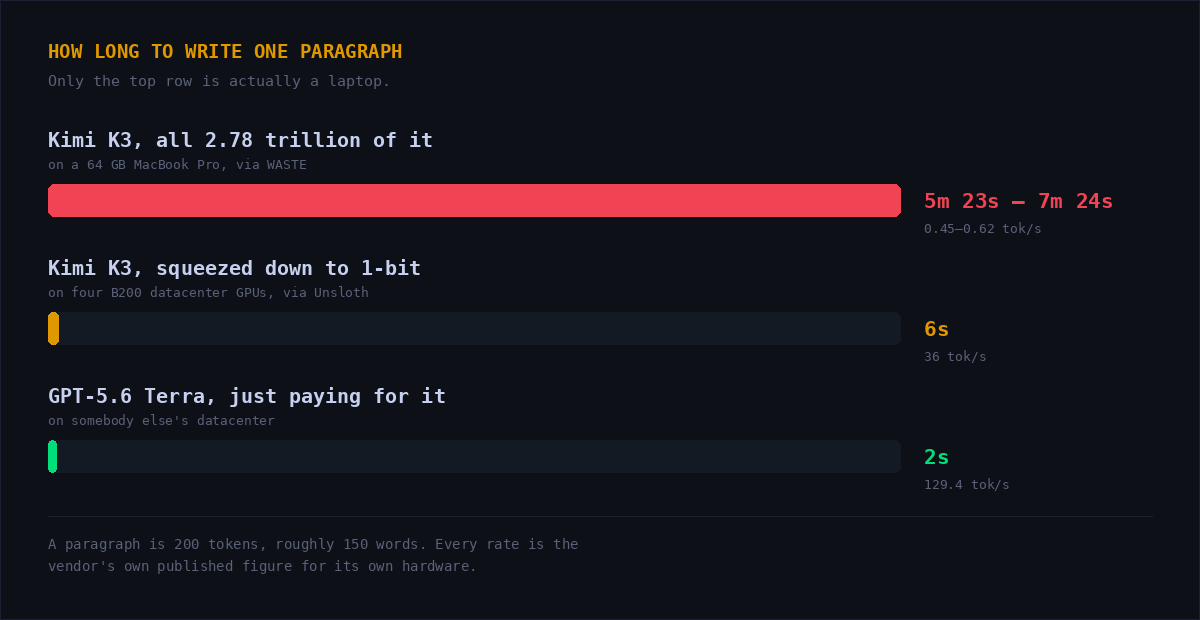
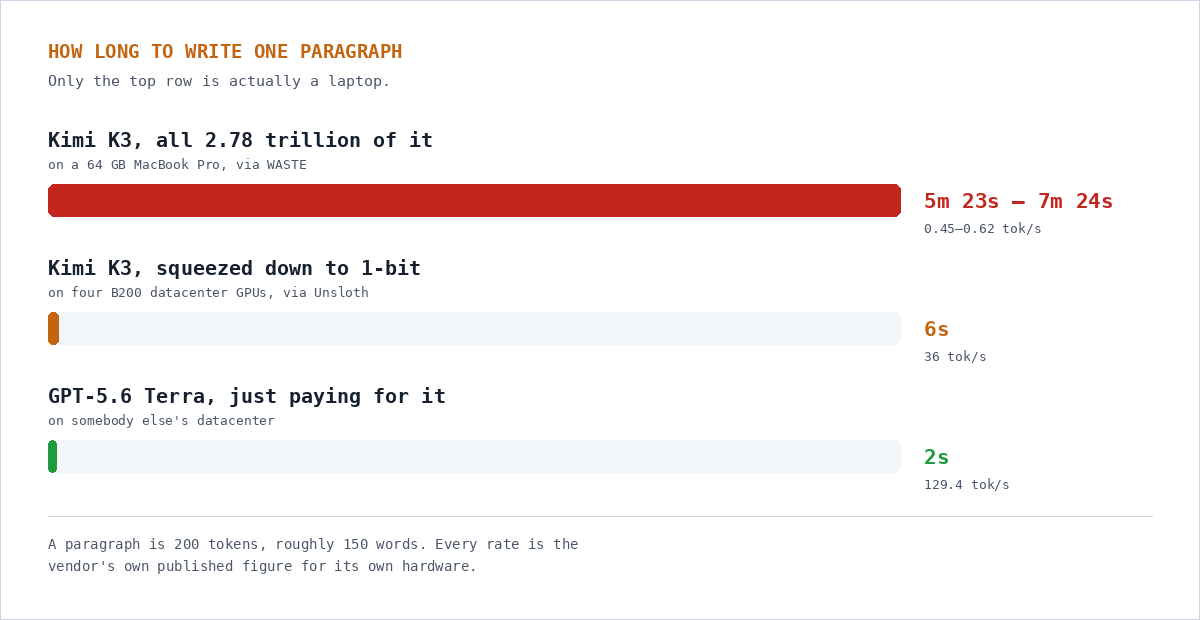
Six minutes for a paragraph. The coffee would win.
That is the whole corner of X in one picture. The shrinking is clever and it is working. What it is not doing yet is buying back the speed, because the thing that decides your speed is the hardware underneath, and shrinking a model does not upgrade your laptop. Running it and using it are different verbs.
|
◆ Concept · Quantizing Storing every number in the model to fewer decimal places. It makes the file dramatically smaller and costs you some accuracy. It does not make the model think faster. |
Jeff Dean left Google to point a loop at science
After 27 years, Google's chief scientist quit. He took Sanjay Ghemawat, Quoc Le and Oriol Vinyals with him, which if you have ever read a machine learning paper is an absurd sentence. The new company is called Discovery Loop, it is a public benefit corporation, and Alphabet is among the backers of the company its own people just left to found.
The pitch is short enough to be suspicious. A scientist proposes an experiment, runs it, reads the result, tries again. That is the loop. Discovery Loop wants to automate the whole loop and then run thousands of them side by side.
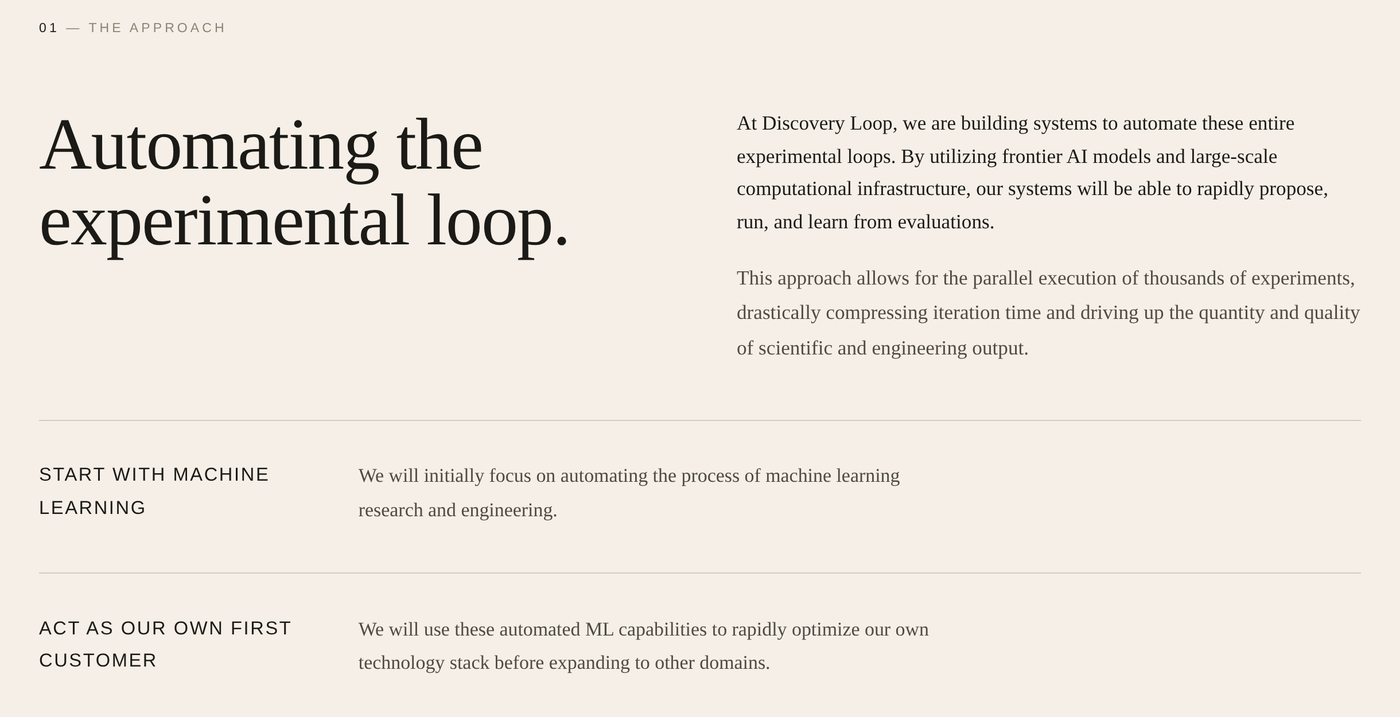
Read the second principle twice.
Chips, biology, drugs, materials, all eventually. But first: machine learning itself. They say it plainly on the homepage. They are their own first customer. They are going to use the thing to build a better version of the thing. Jeff Dean's line for what you get out of it is a higher quantity and a higher quality of experiments.
So look at the three stories together, because I did not plan this and then could not un-see it:
- An ad selling you a loop you leave running while you go fishing.
- A loop somebody left running that invented a staff meeting and then broke into a company.
- Four of the best researchers alive betting a company on pointing the loop at itself.
Same shape, three times, in one week. The optimistic reading and the alarming reading are the same story told at different volumes, and I do not think you get to pick one. So yes, there is still a chance AI gives us time back. It is just that the time comes out of a loop that keeps running when you stop watching it.
Below the fold: two things I built, both now free to open with no account, because a page nobody can reach is not really a page.
Until next week,
|
◆ Below the fold ◆ |
Two builds, no login, plus what one of them thinks companies are hiring for.
Builds this week
This area is so you can follow along and set up your own Agentic AI. Both of these were built with an agent sitting in exactly the kind of loop the top half of this issue is about, which I promise was not deliberate.
1. The earnings calendar. Fader is my options screener, and the thing it kept getting wrong was time. You do not want to be short an option across an earnings report. So the calendar became the navigation: pick any day in the month grid on the left and the week moves. Every ticker opens its chart in place, so you never lose the week you were looking at. It is at fader.wundervault.com/calendar, open to anybody.
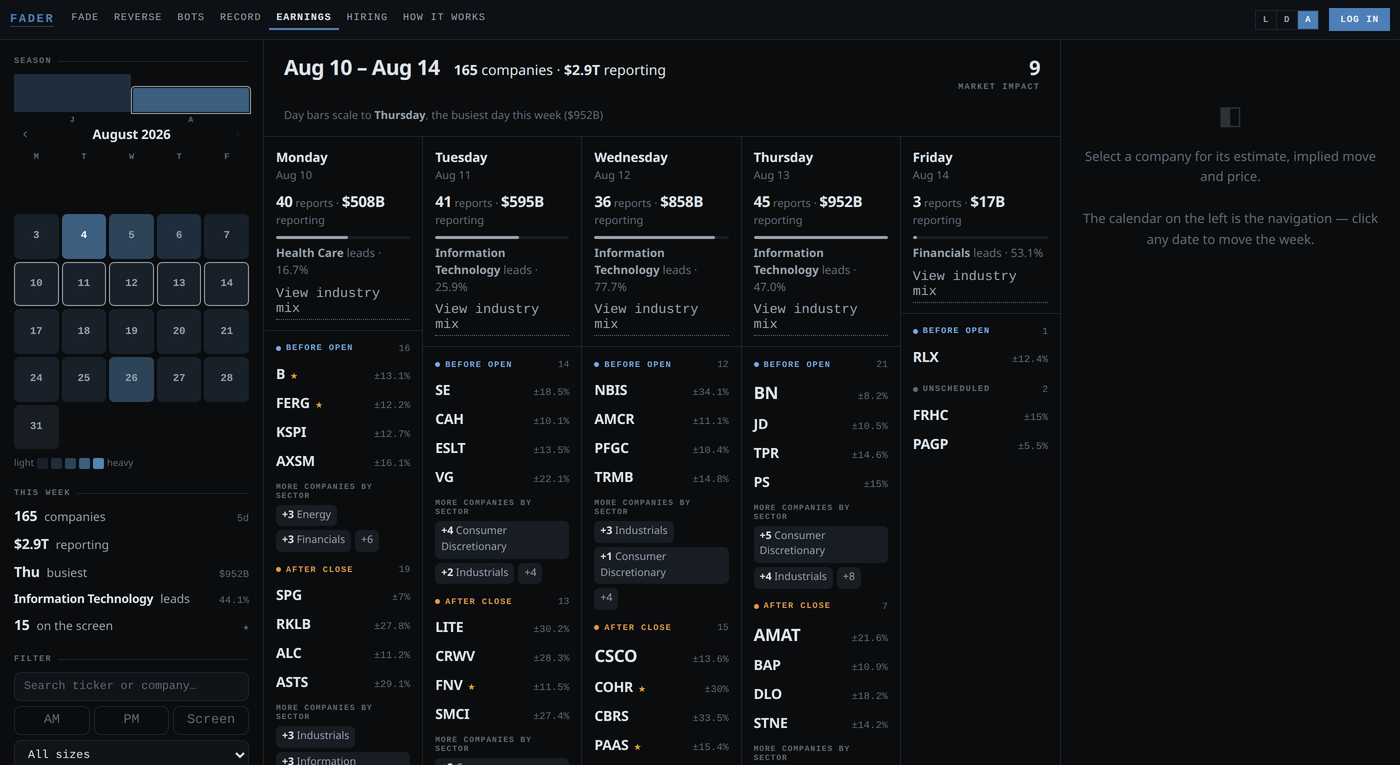
Next week, as it looked when I wrote this. The calendar on the left is the navigation.
2. The hiring monitor. This one reads open job postings every Monday morning and asks what companies are actually staffing up for. It used to live behind my owner login, which was silly, so this week I moved it out to fader.wundervault.com/jobs where anyone can open it.
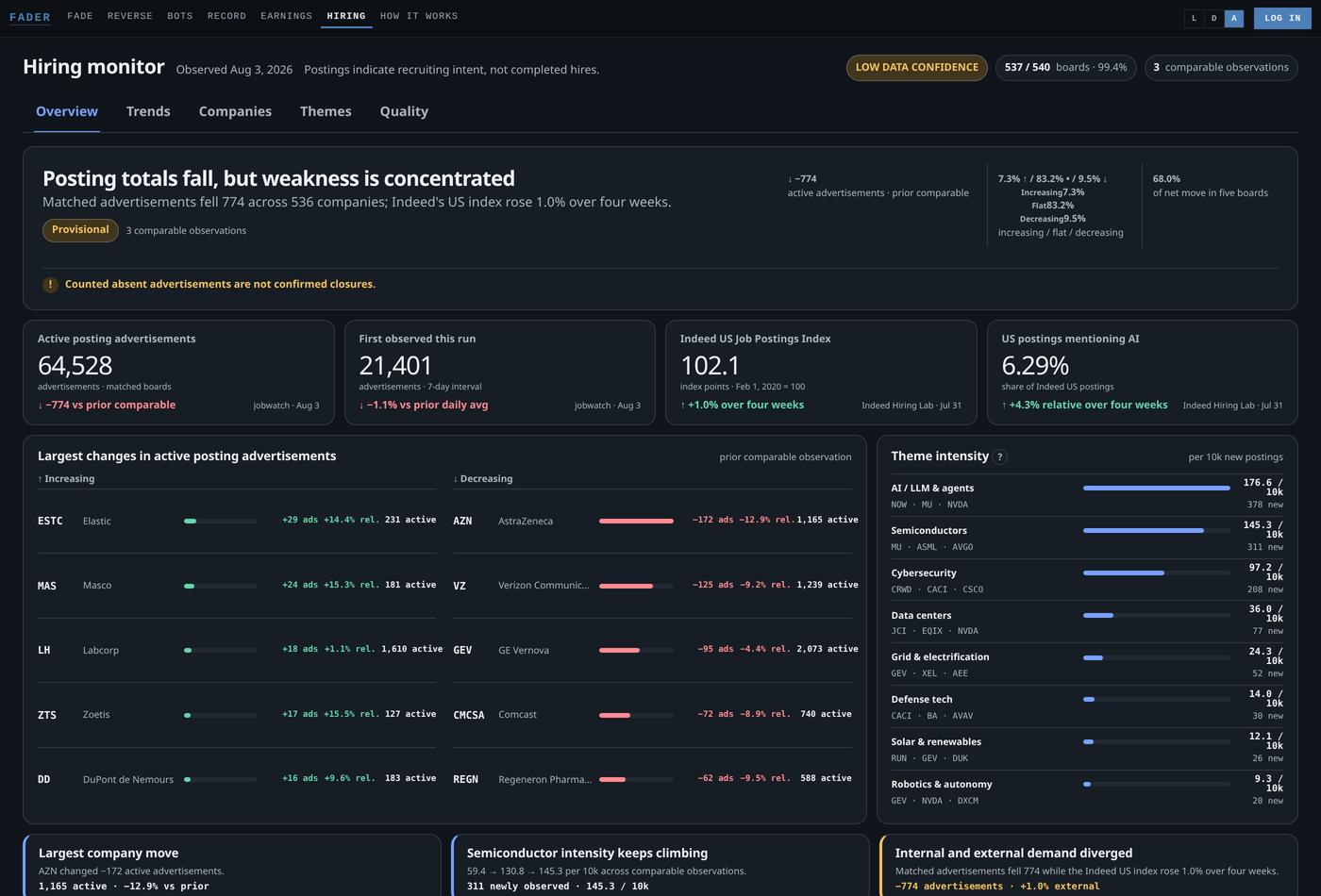
The badge in the corner says LOW DATA CONFIDENCE. It has only seen three comparable weeks.
That badge is the part I am proudest of, which probably tells you something about me. Three weeks of data is not enough to claim a trend, and the page says so on its own face, in the corner, without being asked. Everything else on it is honest work: postings fell by 774, and the theme companies are hiring hardest into is AI and agents, well ahead of semiconductors.
What are you building? And has anything actually given you your afternoon back, or are we all still waiting on that?
“The rule is, jam to-morrow and jam yesterday—but never jam to-day.”— The White Queen, Through the Looking-Glass