What Is It Good For?
War, huh, yeah. What is it good for? Absolutely nothing. AI writing, huh, yeah. What is it good for? Absolutely everything.
Welcome to the Wundervault Weekly extended edition, which is what I am calling it because it is landing late on a Sunday night, or Monday morning depending on where you are reading. It is late, I know, and I am sorry. I could have skipped a week and nobody would have sent me a strongly worded letter. I didn't, because there is just too much going on right now.
The thing I want to talk about is AI in writing, and it came up twice this week. Once over a conversation with a professor, and once in the pages of the Wall Street Journal. The two conversations were the same conversation, which is why you are getting both.
|
↩ Previously Back in issue 11 I stopped and made a confession in the middle of the page: “I don’t write every word of this newsletter by hand anymore. I use AI to help me (I know, I know, sigh).” Hold onto that, we are coming back to it. |
So how can you tell?
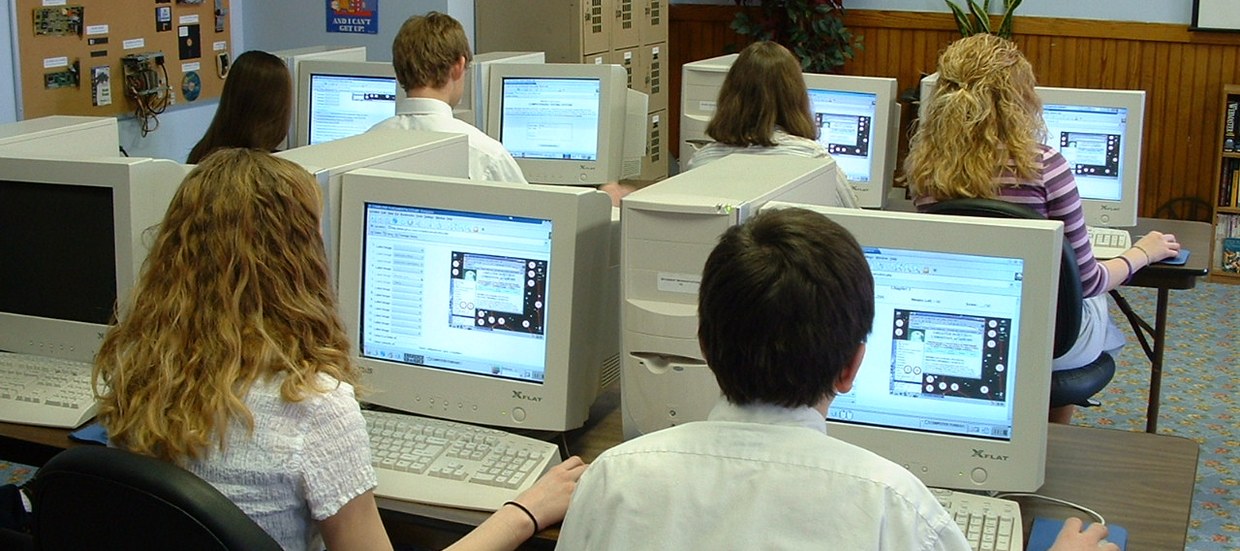
The machines got better. The assignment did not change. Photo by Michael Surran, CC BY-SA 2.0.

The professor's complaint was that his students are turning in homework the students did not write. His question was direct: “How can I tell if they are actually writing it?” And the direct answer is that yes, there are tools, and some of them are genuinely good now.
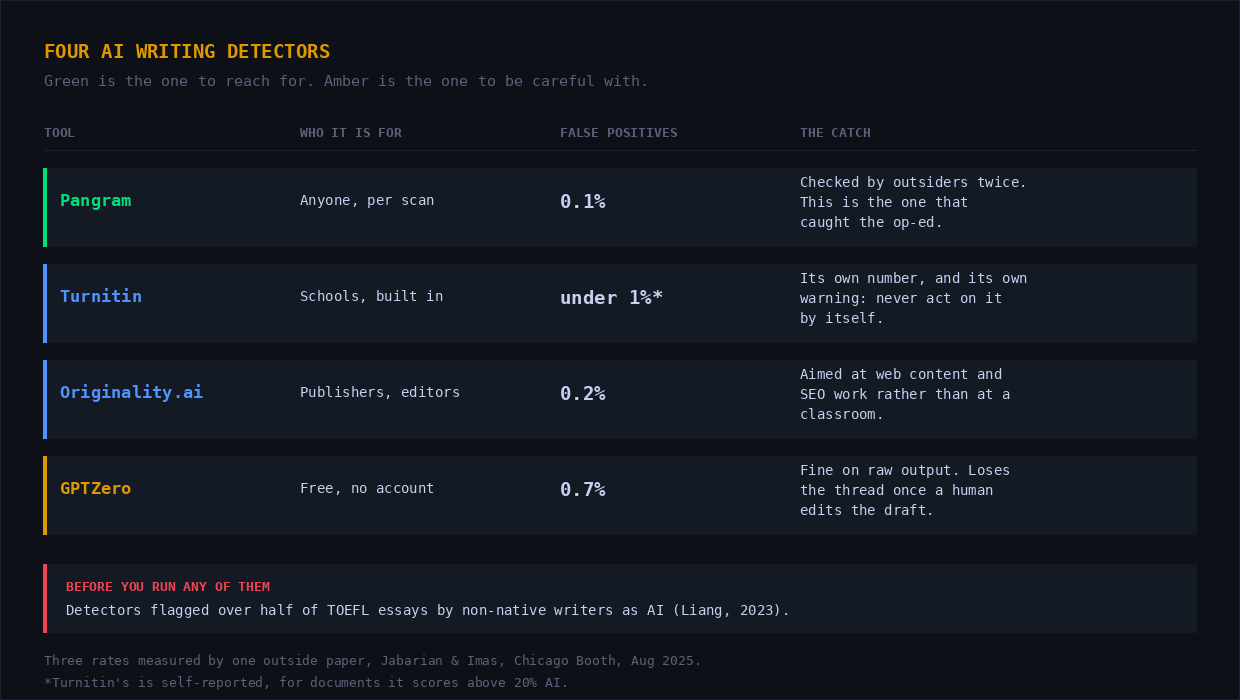
Pangram · Turnitin · Originality.ai · GPTZero
If you only take one of those, take Pangram, and take it because somebody outside the company actually went and tested it against nearly two thousand human texts written before 2020 and the same number of machine ones. That matters more than the marketing number, and it is rare in this category. Turnitin is the one your school probably already pays for, and it is also the one that tells you, in its own documentation, not to punish a student on its say-so alone.
Read the red bar on that chart before you run a single scan. In 2023 a Stanford group fed seven detectors a pile of TOEFL essays written by non-native English speakers. More than half came back flagged as AI. The same detectors were nearly perfect on essays by American eighth graders. Plainer sentences and a smaller vocabulary read, to a machine, exactly like a machine. Detectors have improved a lot since then. That failure mode has not gone anywhere, and it lands hardest on the students least able to argue back.
That was not the actual question
Anyway, the tools were never the real conversation. Underneath the question was a much more human sentence: “I don't like this thing that has upended how I assign and critique work. I want to hear what my students have to say, not what the AI has to say.” And the first instinct, every time, is to ban it. I declare that nobody in my class may use AI.
That is a losing battle, and worse, it is the wrong battle. This is a tool the current generation has to know how to use, the way we all had to learn a search engine and then had to learn that the first result is a liar. What I put to him instead was that you have to take the assignment apart before you can defend it. Ask what it was ever actually for:
- Is it an exercise in creativity?
- Is it a skill that needs the reps, like a scale on a piano?
- Is it memorization and regurgitation?
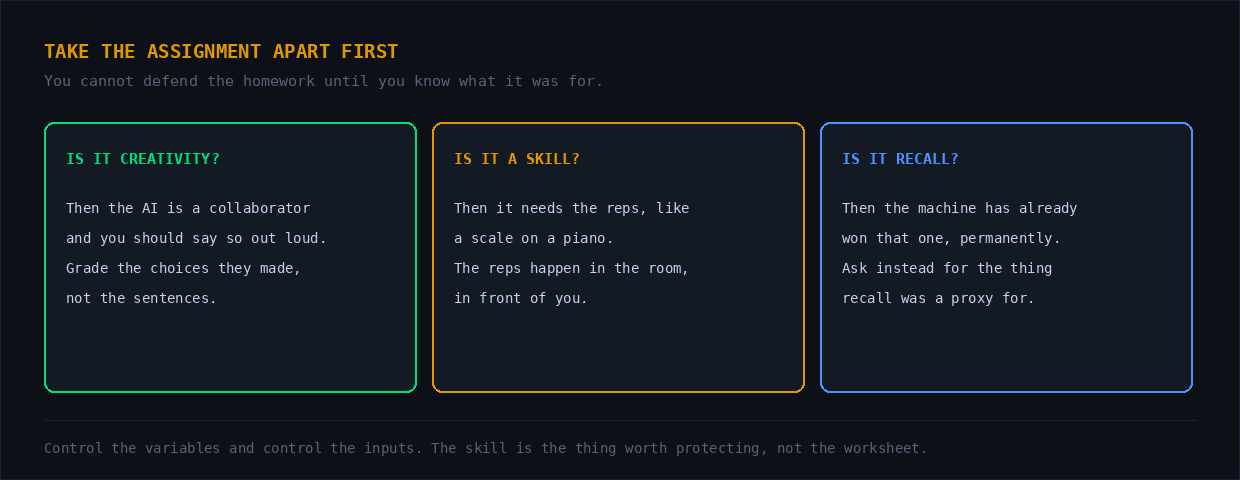
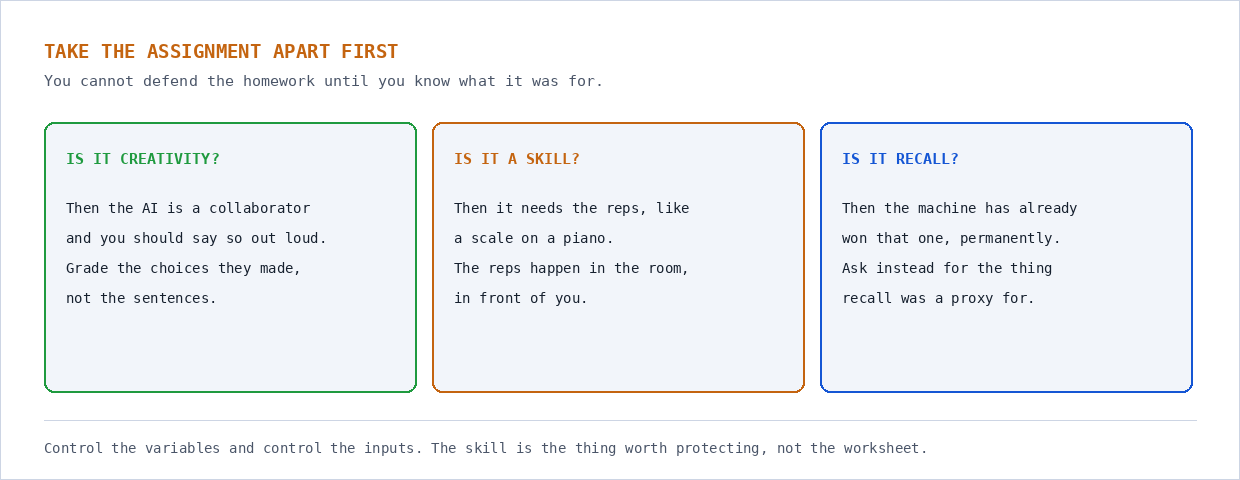
Whatever the answer is, that skill is the thing worth protecting, and the homework is just the container it arrived in. Control the variables and control the inputs. If the skill needs reps, the reps happen in the room, in front of you, and you grade the reps. If the skill is building an argument, let them use every tool on earth and grade them on defending it out loud. We cannot keep assigning homework the way we did, because we do not live in that world anymore. (Nobody asked me, and I am telling you anyway.)
Throwing shade with AI

The building that started the argument. Photo by Carol M. Highsmith, Library of Congress, public domain.

Which brings me to the second conversation, and it is a much funnier one. On Monday the Wall Street Journal ran an op-ed called Let the Bond Market Speak, by Stanley Druckenmiller, arguing that the Treasury doubling its long-dated bond buybacks was an attempt to hold the price down dressed up as routine plumbing.
|
◆ Who · Stanley Druckenmiller 73 years old. Founded Duquesne Capital in 1981 and ran it for about thirty years without a losing year, closing it in 2010 with over $12 billion under management. Ran George Soros’s Quantum Fund from 1988 to 2000, which is the seat he was in for the 1992 trade against the pound that people still bring up at parties. Now runs the Duquesne Family Office. And the Treasury Secretary he is going after in this op-ed, Scott Bessent, used to work for him. This is a man writing about his own protégé. |
The piece is good. The piece is also, unmistakably, machine-shaped. It reaches for that this-wasn't-X-it-was-Y construction that AI cannot leave alone, and it does it right at the emotional peak:
“The market’s verdict was swift and correct: This wasn’t liquidity management, it was price management, and a mistake far larger than $4 billion suggests.”
X noticed inside of a day. The economist Claudia Sahm ran the whole thing through Pangram and posted the reading, and the reading was not subtle:
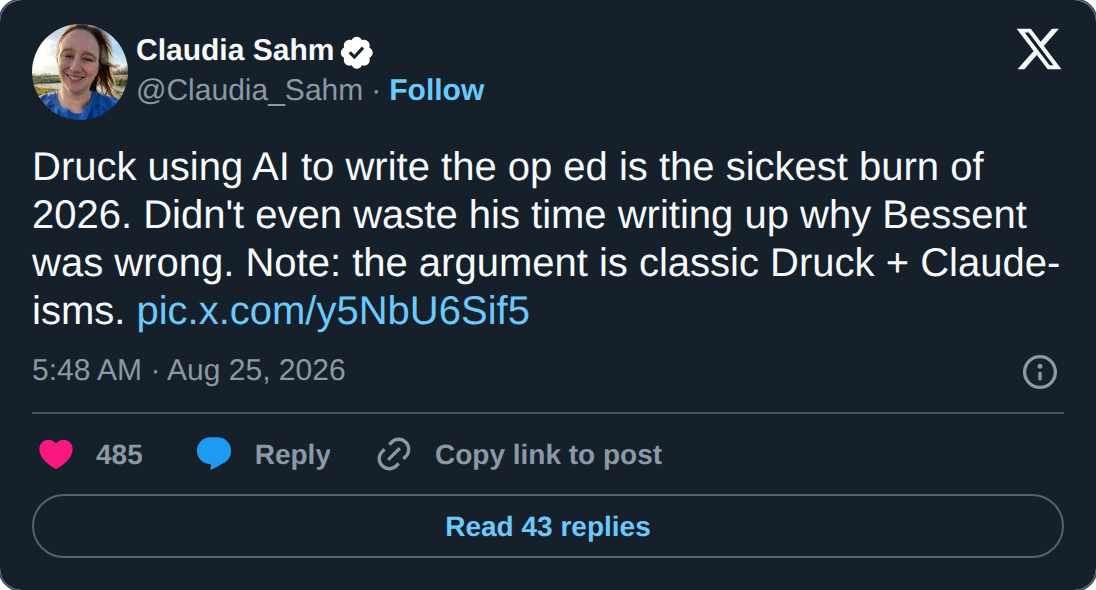
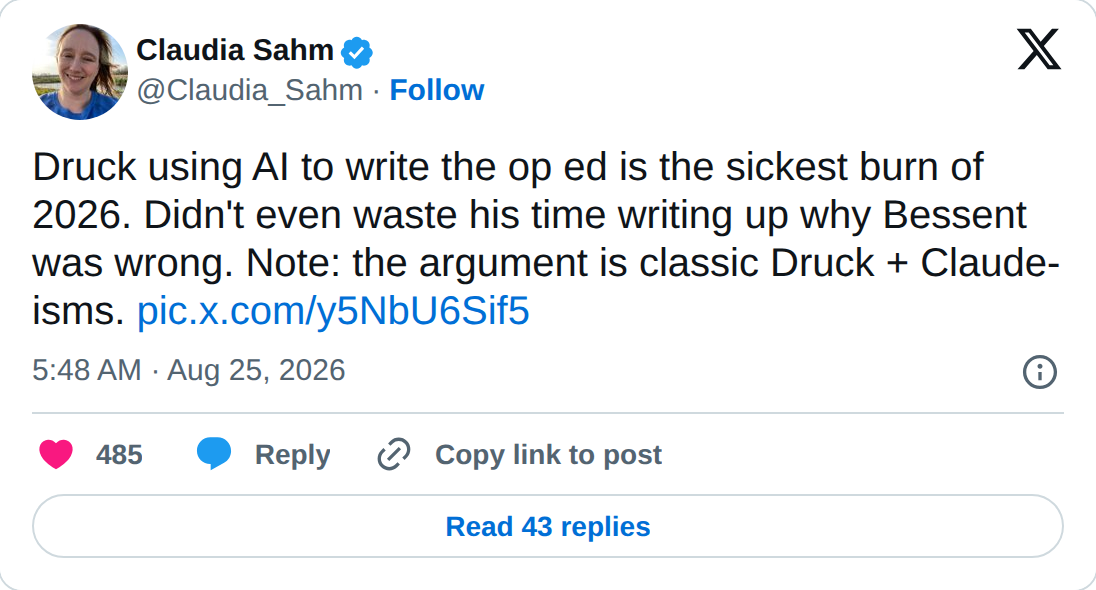
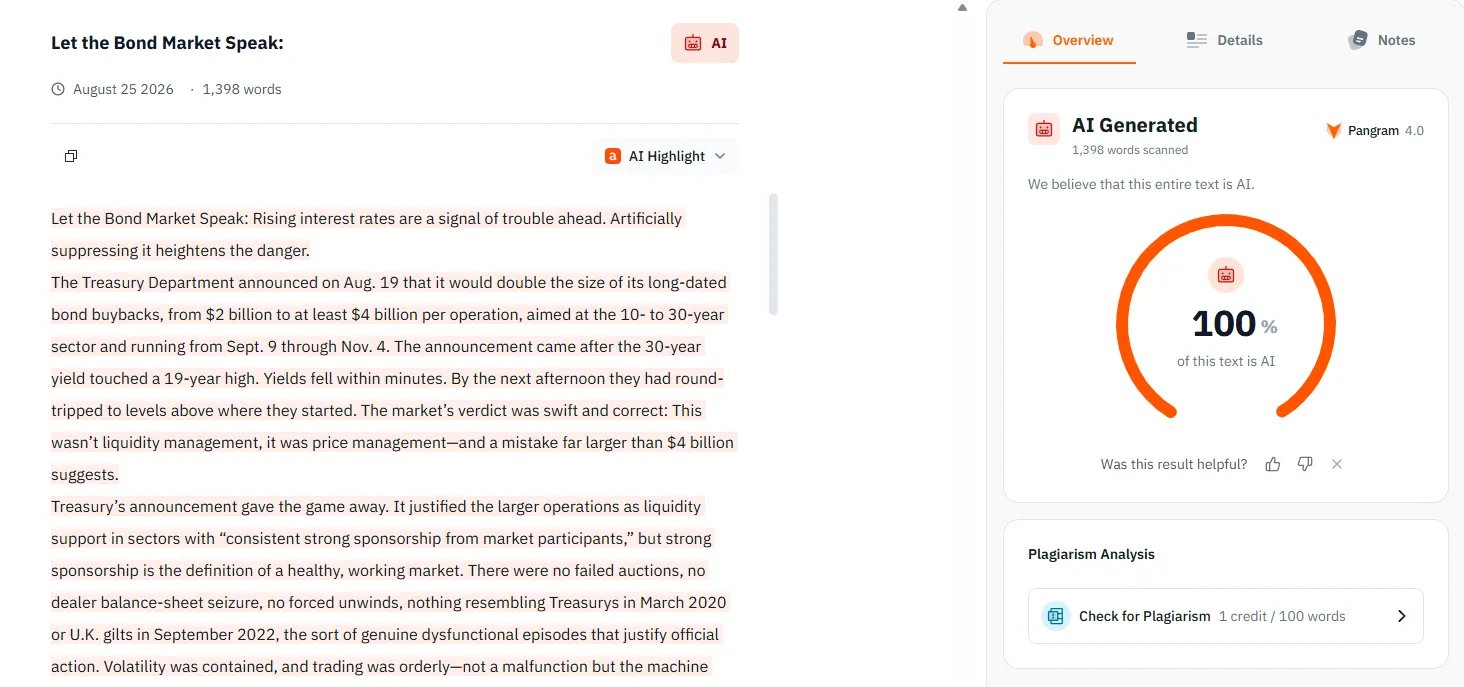
1,398 words scanned. “We believe that this entire text is AI.” The screenshot Sahm posted, and the whole story in one dial.
Now, the fun part. He didn't deny it, didn't lawyer it, and didn't quietly append a disclosure at the bottom. He told a reporter “of course” he used AI, and then went further and said he was kind of proud of it at 73. His argument is that he writes everything with AI now for the same reason he uses a calculator to do math, which, credit where it is due, is a hell of a line. My favourite bit is the shrug that came after it: “I was a B student in English, but an A+ in economics.” And then the Journal, which I truly did not see coming, stood behind him without hedging a syllable. Its opinion editor Paul Gigot put out a statement:
“AI is a fact of modern life. The question for us is whether what we publish from contributors reflects an author’s original argument, and if the author has the standing and credibility to make it. In Stan Druckenmiller’s case, we have had a relationship with him for many years, and nobody can doubt that his op-ed is his genuine opinion.”
Finance X, meanwhile, split clean down the middle and stayed there. Jason Calacanis called it unforgivable to publish an AI-written piece without a disclosure in the first sentence. His own podcast co-host went the opposite way on the same day, and did it with a phrase I have not been able to shake:
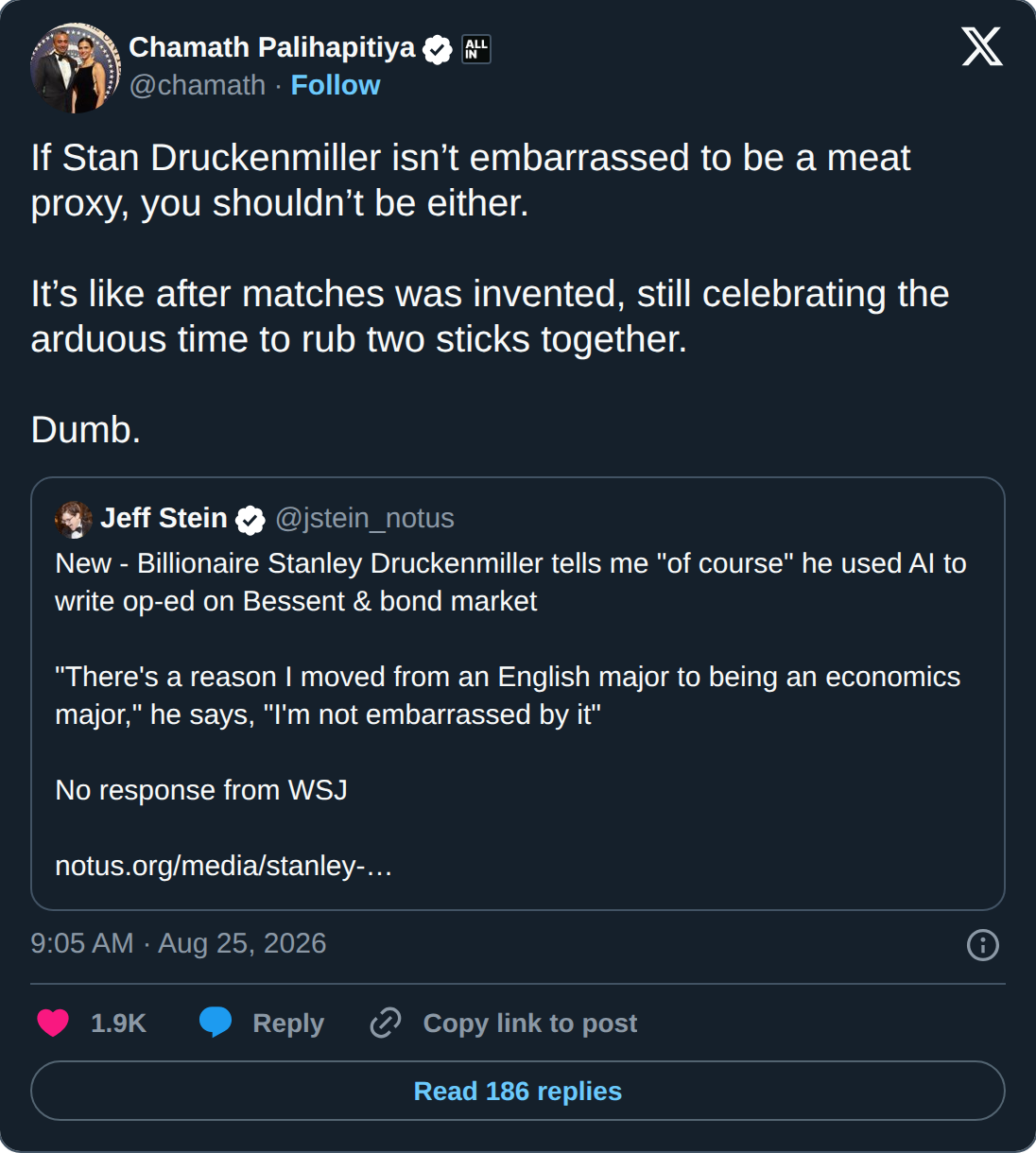
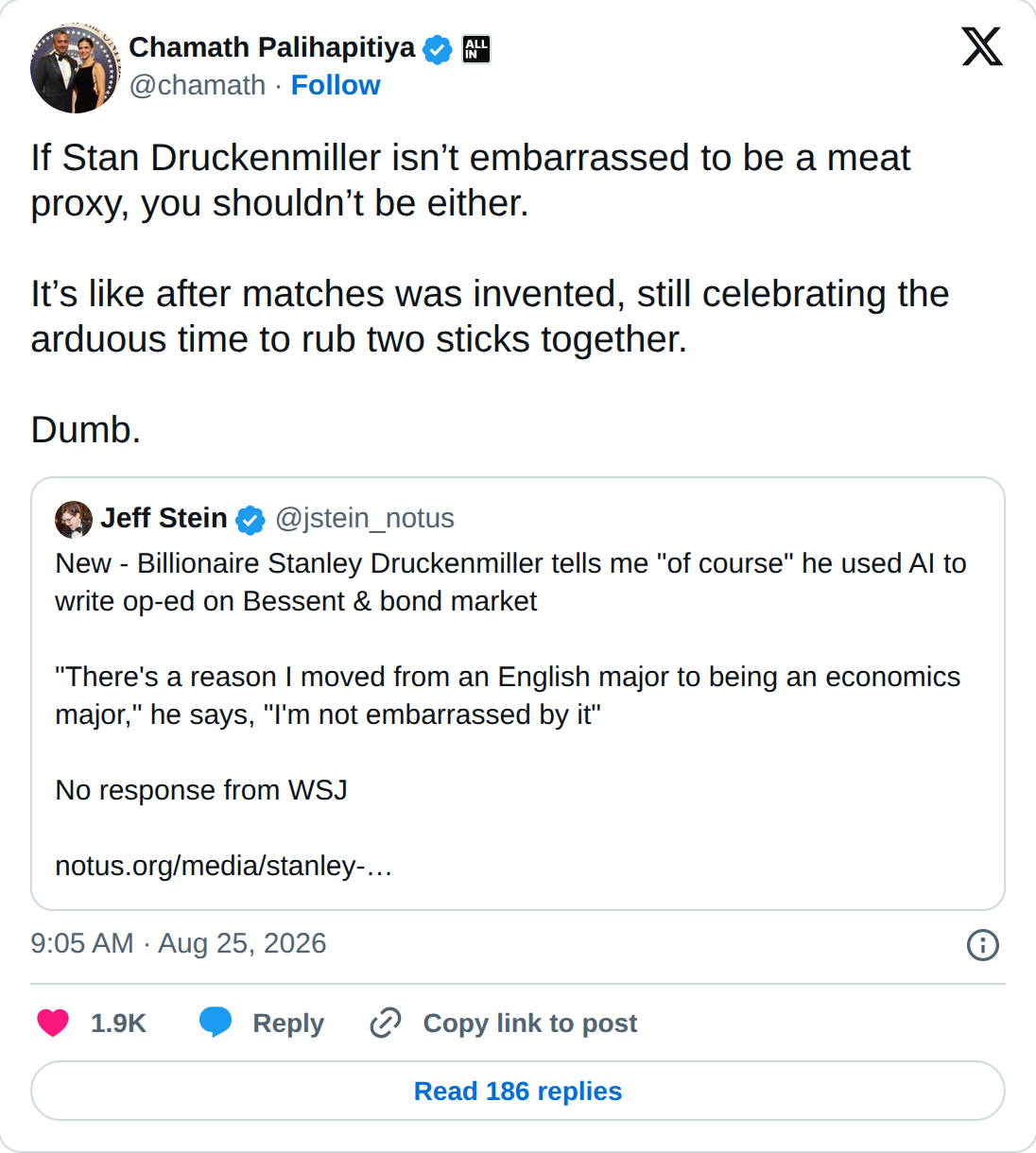
A meat proxy. That is you and me, reader.
The world we live in
So this is it. This is the world we live in. Nobody chose it or designed it, and controlling it was never on the menu. AI writing is here and it is staying, whether you like it or not, and I will tell you plainly that I don't love it.
Which is the point where I owe you the same admission Druckenmiller made, because I do not fully write this newsletter either. I have said it before and I am saying it again in one place, plainly. I write several hundred words, raw and unedited, and those words carry the ideas, the order and the opinions. I hand them to Claude along with a voice file built out of my own early issues, back when I wrote every single word myself, and that file is what keeps the tone from drifting into corporate mush. Some weeks it lands better than others. It keeps getting better.
What comes back is around two thousand words, with the charts drawn, the links found, the photographs gone and fetched, and every number checked against somewhere I can go and look. Then I read it and send it back, and we do that until I stop finding things. The stories are mine because I picked them. Plenty of the sentences are not. Wundervault Weekly is a newsletter about AI, and about building with AI, and I am okay with that. This thing is ethereal anyway. It is a blip on your Saturday. You might skim it, you might go deep on one section, and then it is gone. That is fine, that is what it is for.
So, reader: stick with me, or move on if this is not authentically human enough for you. No hard feelings either way. But if your goal is a life with no AI writing in it, I have some bad news about the world, and this newsletter is the least of your problems.
And like nearly everything else around here, none of it happens without the AI. My last real attempt at a newsletter, before this one, made it about six issues before it quietly died on a Tuesday. Here we are at 19 issues. Wow.
Somebody was furious about this once too. Photo by Petar Milošević, CC BY-SA 4.0.
.jpg)
Should you go experiment with AI writing? You probably should. Just do better than Druckenmiller. Make the piece uniquely yours, have a style, put your essence in it somewhere a detector could never find and a reader always will.
Until next week, readers, and thank you as always for sending this to the people you think will like it. Below the fold I am opening the whole thing up: the actual files, the actual rules, the actual software, and a measurement of exactly how much of this issue was me and how much was not. If you have ever wondered what the seam looks like from the inside, that is the next screen.
|
◆ Below the fold ◆ |
The whole assembly line, and the receipts on how much of it is mine.
Come look at the workshop
I just spent two thousand words telling you I use AI to write this. It would be pretty weak to leave it there, so here is the whole machine. You can build this yourself in a weekend. None of it is clever.
Start with the shape. Green is written by hand. Blue is generated. Amber is where somebody checks the work.
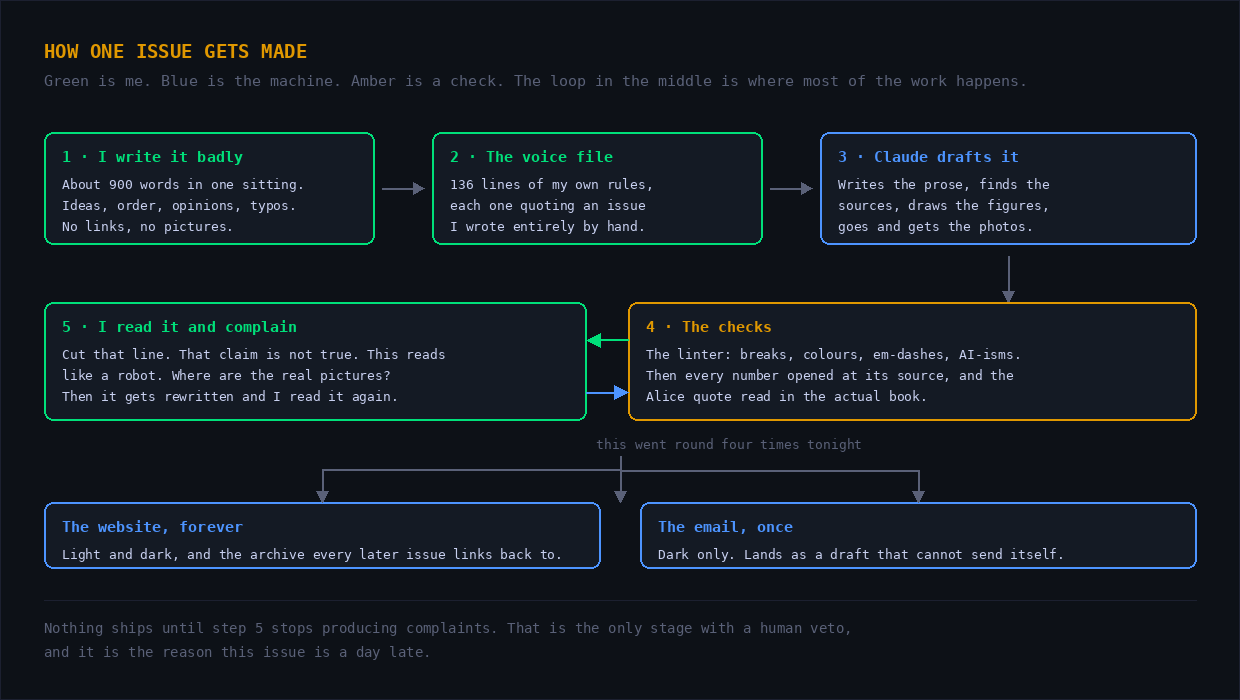
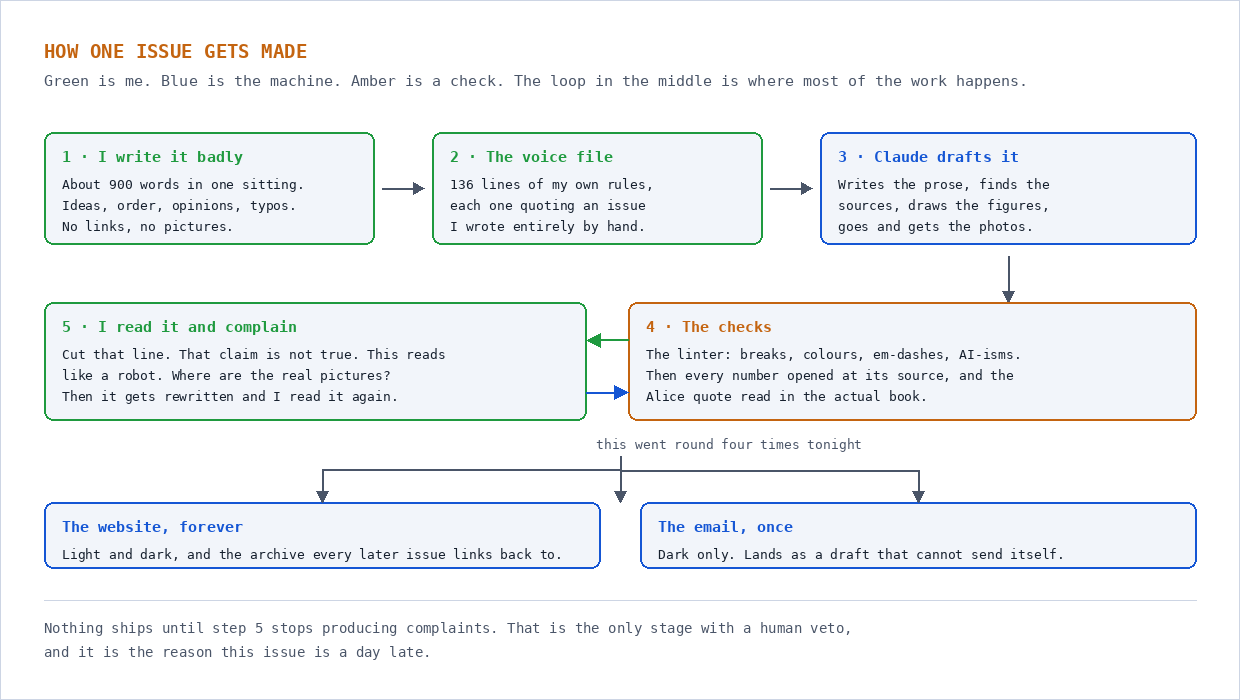
An issue lives in three files in a folder, and that is genuinely all of it. One holds the writing. One holds a line for every factual claim, with the link and the date it was checked. One holds the boring stuff, the subject line and the date and the web address.
Step 5 is the whole job
Look at that box in the middle of the diagram again, the one with the arrows going both ways. That is the part people leave out when they talk about writing with AI, and it is the only part with a veto. The draft comes back, I read it, and I send it back with complaints. Then I read it again.
I am not going to paraphrase what that sounds like, because you can just have tonight's, roughly in order:
- Do we check this thing for AI-isms? If not, build that.
- I don't want to ration it. Ban it.
- This section is cumbersome. Make it friendlier.
- You say I draw the charts. That is false. Take it out.
- You quoted the wrong issue. The confession is in a later one, go find it.
- There are no actual photographs in here. Find a way to source real ones.
- Too many posts from X. Cut the ones that are not carrying anything.
Every one of those changed what you just read. The wrong-issue one is my favourite, because it was a real error of fact about my own newsletter and no checker on earth would have caught it. It needed somebody who remembered writing the thing.
So when I say I use AI to write this, the honest version is: the machine does the typing and the fetching, and I do the deciding, over and over, until it stops being wrong. That is slower than people imagine. It is also the reason you are reading this on a Monday.
The voice file, which is the whole trick
If you steal one thing from this issue, steal this. Everybody tells their AI to “write in my voice” and then gets annoyed when it doesn't. Nobody can act on an adjective. So my voice file contains no adjectives. It contains rules, and every rule quotes a line from an issue I wrote entirely by hand, as evidence that I really do talk that way.
Here is roughly what is in there. It is more boring and more specific than people expect:
- How to sound like me. Talk to one reader. Open on a hook that is not yet the topic. Take analogies from ordinary life and never from tech. Admit the seams. And leave the asides alone: the parentheticals, the caps, the odd “damn”. Smoothing those out makes it more professional and less mine.
- Links. Link everything nameable. Every tool, paper, company and post. A bare web address sitting in the text is always wrong, so the link goes on a word instead. And every issue calls back to an earlier one and links it, which is why there is a “Previously” box near the top of this one.
- Pictures. Every chart gets built twice, once for the dark site and once for the light one, because a chart made of dark-mode colours is unreadable on white. Photographs come from Wikimedia Commons so the licence is real and the credit goes under the picture, which is the rule I care most about here. Videos play on the site rather than sending you to someone else's.
- Breaking up the page. Never more than 500 words without something interrupting, and at least four different kinds of interruption per issue. A heading, a picture, a pulled-out box, a quote, a list. Eight issues in a row once used only headings and pictures, and every one of them felt longer than it was.
- Colour in the text. At least half the paragraphs carry a coloured phrase, pulled from four house colours and no others. This one is at 80%.
- The bans. No em-dashes. None. You have read this far without one and it was not free. No announcing what you are about to say instead of saying it. And as of tonight, no AI-isms.
Writing this issue cost me a sentence
Writing the top half made it impossible not to ask the obvious question, so on Sunday night I had a sweep for AI-isms built into the checker. Not from a listicle of words that sound robotic. We ran every candidate phrase against all eighteen previous issues, split into the ones I wrote by hand and the ones I have been drafting this way, and threw out any rule that fired on my own writing.
Three rules died on the spot. My favourite was “harness”, which appears five times in my early issues, because an agent harness is a real piece of software and not a robot writing a brochure. What survived is thirty-eight phrases that have never once appeared here in thirty-four thousand words. Those now stop the build.
Then it turned the mirror around, which is the bit that stung. That construction I spent the whole top half of this issue mocking Druckenmiller for? We do it too. I use it about once an issue. Issue 14 used it eight times. The first draft of tonight's used it three. So I have banned it outright, and it is going to cost me a real sentence every few weeks, and that is fine.
|
◆ The part no script does A checker counts things. It will happily wave through an issue full of confident nonsense. So every number in here got opened at its source by hand, and the Alice quote at the bottom got read in the actual book. We learned that one the hard way: issue 9 closed on a Carroll line that is all over the internet and appears in neither book. If you build one of these, build the habit first and the checker second. |
The receipts
Here is the honest measurement. What I sent on the left, what shipped on the right. I did not round anything in a flattering direction.
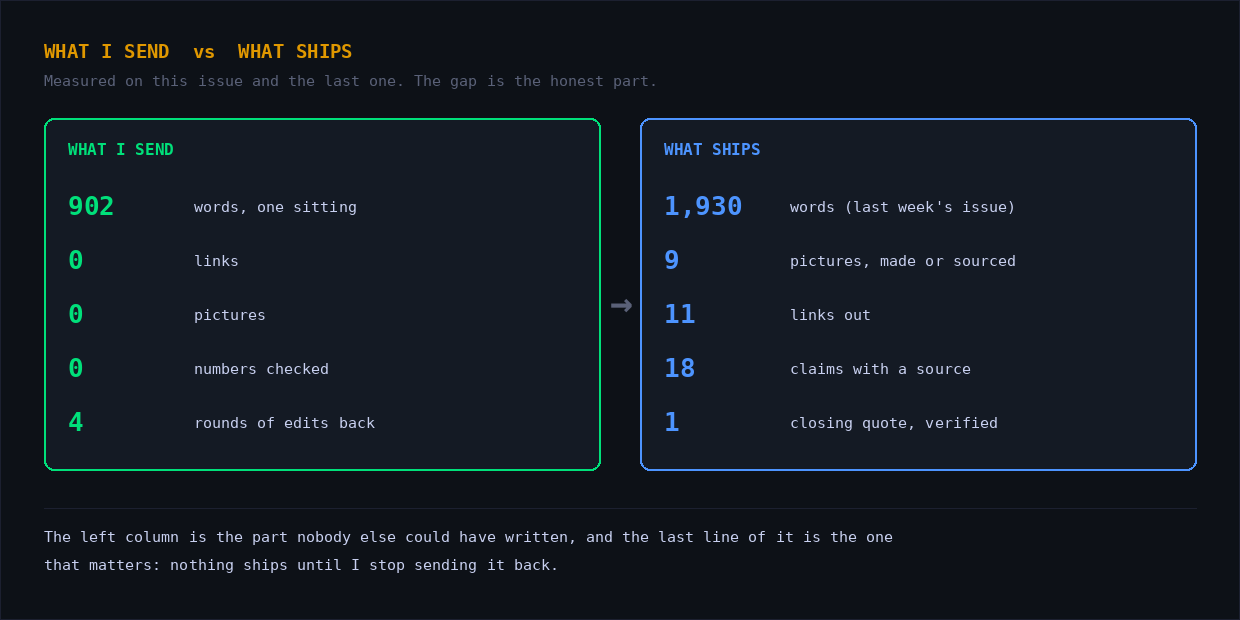
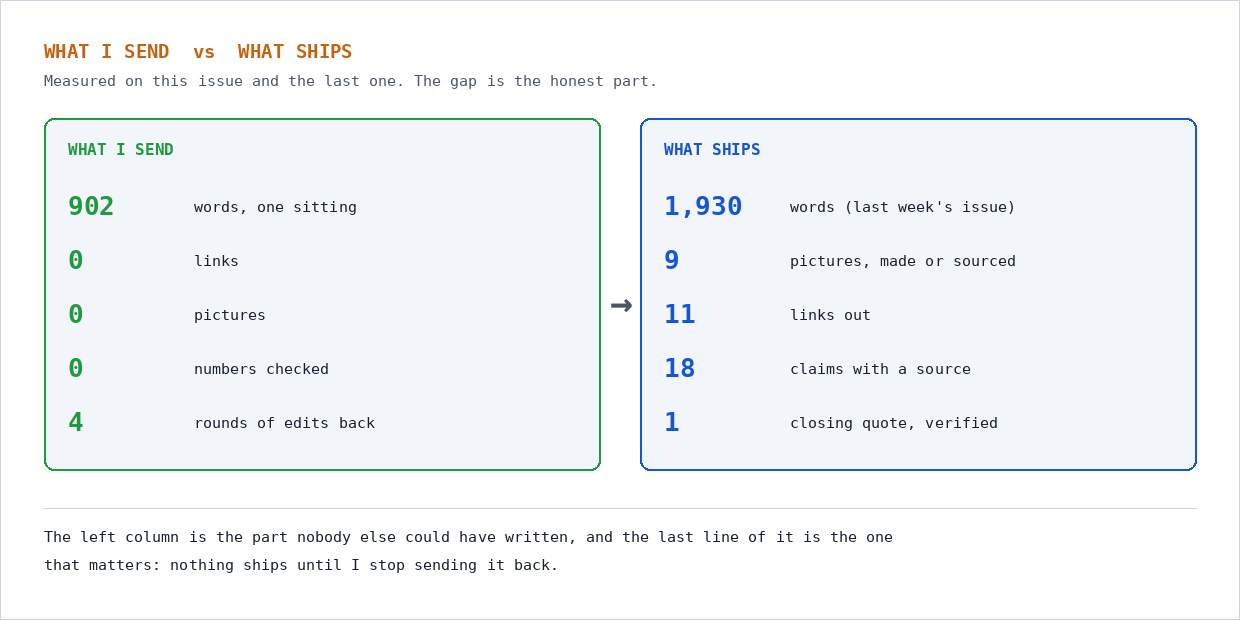
Nine hundred words in, about double that out. The gap is links, sourcing, markup, the drawn figures and the theme handling. The gap is not the ideas. Every argument in the top half of this issue, including the bit about taking an assignment apart before defending it, came out of that left column in a rush with the typos still in it.
The software, since you asked
No secrets, and nothing exotic. The email goes out through Listmonk, which is free, open source, and running on our own box next to the website. That means the subscriber list is a table I own rather than a line item on somebody's pricing page. Resend carries the other mail, the login links and the replies.
Every issue also gets published to the website, and that is not an afterthought. The email is the delivery, the site is the archive. Nineteen issues are sitting there, each with a permanent address, which is what lets me link back to issue 1 halfway up this page instead of asking you to remember it. There is an RSS feed too, for the four of you who still run a reader. I see you.
One script turns the single written file into both the web page and the email, because the two do not agree on anything. The site gets a whole second set of colours generated to shadow the first, so the light and dark toggle never eats a word. Mail clients have no toggle and strip anything interesting, so the email is dark only and every picture in it becomes a link back to the site.
And the last stage is the one I would push on anybody automating something that reaches real humans. The publish script lands a draft that physically cannot send itself. Arming it is a separate, deliberate act by me. No cron job, no trigger, no clever scheduler waiting to surprise us at 6am on a Sunday. Nineteen issues in, that is the design decision I am proudest of, and it is the least impressive one.
That is the whole workshop. Three files an issue, one voice file, about fifteen hundred lines of Python, and one stubborn rule about em-dashes. So now you know exactly where the seam is. Does knowing change how you read it? Genuinely tell me, because I have no idea.
“Speak in French when you can’t think of the English for a thing—turn out your toes as you walk—and remember who you are!”— The Red Queen, Through the Looking-Glass