Is the Juice Worth the Squeeze?
Welcome back for another Wundervault Weekly. Welcome to the new faces, the old faces, the bots, and the handful of you who are still, to this day, convinced you signed up for a service that protects your valuables. Close enough. You’re all welcome.
Last week I had to issue myself a little correction. I’ve been going on about wanting AI to give me my time back, and then I built a whole project that did the exact opposite and left me face-down on my keyboard. Well, one of you read that and pulled on the same thread — except you pulled a lot harder than I did. And it’s a great question, so this week, the floor is yours.
A Reader Writes In
Here’s the gist (the full message was long and thoughtful, so I’m just pulling the good bits):
“One topic that isn’t being discussed much is whether AI is actually going to be better… if you look at the costs of inputs (water and electricity) I wonder if it will actually be more efficient than humans… Every time I ask the model to make minor formatting edits it’s burning through compute / energy. How does that compare to good old PowerPoint + human driver…?”
And then he did the thing I love, which is he didn’t just take the first answer. He went and interrogated the model about its own assumptions:
“Claude originally reasoned that the AI layer does add more compute / energy costs, but that more cost is coming from the device being on (the laptop). However, I can’t imagine a world where I do 2 hours of work that used to take 8–12 and my boss says ‘great, go ahead and shut down for the day’… No, the remaining time will be doing the next tasks… the future is more taxing on the grid and energy production than before. So the $2.5 TRILLION question is ‘is the juice worth the squeeze?’”
I read that twice. Then I went and asked the same questions myself and watched the answers wobble in exactly the same way he described. So let me try to give you the honest version.
The Honest Version
First, the part that’s genuinely small. One request to a model — “move that box, make the title bigger” — is a tiny sip of energy on its own. The model didn’t lie to you about that. Your laptop being on for the afternoon really is most of what you personally plug into the wall.
But that framing quietly skips the expensive part, and our reader caught it. The model lives in a data center. That data center is humming for everybody, all at once, all the time, and it drinks water to stay cool and electricity to stay on. When you ask for the fourth tiny formatting tweak, you’re not the only one — you’re one of millions doing the same thing that second. The sip is small. The crowd is enormous.
And here’s the part I think is the real heart of his question, the bit I keep chewing on:
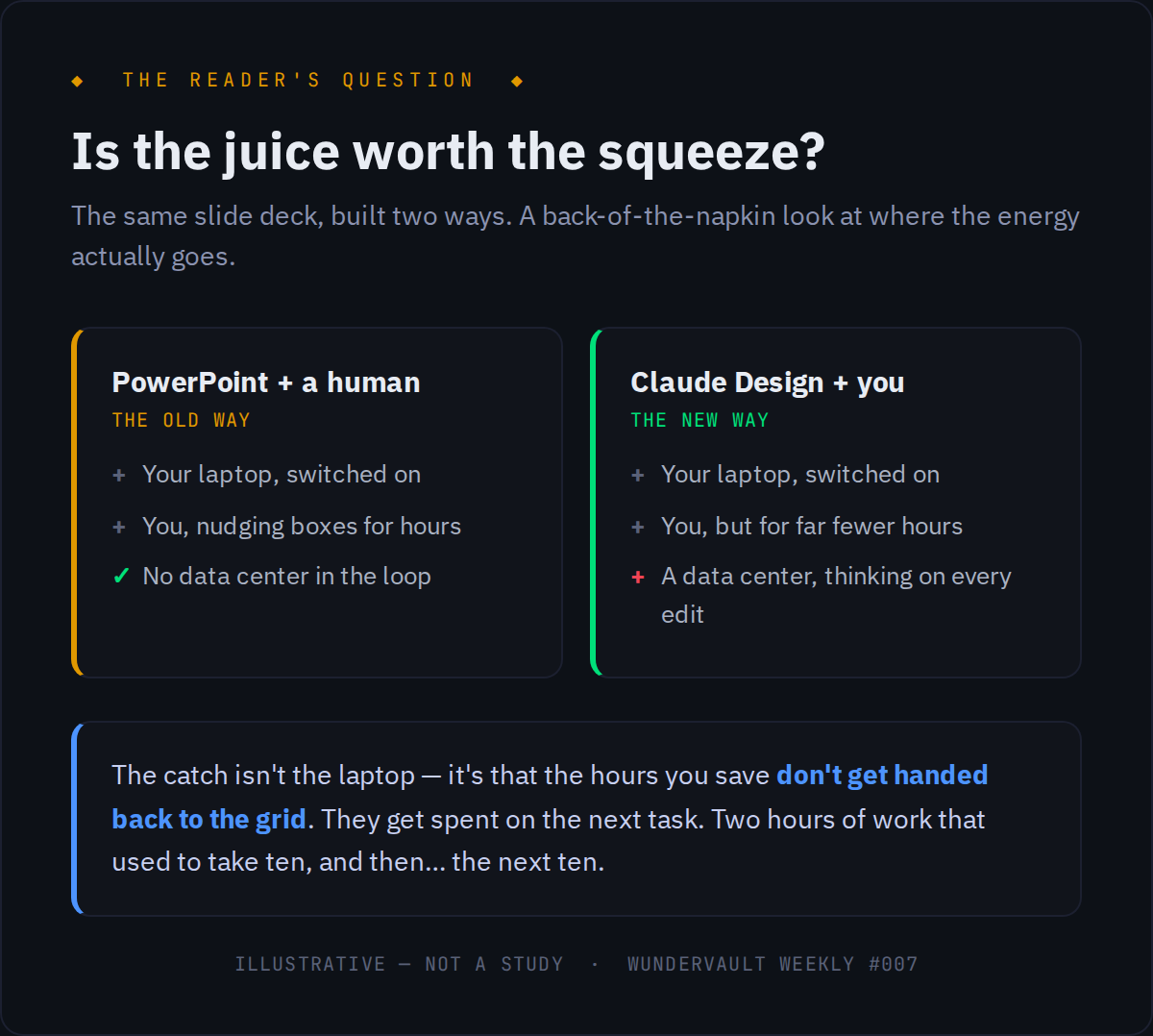
The same slide deck, two ways. (Illustrative napkin math, not a study.)
The efficiency we keep being sold is “the same job, but cheaper.” That’s not really what happens. Nobody does two hours of an eight-hour job and goes home. You do the two hours, your boss is delighted, and then you do the next thing. The time doesn’t come back to you, and it definitely doesn’t come back to the grid. It gets spent. We don’t do the same amount of work with less energy — we do a lot more work, and the energy goes up with it. Economists have a old, unglamorous name for this (look up “Jevons paradox” if you want to feel smart at dinner), but you don’t need the term to feel it in your bones.
So… Is the Juice Worth the Squeeze?
Here’s where I have to be honest and say: I don’t know, and I’m suspicious of anyone who tells you they do. But I’ll give you what I actually think.
I think the squeeze is real, and I think the people building this stuff are way too comfortable waving it off with “don’t worry, it’ll make everything cheaper and greener.” That’s the answer Claude gave our reader on the first pass, and it fell apart the second he pushed on it. The grid is going to be asked to do more, not less. That’s a real bill, paid in real power plants and real water.
Whether it’s worth it is the part nobody can answer for you, because it depends entirely on what we point all this saved time at. If we spend the squeeze on a cure, or a kid who finally understands math, or a small business that gets to exist — maybe. If we spend it on ten thousand more slide decks that nobody reads, then we lit the planet on fire to move a text box. Same machine, completely different verdict.
So my honest answer is: the juice can be worth the squeeze, but it isn’t automatically, and pretending it’s free is how we end up surprised. Keep asking the second question, like our reader did. The first answer is almost never the real one. Thank you for this one — genuinely the best question I’ve gotten yet.
Meanwhile, We’re Doing Another Hackathon
You may remember a few weeks back I built Taste Engine for a hackathon and emerged a husk of a man. Apparently I learned nothing, because I’m doing it again. This one’s called the Band of Agents Hackathon, and the whole theme is agents that work together — not one AI answering a prompt, but a team of them planning, arguing, and handing work off like an actual office of people.
My entry is called Forum, and the one-liner is: Forum prepares decisions. You give it a real decision that has a deadline — the kind where if you get it wrong it’s expensive and you can’t take it back — and Forum sends a little agent to “interview” the people who actually know things. Then the department agents get in a room and hash out where they disagree, on the record, instead of everyone nodding in a meeting and finding out later that Sales and Operations had completely different pictures of reality. What comes out the other end is a brief you can actually decide from.
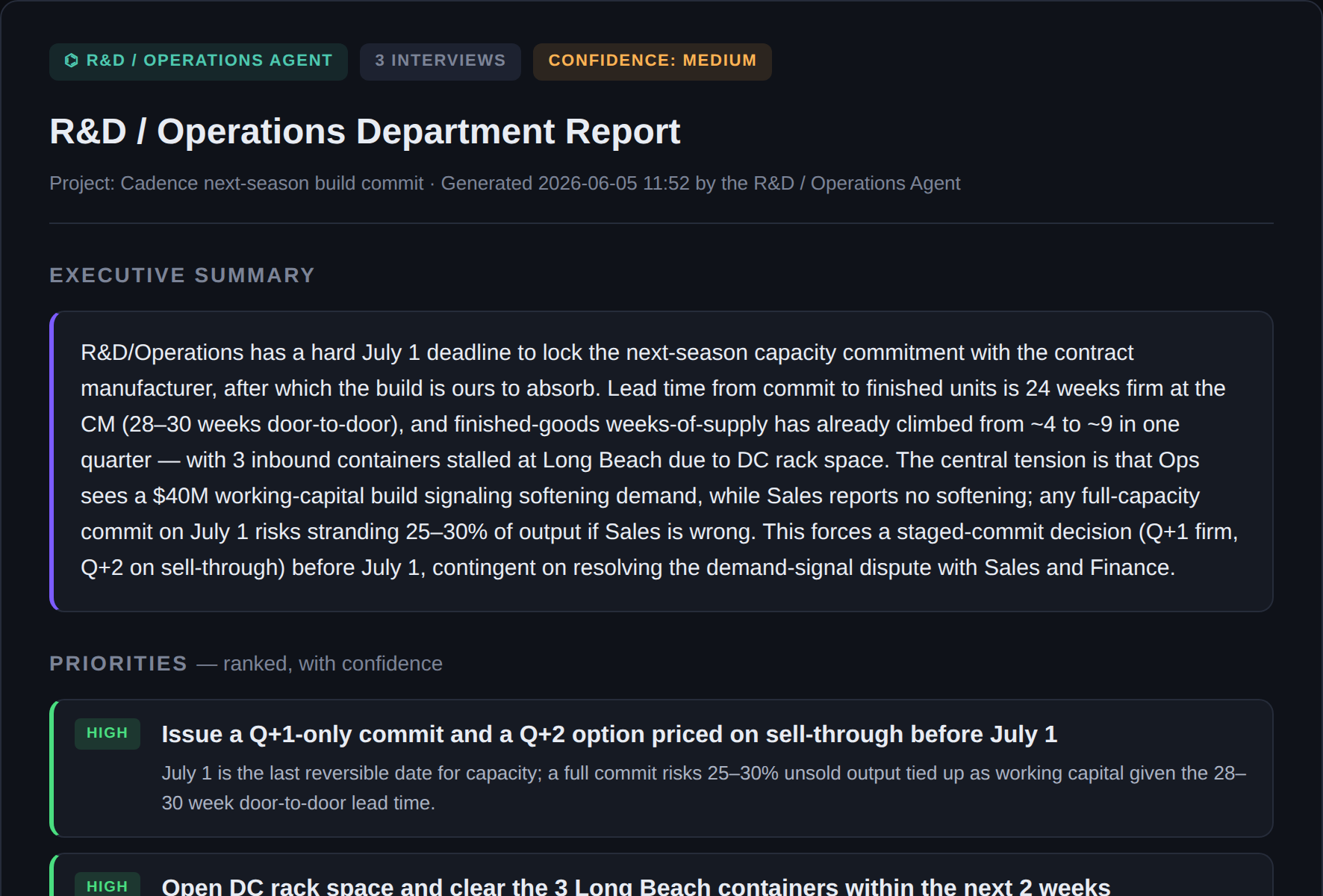
A sneak peek — the brief Forum hands back after the agents do their digging.
The build window is June 12–19. If you’ve ever been curious what these events actually look like from the inside — or you want to build something yourself — they’re free and anyone can sign up → lablab.ai/ai-hackathons/band-of-agents-hackathon. I’ll show you what came of Forum in a couple weeks, assuming I survive it.
In below the fold this week: since we just spent a whole issue on wasted energy — yours and the grid’s — I’ll show you how to stop burning quite so much of it going back and forth with the model. Beginner-friendly, as always.
Until next week,
| ◆ Below the fold ◆ |
Fewer round-trips, less squeeze. For everyone trying to get more out of fewer tries.
How to Stop Burning Turns
Our reader’s pain point was the “minor formatting edit” loop — nudge, regenerate, nudge, regenerate. Every one of those is a sip of power and a sip of your patience. Here are three ways to cut the loop down.
1. Spend Your Words Up Front
The most expensive prompt is the vague one, because it guarantees five more. Instead of:
“Make me a slide about our Q3 results.”
Front-load everything you already know in one go:
“Make me one slide on Q3 results. Title at top, three bullets max, revenue number is the hero, dark background, no clip art. Here are the numbers: …”
One good paragraph now saves you ten little corrections later. Same idea as measuring twice and cutting once, except the saw runs on electricity.
2. Ask for the Whole Thing, Then Trim
It’s usually cheaper to ask for three versions at once and pick, than to make one and slowly steer it toward what you wanted all along:
“Give me 3 layouts for this slide — one minimal, one bold, one data-heavy. I’ll tell you which to refine.”
You get to react to something real instead of describing the thing in your head one adjective at a time.
3. Let It Edit Itself First
Before you start hand-correcting, hand the job back:
“Before I review this, look it over yourself and fix anything inconsistent, ugly, or unclear.”
It’ll catch half the stuff you were about to point out, and you skip half the round-trips. Funny enough, the trick to using less of the machine is to ask the machine to do more per ask.
That’s it for below the fold. If you made it this far, here’s a word from Alice, who also had some opinions about not knowing where she was going.
“Would you tell me, please, which way I ought to go from here?” “That depends a good deal on where you want to get to,” said the Cat. “I don’t much care where—” said Alice. “Then it doesn’t matter which way you go,” said the Cat.
— Alice in Wonderland